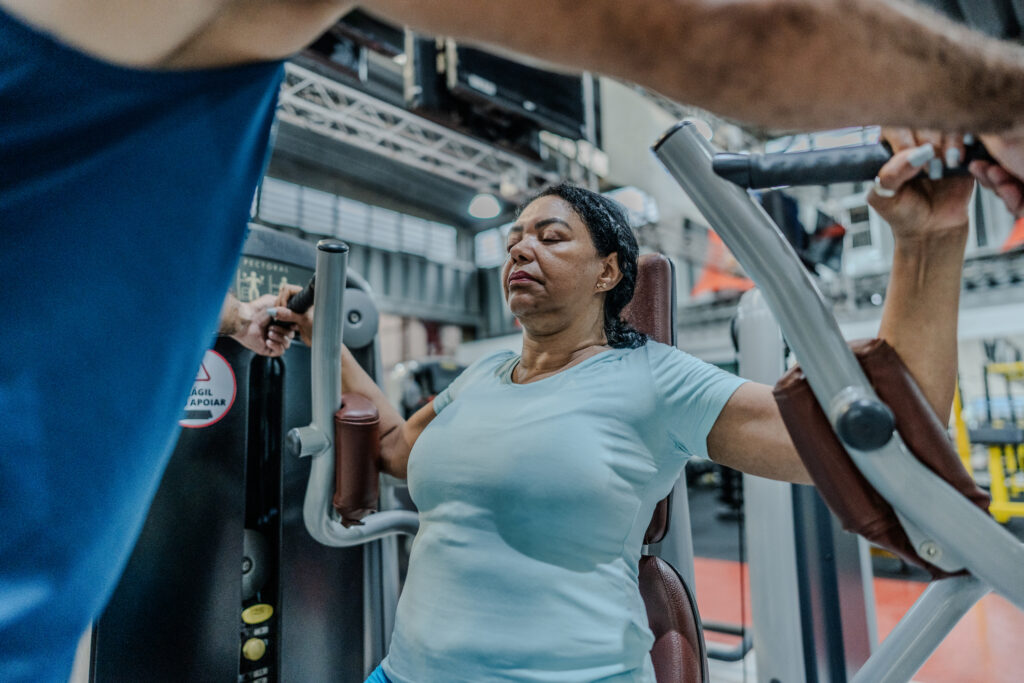
Strengthmaxxing, like spring, is in the air right now. Everywhere you look, someone’s lifting. Celebrities, influencers, scientists, aging, shirtless rock stars and Cabinet secretaries all seem to be touting and demonstrating push-ups, pull-ups, pull-downs, leg presses and other resistance exercises.
Which is worthy and aspirational, because weight training is undeniably good for us. Plenty of recent science equates robust strength and muscle mass with youthful brains, denser bones, longer lifespans and happier moods. In a comprehensive new position stand about the science of resistance exercise published this month by the American College of Sports Medicine (ACSM), more than a dozen academic authors bluntly conclude, “Healthy adults should perform progressive resistance training.”
But how? Gonzo social videos, though impressive, don’t necessarily provide the most effective or safe weight training guidance, especially for someone new to lifting.
So I contacted five experts, established scientists and clinicians who have extensively studied — and practiced — weight training for decades. I asked about exercise form, how much and often to lift, whom to ask for help and why my pull-ups seem so puny, even though I’ve been working on them for months.
What follows is a starter’s guide to getting stronger, aimed primarily at the lifting-curious. It’s about fundamentals, the basic intel many of us need to begin or maintain an appropriate training routine and, if you’re like me, finally get your chin above the pull-up bar, the right way.
1. Check with an expert.
First, if it’s at all feasible financially and logistically, consult a qualified trainer before you start or update a training routine, said Pamela Peeke, an assistant professor of medicine at the University of Maryland and founder of the Peeke Performance Center for Healthy Living. “Ask if they’re certified and by whom.” The ACSM, as well as the American Council on Exercise (ACE), the National Academy of Sports Medicine (NASM) and the National Strength and Conditioning Association (NSCA) offer widely recognized certifications in strength and conditioning.
Alternatively, turn to the internet, with caveats. Some weight-training influencers and trainers there know what they’re doing, said Brad Schoenfeld, a professor of exercise science at Lehman College in the Bronx, who has long studied weight training. But consult trainers’ bios and look for certifications, he said.
2. Start with nothing.
Often, the smartest weight training begins with no weight.
“When you’re just beginning, the only thing you should be worried about is getting a feel for the movement pattern,” Schoenfeld said.
This is because, in the earliest stages of resistance exercise, whether with free weights, machines or body weight, you’re mostly altering your neuromuscular system, meaning the messages flowing between your brain and muscles, and not the muscles themselves. In effect, you’re imprinting new ways of moving onto your central nervous system. Best to make these movements effective and safe.
So, Schoenfeld said, set the resistance on exercise machines at the lowest possible option to start, which usually means zero. If you’re using a barbell for your first dead lift, leave it empty. Opting for calisthenics? One careful push-up can be an adequate — and auspicious — beginning.
3. Range of motion matters.
“I would have beginners aim for full or near-full range of motion,” said Stuart Phillips, a professor of kinesiology at McMaster University in Ontario, Canada, and senior author of the new ACSM position stand.
Full range of motion (ROM), one of the key elements of good lifting form, means you’re moving “from the point where the target muscle is most stretched to the point where it’s most contracted” and back, Peeke said.
In practice this means that, for instance, in a leg press, you’d start with your legs drawn up close to your chest with “a meaningful bend at the hip and knee,” Phillips said, before you “press back toward extension” until your legs are nearly straight. Slowly return to the starting position. You’ve just done a full rep (repetition).
Or, in a pull-up, start with what’s known as a “dead hang,” arms straight as you grasp the pull-up bar, feet off the ground. Pull yourself up until your eyes are at least at bar height, lower back down to another dead hang and repeat. No bouncing. No lowering yourself partway.
In general, the greater the ROM of your exercises, the more you’ll get from them, but (sorry) the tougher they’ll feel. “A pull-up is much harder when you go from a true dead hang” than from a short bounce, Phillips said, “because the muscles are doing more work. And that’s largely the point.”
4. Find your best resistance.
Ready to progress from no weight? “A good starter load is one that allows roughly six to 12 solid reps, sometimes up to 20,” Phillips said.
Lighter weights and more reps can be especially practical and enjoyable for beginners or people with joint issues.
But for all of us, the idea is to approach what the experts call “failure” by your final rep. You should feel as if “you could have managed perhaps two or three more,” Peeke said, but only “if your life depended on it.” Challenging your muscles in this way builds the greatest strength and mass, she said.
Once you easily can manage 12 (or 20) reps, increase the weight.
5. Stay in control.
Influencers often fly through reps in social videos. But speed risks injury or sloppy form.
“Start at a cadence that’s under control,” said Jeremy Loenneke, an exercise scientist at the University of Mississippi who researches resistance training.
Phillips agreed. “The key word,” he said, “is controlled.”
There’s no magic number for the best pace, Peeke added, but, as a general rule, two seconds or so to lift a weight and about the same to return it to starting position is a good beginning.
Beware of momentum. “Make sure your muscles are lowering the weight,” Schoenfeld said, “not gravity.”
6. Try for twice a week.
How often to lift? “Anything is better than nothing,” said Spencer Nadolsky, a physician specializing in obesity and lifestyle medicine and co-host (with brother Karl) of the podcast, Docs Who Lift. Heft a gallon milk carton a few times before you put it in the fridge. Full, it weighs about nine pounds. That’s resistance.
But better to lift at least twice a week if you can, Nadolsky said, at home or at the gym, working your upper and lower body. You may feel sore in the days immediately following a new workout. But unless the pain is sharp, sudden and localized — which might signal an injury — it will soon fade, as your muscles adapt and strengthen.
7. Everybody benefits.
Men, women, young, old — studies show that almost everyone gains significant muscle strength and size when they start lifting. “Biologically, there is no difference in how men’s and women’s muscles respond to resistance training,” Peeke said. Men often add slightly more muscle mass in absolute terms, she said, but relative to their respective sizes, women can gain just as much mass and often more strength, she said.
Age also needn’t be an obstacle. Men and women in their 80s and 90s are capable of adding strength and mass. If you’re older and want to start, check for strength training programs at a gym or local senior center. Trainers should have standard certifications and a senior fitness specialty certification.
Similarly, people with disabilities should check that trainers have inclusive or adaptive fitness certifications from the ACSM or other organizations.
8. Stick with it.
“Consistency is key,” Schoenfeld said. It takes time, often months, to start seeing obvious results.
In fact, the initial benefits won’t be visible at all, Nadolsky said, because strength increases first, well before muscles swell. You may remain unaware of this newfound vigor, until suddenly you can heft your carry-on into the overhead bin with no assistance. (I speak from experience.)
So, if you can, start and keep lifting. Don’t worry if your weights seem paltry. They will increase. Your form and confidence will improve. I know. Until recently, my pull-ups were pathetic. I never returned to a full dead hang after a rep but simply pogoed up and down an inch or two. (These shallow “cheat reps” are common on Instagram.) Now I’m trying for full ROM — and barely eking out one rep on a good day. But each time, I feel more muscles ripple in my shoulders as I grip the bar, take a breath and try again.
Do you have a fitness question? Email [email protected] and we may answer your question in a future column.
The post Strength training is hot right now. Here’s how to do it properly. appeared first on Washington Post.