The Senate voted Tuesday to take up a far-reaching voting bill that President Donald Trump has demanded Congress pass before the midterms — but the legislation has no path to passing even as senators prepare for days of intense debate.
Senate Democrats have vowed to block the bill, known as the Save America Act, which they warn would make it harder to vote. The bill would require voters to prove they are U.S. citizens before registering to vote and to show photo identification when voting, among other provisions.
Republicans, who control the Senate, do not have the 60 votes they need to overcome a Democratic filibuster. Nor do they have enough votes to attempt a riskier gambit that some Republican senators favor: attempting to exhaust Democrats by forcing them to speak on the Senate floor for weeks to block the bill, known as a “talking filibuster.”
Instead, the Senate voted 51-48 to start debate on the bill, a vote that required only a majority. One Republican, Sen. Lisa Murkowski (Alaska), voted with Democrats against starting debate. Sen. Thom Tillis (R-North Carolina) did not vote.
Republicans are expected to spend days — potentially including nights and weekends — making the case for the bill on the Senate floor, according to two people familiar with the process, who spoke on the condition of anonymity to describe it.
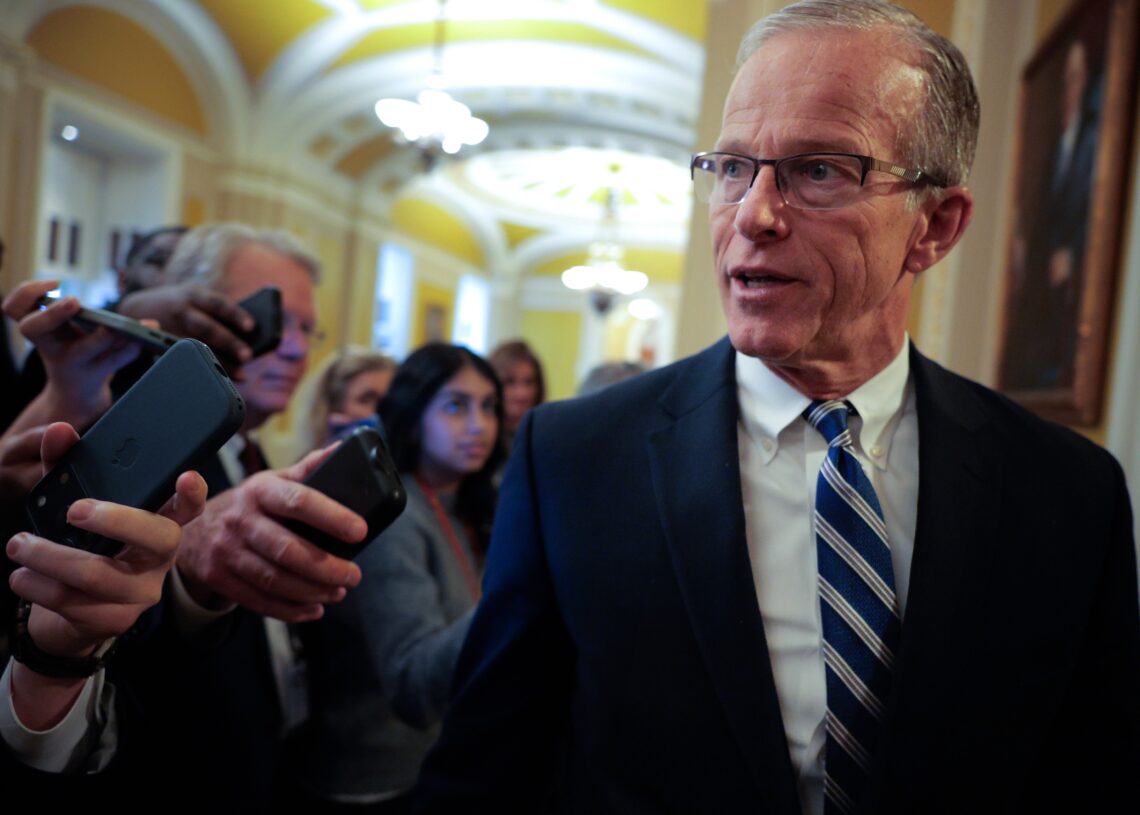
“The votes aren’t there to do a talking filibuster,” Senate Majority Leader John Thune (R-South Dakota) told reporters Tuesday. “So what we are doing is we are having a fulsome debate on the floor of the United States Senate.”
The expected marathon speeches will not bring Senate Republicans any closer to passing the bill, but they could bring attention to the changes to voting that Trump has demanded. In some ways, the strategy resembles the 21-hour speech that Sen. Ted Cruz (R-Texas) made in 2013 opposing the Affordable Care Act or the 25-hour speech that Sen. Cory Booker (D-New Jersey) delivered last year criticizing Trump — although those speeches were made by senators in the minority, not the majority.
Trump has made the bill a top priority, declaring that he would not sign any other legislation until Congress passes it. He pledged Tuesday never to endorse any Republican who votes against it.
“Only sick, demented, or deranged people in the House or Senate could vote against THE SAVE AMERICA ACT,” Trump wrote on social media.
But some Republicans have criticized their party’s plan to debate the bill for days even though it has no shot at passing.
“There isn’t any strategy,” Tillis said. “There’s a zero percent [chance] of this succeeding.”
Murkowski said her constituents are concerned about election integrity — but they also want Washington to take up other priorities such as addressing the cost of housing and rising diesel prices.
“If you don’t think that you can win on it, why are you going into this debate in the first place?” Murkowski said.
Other Republicans insist the Senate needs to do everything possible to pass the bill — and even raised the prospect that Republicans could change their minds and decide to pursue the “talking filibuster” strategy after all.
“We’ve got to stay on the bill until it becomes law,” Sen. Mike Lee (R-Utah) said in a video he posted Monday. “There can be no surrender. There can be no ifs, ands or buts. There can be no cheap imitations here.”
Sen. John Neely Kennedy (R-Louisiana), who supports the bill, said Tuesday that he could not predict how the debate over it would play out.
“I cannot tell you how this vampire movie is going to end,” Kennedy said.
Republicans have described the changes as necessary to prevent undocumented immigrants from voting, but noncitizens rarely register to vote or cast ballots. The Justice Department charged a Chinese student at the University of Michigan with illegally voting in the 2024 election in a rare exception; the student, Haoxiang Gao, fled the country after he was charged.
When noncitizens find themselves on the voter rolls, it is often because of administrative mistakes. In one of the most comprehensive reviews of voter registration by noncitizens, a federal judge found in 2018 that at most 39 noncitizens got on the voter rolls in Kansas over almost two decades.
Trump has argued the voting changes will help Republicans politically, telling House Republicans last week that passing the bill would “guarantee the midterms.”
Democrats have warned the bill would make it easier for Republicans to meddle in the midterms, pointing to a provision that would give the Department of Homeland Security access to states’ voter rolls.
“They will purge tens of millions of people from the voter rolls,” Senate Minority Leader Charles E. Schumer (D-New York) told reporters. “Once purged, you don’t even know it. They have no obligation to tell you. So you can show up at the polls on Election Day, same place you’ve been showing up for 20 years, and they’ll say, ‘Sorry, Ms. Jones, sorry, Mr. Smith, you’re no longer on the voter rolls. You’ve been purged.’”
Democrats made a similar push to pass voting legislation in 2022 even though they did not have the votes to overcome a filibuster. Two Democrats, Sens. Joe Manchin III (West Virginia) and Kyrsten Sinema (Arizona), blocked the rest of their party from changing the Senate’s rules to pass the legislation. Schumer has said the Democratic effort was different because his party was seeking to expand voting rights and Republicans are trying to restrict them.
The House passed the Save America Act last month, but Trump has demanded Republicans add new provisions in the Senate, including banning most voting by mail, barring transgender women from participating in women’s sports and restricting gender-transition care for children. Sen. Eric Schmitt (R-Missouri) is planning to introduce an amendment to make those changes to the bill.
Some Republicans who represent states where mail voting is popular have raised concerns about the proposed restrictions, which Thune said the party has been working to address.
“Over 70 percent of Montanans vote mail-in, and it goes up every election,” Sen. Steve Daines (R-Montana) told reporters Tuesday. “We like mail-in ballots. The issue is fighting against mail-in ballot fraud. That’s the issue. Let’s focus on that, not just mail-in ballots.”
Once Republicans feel they have advocated the bill enough on the Senate floor, Thune is expected vote to cut off debate on the bill and any amendments, including Schmitt’s. But without 60 votes to surmount a filibuster, those votes will fail.
Some of the bill’s provisions are popular. Sixty-one percent of Americans support requiring that voters provide proof of citizenship such as a passport or a birth certificate and matching photo identification when they register, with 22 percent opposed, according to a Washington Post-ABC News-Ipsos poll conducted last month.
A Pew Research Center survey conducted in August found 83 percent of Americans supported requiring photo identification to vote, with 16 percent opposed. Banning mail voting was less popular: 58 percent of Americans supported allowing any voters who wants to vote by mail to do so, with 42 percent opposed, according to Pew.
Barring transgender athletes from playing on teams that do not match their birth gender is also popular, according to Gallup polling conducted last year. And a New York Times-Ipsos poll last year found 71 percent of Americans support barring doctors from transgender care such as prescribing puberty-blocking drugs or hormone therapy to anyone under 18.
Trump told reporters in the Oval Office on Monday that he had spoken to Thune that morning and that he thought Thune was trying to get the bill over the line.
“I think it’ll be a very, very bad thing for the country if they don’t,” Trump said.
Scott Clement and Patrick Marley contributed to this report.
The post Senate votes to take up Trump’s voting bill to ‘guarantee the midterms’ appeared first on Washington Post.