Senate Republicans are set on Tuesday to open what is expected to be a prolonged and bitter election-year debate on a bill to stiffen voter identification and registration rules, defying Democratic vows to block the measure even though they lack the votes in their own ranks to push it through.
Under pressure from President Trump, the House and the far right, Senate Republicans plan to move ahead with the legislation they call the SAVE America Act, which would require voters to show approved photo identification to vote in federal elections and proof of citizenship to register. It would also require states to turn over voter rolls to the Department of Homeland Security to remove those flagged as noncitizens.
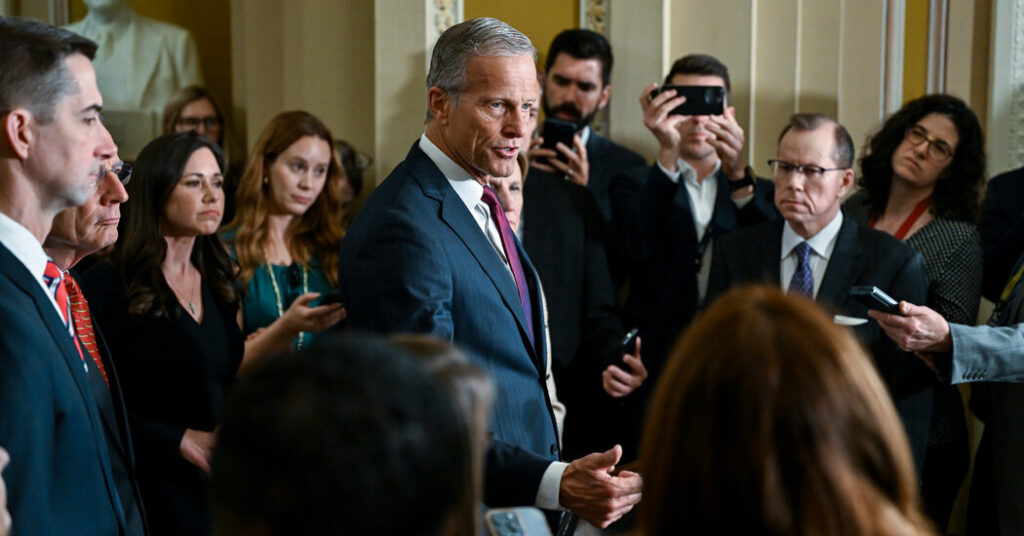
Senate Republicans say the measure is needed to prevent noncitizens from voting, though it is already illegal for them to do so and there is no evidence of widespread cases of such voter fraud. Senator John Thune of South Dakota, the Republican majority leader, said he wanted the debate to showcase Democratic resistance to what his party calls basic proposals to better secure elections that have widespread support.
“I can’t guarantee an outcome on this legislation, but I can guarantee that we are going to put Democrats on the record,” Mr. Thune said. “They will be forced to defend their outrageous positions on these issues and explain to the American people why common sense and the Democratic Party parted ways.”
Democrats say the real intent of the bill is to make it difficult for Americans to vote, in a bid to boost Republican candidates who are currently facing big losses. Or should the measure die, they say, a prolonged debate would focus on the potential for election fraud in order to lay the groundwork for challenges to the November election results. They warn that the Trump administration intends to purge voter rolls of registered voters and not inform those who may be affected, complicating their ability to vote on Election Day.
“What Republicans should be doing is changing their policies because they’re so unpopular with the American people,” said Senator Chuck Schumer, Democrat of New York and the minority leader. “Instead, they want to rig our democracy and make it much harder for people to vote.”
Mr. Trump and other proponents of the bill have been clear that they believe its passage is critical to protecting Republican House and Senate majorities in the November midterm elections, a cycle when the party holding the White House historically loses seats and sometimes its congressional majorities. Polls show the Republican hold on both the House and Senate to be in jeopardy.
Mr. Thune has come under relentless criticism from the far right for refusing to try to push through the legislation by forcing round-the-clock sessions aimed at exhausting Democrats into abandoning a filibuster against it. But experts inside and outside the Senate have said that such a strategy is unlikely to work without some change in the chamber’s procedure or precedents to undermine the filibuster, and Senate Republicans do not currently have the minimum 50 votes necessary to make such a change.
“I believe the filibuster provides important safeguards for the minority party, and I think we all need to remember what goes around, comes around,” said Senator Susan Collins, Republican of Maine, one of those who have said they will not support any weakening of the filibuster.
Other Republicans said it was hypocritical for members of their party who assailed Democrats in 2022 for trying to weaken the filibuster, in the hope of passing their own version of a broad new voter law, to now pursue the same strategy to get their own legislative win on an election-related bill.
“You’ve got to reconcile for me how three years ago we were attacking Senate Democrats for potentially nuking the filibuster to nationalize elections and now we are doing the same thing,” said Senator Thom Tillis, Republican of North Carolina, using a Senate term for unilaterally undermining the filibuster on a partisan vote. “I want to encourage states to live with national standards, but not force it down their throats.”
The Senate is expected to vote as early as Tuesday to take up the legislation already passed by the House, a move that requires a simple-majority vote, not the 60 votes needed to overcome a filibuster. Mr. Thune has indicated that he will allow the measure to be debated for days, though he suggested that it would still ultimately be subject to the 60-vote threshold to cut off debate, dooming the legislation since Republicans hold 53 seats and Democrats are strongly united in opposition.
Still, proponents of the legislation have taken heart from Mr. Thune’s strategy to bring it to the floor and air out the issues rather than call for a quick vote. They hope to build on any momentum and persuade some of their reluctant colleagues to join them in doing whatever it takes to get the legislation to the president’s desk.
“Let’s put the bill on the floor, make those who want to filibuster speak and keep it on there as long as possible,” Senator Mike Lee, Republican of Utah and one of those calling for a so-called talking filibuster, said in a video posted on social media.
Mr. Lee and his allies won one convert last week when Senator John Cornyn, the Texas Republican locked in a difficult primary, abandoned his longtime support of the filibuster rules to say he would back a rules change to pass the election bill. Mr. Trump has pressured him relentlessly on the issue, withholding his endorsement in the primary contest as he seeks to force the Senate to move on the voting measure.
Senate Republicans also expect efforts to amend the legislation to add provisions sought by Mr. Trump. Those include anti-transgender language that played well politically for Republicans in the 2024 elections, along with strict new limits on voting by mail even though it is a main method of voting in multiple states.
At a party luncheon last week, some senators raised objections to the added restrictions on voting by mail and indicated they could not support them and would not back the legislation if they were included.
Some election experts contend that even if no new restrictions were added, the new voter I.D. requirements — which would require voters to enclose a copy of photo identification both when requesting a ballot and when returning it — could effectively prevent states from offering the option of voting by mail, since many people lack the materials that would be needed to comply.
Carl Hulse is the chief Washington correspondent for The Times, primarily writing about Congress and national political races and issues. He has nearly four decades of experience reporting in the nation’s capital.
The post Senate to Take Up Voter Bill Sought by Trump but Opposed by Democrats appeared first on New York Times.