The musician Willy Chirino was singing a protest song at a gala hosted by Cuban American lawyers in Miami last month when the event’s special guest joined him onstage. Mike Hammer, the head of the U.S. embassy in Havana, shimmied as Mr. Chirino held the microphone to his lips so he could chant the chorus with the raucous crowd.
“¡Que se vayan ya!” they sang: “They should leave now.” In this town, everyone knew that the “they” referred to the communist leaders of the Cuban government.
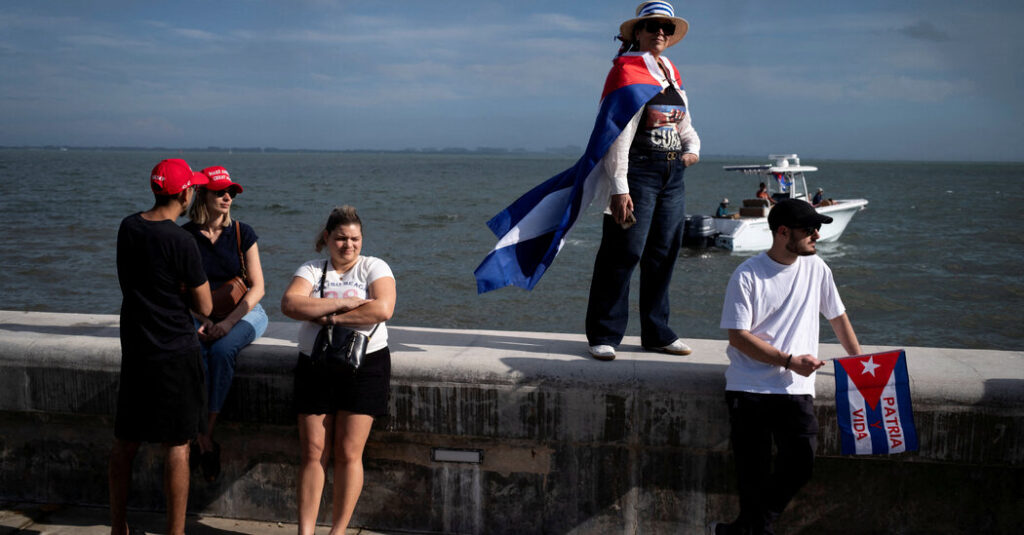
The scene captured the hope and exuberance that Cuban Americans in South Florida have felt since the Trump administration began a pressure campaign and secret talks to force change in Cuba, 67 years after the Communist revolution that spurred an exodus to Miami and reshaped the city.
Two weeks later, that excitement has been tempered by the realities of geopolitics and diplomacy. Conservative Cuban exiles, who have sought political change on the island for decades, fear that wholesale transformation is not in the cards for now.
Their disappointment, even before any deal has been announced, is evidence of the complications that seem inescapable for the Trump administration’s Cuba negotiation team, led by Secretary of State Marco Rubio, the most prominent Miami Republican in the country.
The New York Times reported on Monday that the Trump administration wants to push President Miguel Díaz-Canel of Cuba from power. But The Times also reported that the administration is not seeking to dilute the power still wielded by relatives of Fidel Castro, the leader of the 1959 revolution who died in 2016. One of them — Raúl Guillermo Rodríguez Castro, a grandnephew of Mr. Castro — has been one of Cuba’s main negotiators with the United States.
But what might constitute a win for President Trump in Cuba might not go far enough for some of his most ardent Cuban American supporters, some of whom have devoted their lives to the cause of a free Cuba. The island country has dominated Miami politics for almost seven decades.
That tension has put some Republican politicians in South Florida in an uncomfortable position. While broadly supporting the president’s push, they have also already started chiding him over the specific details.
“The Castros have to go,” said Mayor Bryan Calvo of Hialeah, Fla., a heavily Republican city outside Miami that is home to the highest proportion of Cuban immigrants in the country. “Díaz-Canel has to go. You need a free and fair elections. You need a democratic transition. That’s the only way that you know we’re going to have a lasting change.”
Many Cuban Americans have unresolved, decades-old disputes over properties seized by the Communist government. Some want their land back, and many have demanded the release of political prisoners and the restoration of civil rights in Cuba.
Castro family members remain Cuba’s top decision makers, and many exiles consider anything short of their removal insufficient. Some hard-liners in South Florida have called not only for them to be forced from the island but also for their arrest and prosecution, akin to the Nuremberg trials.
For now, the only change the Cuban government has announced in the face of a collapsing economy is a plan to allow foreign investment from Cubans abroad, including in the United States.
Mr. Rubio told reporters in the Oval Office on Tuesday that Cuba’s leaders are unable to fix the economy and that the island needs “new people” in charge. In a statement, the State Department noted that Cuban Americans have “overwhelmingly backed” Mr. Trump.
Concerns among Miami Republicans about the negotiations began to surface last week after a USA Today report suggested that Mr. Trump might be eyeing an economic — but not political — deal with Cuba. That sounded similar to the approach he took with Venezuela in January, when the U.S. military captured the country’s leader, Nicolás Maduro, but left one of his close allies, Delcy Rodríguez, in power.
That arrangement, along with Mr. Trump’s focus on obtaining Venezuelan oil rather than on restoring democracy or supporting María Corina Machado, the Venezuelan opposition leader and Nobel Peace Prize winner, has not sat well with many in South Florida. The region is home to the biggest Venezuelan community in the United States.
“The Cuban diaspora is looking for, first off, political reform,” Representative Carlos A. Giménez, the only member of Congress who was born in Cuba, said in an interview this week. He later said that any approach to change on the island that did not include the Castros’ ouster would be “insane.”
If the Castros are “perpetuated” in power, Representative María Elvira Salazar, who is Cuban American, told the Spanish-language television network Telemundo, then “don’t count on me.”
Miami’s three Republican House members, including Representative Mario Diaz-Balart, have succeeded in pressuring the White House on Latin America policy before. Last year, they opposed certain talks with Venezuela as Mr. Trump was rallying support for a sweeping domestic policy bill. Mr. Trump put a potential deal with Venezuela on hold to reduce the risk of the bill’s defeat.
Ramón Saúl Sánchez, a prominent Cuban exile in Miami, has called on Mr. Rubio to meet with activists, like himself, who fear “stabilizing a dictatorship.”
“The regime is at the end of its rope, and now they’re going to throw them a lifesaver to stabilize the economy?” Mr. Sánchez said. “That’s unacceptable, especially in light of what the Cuban people are doing, slowly taking to the streets.”
No one understands South Florida’s political dynamics better than Mr. Rubio, the son of Cuban immigrants, who was a policy hawk on Latin America as a U.S. senator. With Mr. Rubio leading the Cuba talks, skeptical hard-liners are giving the Trump administration more benefit of the doubt than they afforded former President Barack Obama when he announced a surprise rapprochement with Cuba beginning in 2014.
At the time, “There were no Cubans involved in the negotiations from outside of Cuba,” said Joe Garcia, a former Democratic congressman from Miami.
“I’m a Democrat, and I’m a political opponent of Marco Rubio,” Mr. Garcia acknowledged. Still, he said, Mr. Rubio’s involvement means that this time, “There is a Cuban in the room, and he represents me and the Cubans that Obama avoided.”
Cuban Americans’ respect for Mr. Rubio could shield Mr. Trump and other Republicans from suffering any political punishment at the polls if the Cuba talks do not go as far as those in South Florida would like. Some Republican voters might stay home in the November midterm elections, but it seems unlikely that Republicans who care about regime change in Cuba would suddenly flip to vote Democratic.
Carlos Trujillo is a Cuban American and former state legislator from Miami who served as U.S. ambassador to the Organization of American States during the first Trump administration. He said the type of “orderly transition” of power that he sees the White House pursuing might result in the ouster of some key members of Cuba’s Communist Party, but not all of them.
“The people who think these people are going to get on the next 737 and get out of town, that’s not realistic,” Mr. Trujillo said. Party members run hospitals and sewers, he noted: “You can’t completely have everyone removed from these positions.”
At the gala on Feb. 28, held by the politically influential Cuban American Bar Association, Mr. Hammer, the top American diplomat in Havana, delivered a speech in which he praised the resilient Cuban people. He offered no specifics of how the talks might go, other than one tantalizing promise.
This year, he vowed, “Cuba will be free.”
David C. Adams contributed reporting from Hialeah, Fla., and Edward Wong from Washington.
Patricia Mazzei is the lead reporter for The Times in Miami, covering Florida and Puerto Rico.
The post Miami Cubans Fear Trump Won’t Go Far Enough: ‘The Castros Have to Go’ appeared first on New York Times.