New York transit officials on Tuesday sued the federal government for withholding close to $60 million in promised funding that could once again stall a Manhattan subway expansion a century in the making.
The Metropolitan Transportation Authority, the state agency that operates the city’s subway, sued for breach of contract in the Court of Federal Claims in Washington, arguing that the overdue reimbursements could delay a nearly $7 billion expansion of the Second Avenue Subway line into East Harlem.
The suit claims that the U.S. government had “agreed to provide but has improperly refused to disburse” more than $58 million for the project. The M.T.A. warned the Trump administration last month that its failure to pay for its share of the project could cause “a domino effect” of delays and inflated costs.
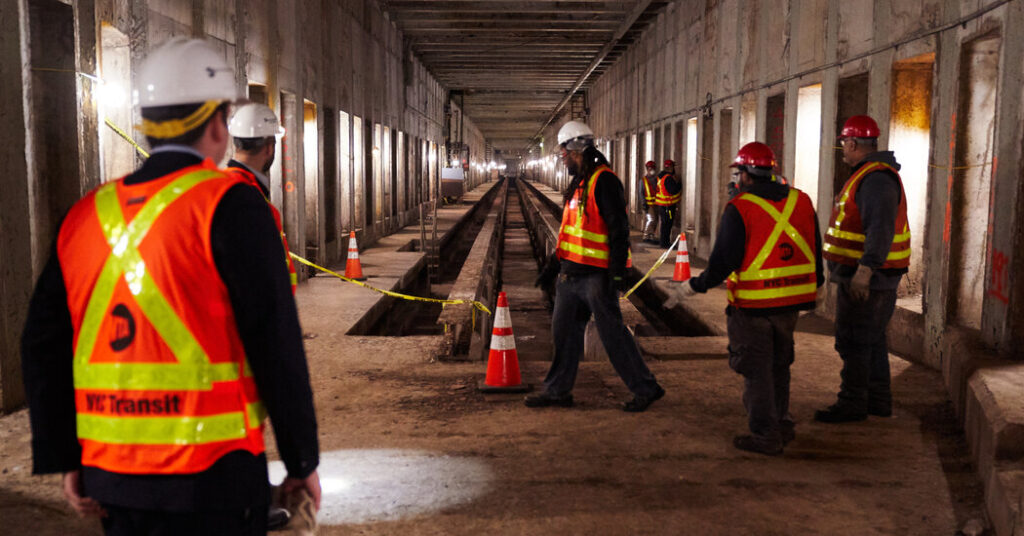
The M.T.A. plans to extend the Q line from 96th Street and Second Avenue to 125th Street and Lexington Avenue. Construction on the extension, a version of which was included in the original proposal for the subway line in the 1920s, is already underway. The expansion is currently slated to be completed in 2032.
About half of the expected $6.9 billion price tag, $3.4 billion, is expected to come from the federal government, the authority has said. But in October, President Trump declared that he would withhold federal funding for the project, as well as for a multibillion-dollar tunneling plan under the Hudson River, after a political dispute with New York Democrats.
In a statement, Gov. Kathy Hochul laid the blame for the lawsuit squarely on Mr. Trump.
“His actions alone have put the commutes of over 130,000 New Yorkers and the jobs of thousands of union workers on the line, but New York will not back down,” she said.
The lawsuit comes after a similar funding fight broke out over the Hudson River tunnel project, known as Gateway, for which the federal government had pledged more than $11 billion.
Last month, a federal judge blocked the Trump administration from withholding more than $200 million from the project. The Department of Transportation released the money, plus $50 million more that was due, but not before the funding gap forced the planners to halt work for more than a week and lay off about 1,000 union workers.
A federal judge in a separate case declined to issue an order that would prevent the Transportation Department from withholding additional money from the Gateway project, leaving open the possibility of another dispute.
The M.T.A. has already committed billions of dollars to the Second Avenue Subway extension, which is projected to create more than 70,000 jobs, reduce overcrowding along the Nos. 4, 5 and 6 train lines, and provide better service to parts of Upper Manhattan that lack mass transit options.
Trump Administration: Live Updates
Updated
- Senate to take up voter bill sought by Trump but opposed by Democrats.
- The Supreme Court has deferred a decision on Trump’s bid to end protections for migrants.
While the subway extension is less reliant on federal money than Gateway, the M.T.A. has said that similar delays, and the ensuing lack of clarity on funding, could seriously hobble its plans.
The Trump administration suspended the funds in October, at the same time Mr. Trump was pressuring Chuck Schumer, the Senate minority leader and a New York Democrat, to end a government shutdown.
The Transportation Department had told the M.T.A. that the subway funding had been held up because of a review of the authority’s race- and sex-based criteria for working with disadvantaged businesses. But the M.T.A. said it had already complied with the new requests.
Work on the extension has been divided into four major parts. The contracts for the first two parts, which involve relocating utilities and assembling a giant tunnel-boring machine, among other work, have been awarded.
The M.T.A. was planning this month to award a contract for the third part, which includes excavation work at the planned 106th Street station, but the funding bottleneck could disrupt that plan.
Construction delays could also stymie a proposed westward extension of the train line to 125th and Broadway, which would add three new crosstown stops that would connect to several train lines and bus routes. Ms. Hochul said she supported the plan in January.
The Second Avenue Subway has run into one obstacle after another.
The original proposal, which was part of a larger subway expansion, was put forth in 1929 and would have cost $800 million. But the stock market crash scuttled the plans.
Tunneling began in East Harlem more than 40 years later, in 1972, before the city’s fiscal crisis halted construction.
In 2007, work finally started on the first phase of the project to be completed — three new stations on the Q line along Second Avenue at 72nd, 86th and 96th Streets. They opened a decade later, after years of delays and cost overruns turned the tunneling project into one of the most expensive ever built.
Work on the Harlem extension was paused in June 2024 after Ms. Hochul delayed the start of Manhattan’s congestion pricing program, which was expected to raise billions of dollars for the project.
After congestion pricing went into effect the following January, the subway extension was threatened further when the Trump administration said it would withhold funding for a range of state transportation projects if New York refused to kill the tolling program.
Earlier this month, a federal judge ruled that Washington’s attempts to kill congestion pricing were illegal and that the tolling could continue — assuring, for now, that an important revenue stream for the subway plan would remain in place.
Stefanos Chen is a Times reporter covering New York City’s transit system.
The post M.T.A. Sues Trump Administration to Release 2nd Avenue Subway Funding appeared first on New York Times.