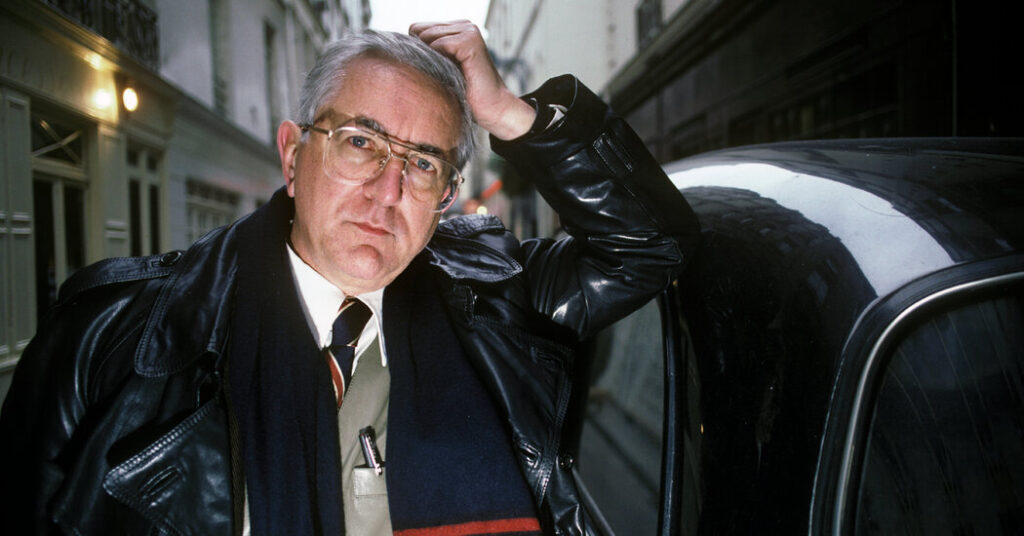
Len Deighton, the British author who brought a documentary-style realism to the spy genre in 1960s Cold War thrillers like “The Ipcress File” and “Funeral in Berlin,” the film versions of which helped make Michael Caine an international star, died on Sunday at his home in Guernsey, one of the Channel Islands between England and France. He was 97.
His death was confirmed by Russell Clark, the family’s lawyer.
Mr. Deighton, the son of a chauffeur and cook, had a background as a military photographer, globe-trotting airplane steward and commercial illustrator before turning to literature on a whim. The result was “The Ipcress File” (1962), which he regarded a riposte to the James Bond novels of Ian Fleming
Instead of Bond’s cartoonish and morally simplistic take on spycraft, Mr. Deighton offered a shadow world through which his unnamed hero — christened Harry Palmer for the film versions — made his way, beset by disinformation, triple-crosses and dim bureaucrats.
Unlike the impossibly suave, action-oriented Bond or George Smiley, John le Carré’s dumpy, cerebral, upper-class spy hero, Mr. Deighton’s central character is self-consciously proletarian, with a jaded, frequently hostile attitude toward his superiors, a droll sense of humor and a love of cooking.
Mr. Deighton took a sardonic view of his sudden achievement as a brand-name writer. “All you need is a profound inferiority complex, no training as a writer and growing up a victim of the English class system,” he told Publishers Weekly in 1993.
Although he remained best-known for his early titles, including “Funeral in Berlin” (1964), he continued to write prolifically. His unnamed hero appeared in two other novels, “Horse Under Water” (1963) and “Billion-Dollar Brain” (1966), and another recurring character, the middle-aged, discontented intelligence officer Bernard Samson, played the central role in three spy trilogies with interlocking titles released starting in the mid-1980s.
The first trilogy consisted of “Berlin Game,” “Mexico Set” and “London Match” (often referred to as the “Game, Set and Match” trilogy), followed by “Spy Hook,” “Spy Line and “Spy Sinker” (known as “Hook, Line and Sinker”). The final series, published in the 1990s, was “Faith,” “Hope” and “Charity.”
“He is the master of the intricately plotted espionage thriller that offers an antihero with his roots demonstrably in the British people, rather than the civil-service aristocracy,” said Lars Ole Sauerberg, a professor of literature at the University of Southern Denmark and the author of “Secret Agents in Fiction” (1984). “I can think of no other writer of secret-agent fiction with a comparable command of the reality behind the clandestine games.”
Mr. Deighton also wrote several works of historical fiction, set during World War II, that critics put on a par with his best spy novels. These included “Bomber” (1970), about a failed Royal Air Force raid on the Ruhr in 1943, and the counterfactual “SS-GB” (1978), which imagines Britain under Nazi occupation in 1941.
Leonard Cyril Deighton was born on Feb. 18, 1929, in London’s Marylebone neighborhood. His father, also named Leonard, worked as a chauffeur and mechanic for a the family of Campbell Dodgson, a curator of prints and drawings at the British Museum.
Mr. Deighton liked to tell interviewers that he “grew up in a house with 15 servants,” before noting that his parents were two of them. His Irish mother, Dorothy (Fitzgerald) Deighton, was a part-time cook.
In part to escape his father’s brutal temper, he said, he spent ample time in the kitchen with her. Based on what he learned, he briefly worked as a chef’s assistant in his 20s and gave the same kitchen skills to the hero of the early novels.
At 17, Mr. Deighton joined the R.A.F., where he trained as a photographer in the special investigation branch. His failure to qualify as a pilot led him to focus on a growing interest in art. On a grant for veterans, he studied for three years at St. Martin’s School of Art in London before graduating in 1955 from the Royal College of Art.
Keen to see the world, he spent two years as a cabin steward on long-haul fights for BOAC, a predecessor to British Airways. He was later a magazine illustrator in New York and the art director of an advertising agency in London. He designed many book jackets as well.
While vacationing with his first wife, Shirley Thompson, in France on an island off Toulon, Mr. Deighton wrote the first half of “The Ipcress File.” The novel’s cryptic title refers to a mind-control technique used by foreign intelligence operatives to make British scientists forget their own research.
Although Mr. Deighton never worked for the British government or any of its intelligence agencies, he was an avid amateur historian and cultivated a wide circle of well-informed sources thanks to his many jobs and travels.
In an introduction to the 2009 reissue of “The Ipcress File,” he wrote that the Old Etonians at his London advertising agency provided him with a storehouse of visual material and personal mannerisms when it came time to create the fictional intelligence offices of his novels.
A literary agent he met at a party, Jonathan Clowes, whose firm still represents him, sold the novel to Hodder & Stoughton. The timing was excellent. The film rights were immediately snapped up by Harry Saltzman, who had just produced the first Bond film, “Dr. No.”
Julian Symons, reappraising the novel in The New York Times Book Review in 1979, awarded the author high marks: “The verve and energy, the rattle of wit in the dialogue, the side-of-the-mouth comments, the evident pleasure taken in cocking a snook at the British spy story’s upper-middle-class tradition — all these, together with the teasing convolutions of the plot, made it clear that a writer of remarkable talent in this field had appeared.”
In an interview with Life in 1966, Mr. Deighton said he wanted “The Ipcress File” to take a different approach to the spy genre.
“I don’t read much fiction, but it did strike me that the thrillers I read weren’t logical, didn’t have the right sort of feeling,” he said. “I feel that all tragedy, which really means all dramatic writing, should have this element that everybody is right in his own sort of way, and it’s the fact that all these trains are coming together and breaking, that is the thing that’s tragic about it. There’s nothing tragic about a villain dying, or about something bad being destroyed.”
Mr. Deighton sometimes said that he saw his central character not as an antihero but as a romantic, incorruptible figure, not unlike Philip Marlowe, Raymond Chandler’s hard-boiled detective. And he was most certainly not a one-man killing machine, like James Bond.
“When I started writing, I had rules,” he told The Daily Telegraph in 2009. “One was that violence must not solve the problem, and I cannot have the hero overcome violence with a counterweight of violence.”
After the success of “The Ipcress File,” Mr. Deighton began publishing illustrated recipes, which he called cookstrips, in The Observer of London. These were collected in “Où Est le Garlic: Len Deighton’s French Cook Book” and “Len Deighton’s Action Cook Book.”
Mr. Deighton later wrote more books on French cooking and nonfiction works of military history, notably “Fighter: The True Story of the Battle of Britain” (1977) and “Blitzkrieg: From the Rise of Hitler to the Fall of Dunkirk” (1979).
In the 1960s, Mr. Deighton was Playboy magazine’s travel editor and helped adapt his novel about con artists, “Only When I Larf,” into a 1968 film starring Richard Attenborough. He also helped produce and write the screenplay of the antiwar musical farce “Oh! What a Lovely War” (1969), which marked Mr. Attenborough’s directing debut. Mr. Deighton’s experiences in moviemaking was not altogether a happy one, and he wrote jadedly about the industry in his 1972 novel “Close-Up.”
Mr. Deighton’s first marriage ended in divorce after years of estrangement. He is survived by his wife, Ysabele de Ranitz, the daughter of a Dutch diplomat; their two sons, Antoni and Alexander; and five grandchildren.
Like the hero of his early novels, Mr. Deighton turned a jaundiced eye on his himself and his accomplishments.
“When I wrote ‘The Ipcress File,’ I didn’t want to be a writer at all,” he told The Daily Telegraph. “I don’t like writers, they give me a pain in the butt. They’re always whining and whingeing and telling you their sales aren’t good enough. For goodness sake, it’s better than driving a truck, as Elvis Presley said about singing.”
Ash Wu contributed reporting.
The post Len Deighton, Author of Espionage Best-Sellers, Dies at 97 appeared first on New York Times.