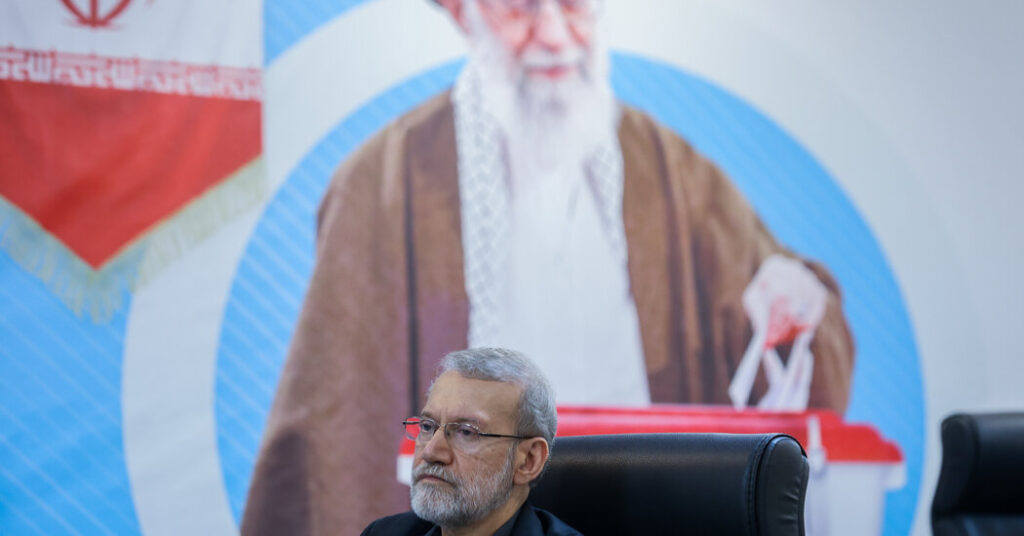
Israeli military and political officials on Tuesday trumpeted the killing of Ali Larijani, Iran’s de facto leader, as a feat of intelligence and military prowess.
Combined with a deadly strike targeting top commanders of the country’s internal-security militia, it was the most damaging blow to the Iranian leadership since the first day of the U.S.-Israeli attack. Airstrikes that day killed Ayatollah Ali Khamenei and his top military commanders in a Tehran compound.
It also highlighted how heavily Israel is relying on targeted killings to achieve its war aims — especially its goal of destabilizing the Iranian government and helping make way for a popular uprising by weakening its internal-security forces. Earlier this year, those forces killed thousands of unarmed protesters.
“If we persist in this, we will give them a chance to take their fate into their own hands,” Prime Minister Benjamin Netanyahu told Israelis in a video message Tuesday.
Israel Katz, the country’s bombastic defense minister, said he had ordered the military to keep hunting down Iranian leaders and to “repeatedly cut off the head of the octopus and not let it grow.”
But Mr. Larijani’s death raises questions about whether Israel is killing so many Iranian leaders because that appears the surest way to achieve its military objectives — or merely because it can. The approach carries a risk of backfiring in unforeseeable ways.
Israel has long experience eliminating its enemies.
In 1972, after 12 of its Olympic athletes were slain in Munich, Israel launched a yearslong campaign of vengeance aimed at killing every person responsible. In the early 2000s, it gunned down or blew up many Palestinians it accused of terrorism during the Second Intifada. And in 2024, it killed Hassan Nasrallah, the leader of Hezbollah, in an airstrike on his headquarters in Beirut. (His successor was killed in an airstrike days later.)
Some Israeli analysts say there is at least some basis to believe that the tactic could now undercut Iran enough that the government signals a readiness to compromise on its nuclear ambitions and ballistic-missile capabilities.
Sima Shine, a former Mossad officer and expert on Iran and its proxies at the Institute for National Security Studies in Tel Aviv, noted that the Nasrallah killing helped weaken Hezbollah to the point that the Iranian-backed militant group agreed to a cease-fire with Israel in late 2024.
“It might come to a point where they say, this is too much for us,” Ms. Shine said. “We are not there yet, and they’re not saying it, but it might happen.”
Eliminating commanders of the internal security militia, the Basij, could similarly go a long way toward persuading it lower-ranking members “to wake up in the morning and not go to work,” she said.
But killing a top Iranian leader like Mr. Larijani could prove counterproductive, depending on who takes his place, Israeli analysts warned.
Mr. Larijani had a reputation as a pragmatist capable of working with moderates and hard-line military leaders alike, she said. His death could bolster hard-liners like the head of the Iranian Revolutionary Guards Corps and the speaker of Iran’s Parliament, Mohammad Bagher Ghalibaf, himself a former I.R.G.C. commander.
“They are the ones actually conducting the war,” Ms. Shine said. “And strengthening the I.R.G.C. means continuing the resistance, continuing the war, and making demands that are unacceptable to the U.S. and Israel.”
Others argue that Iran’s leadership — its “bench,” in sports terms — is too deep for Israel ever to bring its government to the point of collapse. After Ayatollah Khamenei was killed, Iran named his son, Mojtaba Khamenei, a fellow hard-liner, to succeed him as supreme leader.
“Decapitation has its limitations,” said Danny Citrinowicz, a former head of the Iran branch of Israeli military intelligence. “I don’t think we’ve scratched the surface in the ability of Iran to find replacements that can take over for the people that have been decapitated.”
Mr. Citrinowicz noted that Israel killed nearly all of Hamas’s leaders in Gaza, and both Mr. Nasrallah and his successor as Hezbollah’s leader. Yet both organizations are still functioning, if significantly weakened.
“It’s not that I don’t think decapitation is an important tool,” he said. “But we can’t build a strategy only on that.”
A healthy respect for the unknown — like unintended consequences — also argues against an overreliance on targeted killings, said Ami Ayalon, 80, a former commander of Israel’s internal security agency and of its navy.
In an interview, he recalled warning disbelieving American officials that toppling Saddam Hussein in Iraq would unleash chaos, not the flowering of democracy.
“We are very, very close to creating chaos not only in Iran, but all over the Middle East,” Mr. Ayalon said.
He faulted American and Israeli leaders for failing to articulate clear, achievable objectives for the war. And he suggested that Mr. Netanyahu’s optimistic but vague talk of “creating the conditions” for the Iranian people to overthrow the regime was misguided, misleading or both.
“Let’s assume that Bibi is right,” he said, using Mr. Netanyahu’s nickname. “It will take months or years. There are millions of people who depend on the regime, and they understand that on the day after the war, they’re going to be slaughtered. And they will fight and kill in order to not see that happen.”
Mr. Ayalon added: “In chess, there are stupid players who think that it’s enough to kill the king to win. But in the case of ideology, every player plays a major role on the battlefield.”
David M. Halbfinger is The Times’s Jerusalem bureau chief, leading coverage of Israel, Gaza and the West Bank. He also held that post from 2017 to 2021. He was the politics editor from 2021 to 2025.
The post Israel Keeps Killing Key Iranian Leaders. Will It Work? appeared first on New York Times.