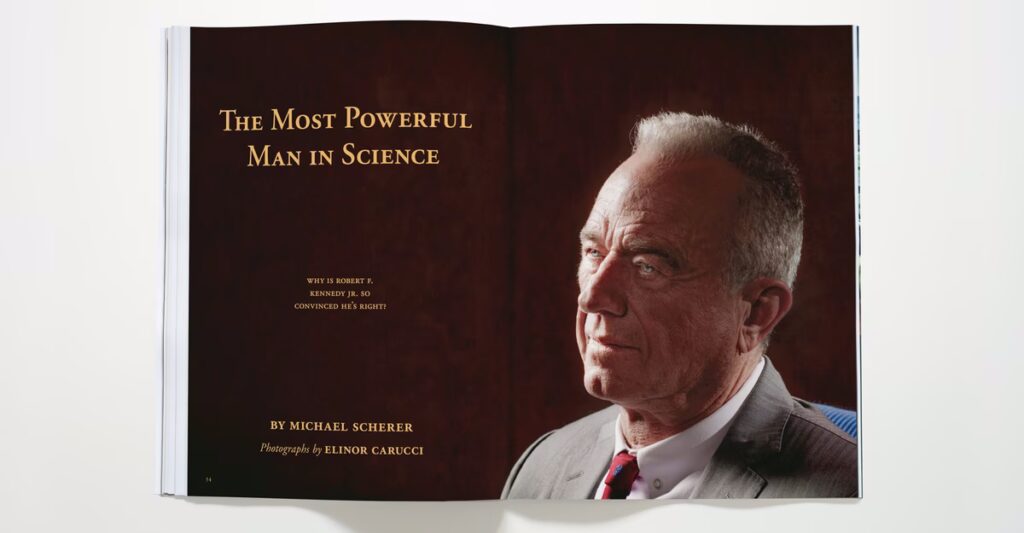
The Most Powerful Man in Science
In the January issue, Michael Scherer considered why Robert F. Kennedy Jr. is so convinced he’s right.
I am a pediatrician who witnessed the rise of vaccine and science skepticism during the coronavirus pandemic, and I’m terrified by Robert F. Kennedy Jr.’s decimation of the Department of Health and Human Services, the CDC, and the National Institutes of Health. Michael Scherer’s article resonated with me. I am open-minded; I believe in integrative practices, and I agree that the medical establishment can be arrogant and unduly influenced by the pharmaceutical industry, which now funds so much of medical research. But I fully understand Scherer’s frustration with his interminable discussions with Kennedy about scientific articles. I, too, have read articles about the benefits of weird diets or the dangers of vaccines, and tried to reason with my patients’ parents about them—parents who didn’t understand the meaning of statistical significance, or any of the scientific jargon used in the articles they would bring me.
But after reading about RFK Jr.’s 14-year battle with drug addiction, his daily Alcoholics Anonymous meetings, and his admitting that he has had to “completely commit” himself “to a way of life” in AA, I was struck by his final words to the author: “Good health does not just come in a syringe.” Very bad things happened to him and those around him due to the contents of syringes. I understand if he has a deep-seated skepticism of anything delivered through a needle. But even if his skepticism is understandable, as the head of the largest and most important civilian agency in the federal government, he must rely on facts, not fear.
David Gottsegen, M.D. Belchertown, Mass.
Francis Collins, a former director of the National Institutes of Health, had advice for dealing with people like Robert F. Kennedy Jr.: Try to understand the backstory of someone you don’t agree with, in order to convince them that you have given them a fair hearing without trying to change their mind. I admire that Michael Scherer appears to have followed his advice.
RFK Jr. has raised many questions about the way the government has handled the problems of public health, and those questions deserve answers. But he has stubbornly and falsely alleged that no one has contradicted his research or his supposed “evidence.” At a certain point, he has no right to be taken seriously by anyone who truly cares about public health.
Kirk S. Ray Little Rock, Ark.
I am a retired infectious-disease physician. In his interviews with Michael Scherer, Robert F. Kennedy Jr. seemed to demand absolute certainty that all risk has been removed from a given treatment before a doctor can recommend it. If this were the case, we would be unable to recommend treatment for any disease. Certainty is impossible in medicine—that’s why physicians speak in terms of risks and benefits. Even good old penicillin has its risks.
As for Kennedy’s investigation into whether vaccines cause autism: He is directing millions of dollars toward one line of inquiry while neglecting other possible factors. We do epidemiological studies to test hypotheses. If there isn’t a “signal” suggesting a link between two things, then why keep searching for one? Resources aren’t limitless.
RFK Jr. isn’t trained to think like a scientist or a physician. Ultimately, this isn’t a battle of viewpoints or ideologies. It’s a question of data—and we have reams of them, interpreted by credentialed statisticians.
Barbara McGovern, M.D. Needham, Mass.
Upon finishing Michael Scherer’s profile of Robert F. Kennedy Jr., I realized that he and Donald Trump are not strange bedfellows after all, despite their initial differences in political affiliation. Both searched for issues that could lead them to the pinnacle of national power, and both found the same target: America’s highly educated, cosmopolitan elite, which had written them off as unserious. The rest of us are watching their revenge play out on a grand scale.
John Yochelson Bethesda, Md.
In April 1980, as a radio reporter with one year of experience, I interviewed Robert F. Kennedy Jr. in North Carolina. He was in the state campaigning for his uncle Ted Kennedy, who was running in the Democratic presidential primary. I remember RFK Jr., then only 26, as irascible—especially after I asked how he thought his uncle would explain the events of Chappaquiddick and the death of Mary Jo Kopechne to voters. He yelled at me and the interview ended abruptly. It was through that lens that I read Scherer’s profile.
Forty-five years later, it seems that RFK Jr. has not changed. He still can’t reflect. He is still irascible in his responses. His fixed belief remains: He is absolutely right about vaccines causing autism. He shows little understanding of what one can and cannot conclude from scientific research. It was his cousin Caroline who labeled him a predator. “I would not contest it that much,” Kennedy said, when reminded of his cousin’s comments by Scherer. “Addiction is kind of narcissistic.” His narcissistic personality persists, even beyond his addiction, and it’s causing him to prey on parents desperately seeking answers about autism and chronic disease.
Sue Ferrara Hamilton, N.J.
My childhood friend Susan, stricken with polio, was in an iron lung in 1946 when I was finally permitted to visit her. We were both 13. I remember being terrified at the sight, though we had desperately wanted to see each other. I was allowed to visit because she was not expected to live. Another friend of mine, Jack, was carefully isolated at home during a whooping-cough epidemic the next summer because he had rheumatic fever. He still contracted that severe and highly contagious bacterial infection. Susan was released from the iron lung after three months and lived to adulthood, though with physical disabilities; Jack died of heart failure at 19.
I’m sorry that Robert F. Kennedy Jr., who was born in 1954, the year I turned 21, cannot envision those days. Or imagine the excruciating fear that enveloped my family in 1939, when my older sister Jane had measles. She was kept in a room with the shades and curtains tightly drawn to shut out any ray of light; similar cases were leaving children sightless. Jane recovered and lived into her 70s without vision problems; she was a painter.
These diseases that shadowed my childhood were all but eradicated as vaccines were developed—and now the secretary of health and human services seems to want to bring them back. Because he lives in some alternate reality that refuses to acknowledge what science and history have so clearly proved, 13-year-olds today will suffer needless disability and early death. Why our own health and humanity should have to be sacrificed at the altar of RFK Jr.’s stubborn misconceptions is beyond comprehension.
Fran Moreland Johns San Francisco, Calif.
Behind the Cover
In this month’s cover story, “Sucker,” McKay Coppins writes about his foray into sports gambling. Coppins wagered on games throughout the 2025–26 NFL season. He describes how betting changed his relationship to football—and his family—and considers the social costs of having casinos in our pockets, in the form of now-ubiquitous betting apps. For our cover image, we inverted the magazine’s “A” logo to create an ace of spades, a symbol of a quainter era of gambling, when the vice was still largely confined to remote desert cities.
— Colin Hunter, Art Director

Correction
“The Man Who Broke Physics” (March) stated that no other figure skater besides Ilia Malinin has landed more than three quadruple jumps in competition. In fact, no one besides Malinin has landed more than four.
This article appears in the April 2026 print edition with the headline “The Commons.”
The post I Remember a World Without Vaccines appeared first on The Atlantic.