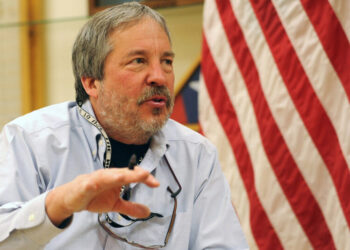
GENESEE COUNTY, Mich. — The sky had long been dark when the white minivan pulled into the packed parking lot of the mosque on the outskirts of Flint for Abdul El-Sayed’s last campaign stop of the day. He walked inside and removed his shoes near the wall covered in posters reading “Free Palestine,” drawn by children and scrawled with heart doodles.
“We are in the month of Ramadan,” El-Sayed said that night in late February, asking the worshipers kneeling on the carpet to consider their blessings and responsibilities. “None of us today, when we woke up, had to think about whether or not our home was going to be bombed.”
He added: “Every dollar that is spent dropping a bomb on somebody else is a dollar that is not spent providing good health care or good schools.”
One week later, the United States and Israel would launch a massive military campaign against Iran that has triggered retaliatory strikes across the Middle East and threatened to engulf the region in a wider war.
The assault on Iran has again thrust U.S. support for Israel to the forefront of Democratic politics, forcing candidates to confront party divisions that to many Democrats were central to their losing the White House in 2024.
The issue is especially critical in Michigan, which has the country’s largest concentration of Arabs and Muslims and where El-Sayed is competing in a three-way, razor-tight Democratic primary for U.S. Senate. El-Sayed, who has long called Israel’s military actions in Gaza a genocide, ties the U.S. relationship with Israel to his populist economic agenda, which he believes is key to winning this battleground state that will help decide control of the Senate.
El-Sayed, who is backed by Sen. Bernie Sanders (I-Vermont) is betting he can harness widespread hunger for a new politics with such progressive proposals as Medicare-for-all, abolishing U.S. Immigration and Customs Enforcement, opposing U.S. military aid to Israel and increasing taxes on billionaires — even in a swing state that President Donald Trump has won twice and where El-Sayed lost a bid for governor eight years ago. If elected, he would be the country’s first Muslim senator.
Some Democrats have urged their party to move back to the center to broaden its appeal.
El-Sayed, 41, faces two primary opponents. Rep. Haley Stevens, 42, is a moderate favored by Democratic leaders who casts herself as a fighter for manufacturing, in part by pushing back against Trump’s tariffs. She joined Congress in 2019, representing suburban Detroit, and has been a vocal supporter of Israel.
Mallory McMorrow, 39, is a two-term state senator also representing the Detroit suburbs who says her party needs a generational shift. A self-described “Democrat with a backbone,” she believes she can attract progressive and moderate voters.
Each of the three millennial candidates is pitching themself as an antidote to the chaos of the second Trump administration. Whoever wins will face former congressman Mike Rogers, who narrowly lost to Sen. Elissa Slotkin (D) two years ago. The race, in which Democrats are playing defense after Sen. Gary Peters’s retirement, represents one of Republicans’ best opportunities to pick up a seat, according to the Cook Political Report.
Who emerges victorious in the August primary may help guide the direction of the Democratic Party, which has struggled to define itself after losing every swing state in the 2024 presidential election. A win for El-Sayed would represent an embrace of populist ideals and a sharp shift to the left in a state that has traditionally produced moderate senators, while a victory for either Stevens or McMorrow would represent voters’ desire for more traditional candidates. (The state has embraced populist candidates before: Sanders won the Michigan Democratic presidential primary against Hillary Clinton in 2016 but lost to Joe Biden in 2020.)
Though the Senate candidates are eager to focus on other issues, Israel is sure to feature prominently in the months ahead. Beyond the U.S.-Israeli military operation against Iran, some elected officials and operatives are bracing for heavy spending by the American Israel Public Affairs Committee, which has supported Stevens in the past. El-Sayed and McMorrow have vowed not to take any money from the powerful lobbying group. A spokesperson for AIPAC said the group has not endorsed a candidate in the race.
An attack Thursday on a Michigan synagogue, described by authorities as a “targeted act of violence against the Jewish community,” has again thrust the issue to the forefront of the campaign. The perpetrator, a Lebanese American man who plowed his vehicle into Temple Israel near Detroit, had relatives who were killed this month in Israeli attacks on Lebanon, an official said Friday.
And scores of House Republicans have fomented anti-Muslim sentiment in recent months, which House Speaker Mike Johnson (R-Louisiana) has refused to condemn. In one instance, Rep. Andrew Ogles (R-Tennessee) said on social media this month: “Muslims don’t belong in American society.” El-Sayed described the remark as a “reach for the bottom of the barrel of hate.”
El-Sayed believes his stance on the Israel-Gaza war has built credibility with critical voter groups, including the state’s Arabs and Muslims, who swung away from Democrats in 2024 because of Biden’s largely unconditional support of Israel. El-Sayed has adamantly opposed Trump’s war with Iran and blasted congressional Democrats — including Michigan’s Slotkin — who have said they may be willing to fund the military operation.
Stevens, who recently supported a measure to curb Trump’s authorities in the Iran war, has said that the administration rushed into military action “without a plan,” though she also noted in a statement that “we cannot ignore that an armed and nuclear Iran would bring even more violence.” McMorrow, in a statement, said, “We don’t need another costly, protracted conflict in the Middle East with no strategy.”
The views of Democratic voters on Israel and the Palestinians have rapidly changed — even since El-Sayed’s run for governor eight years ago. Sixty-five percent of Democrats say their sympathies lie more with the Palestinians, while 17 percent say they sympathize more with Israelis, according to a recent Gallup poll — a reversal from two decades ago.
El-Sayed says some may view his name as a liability in a tough congressional race, but he views it as an asset — something to draw upon to connect to a wide swath of voters.
“There is no better place to be Muslim in the entire world than in the United States of America,” El-Sayed told worshipers that February night. A country, he said, where the grandson of an Egyptian vegetable salesman could rise to become a Rhodes scholar, a doctor, a public health official and, he hoped, a U.S. senator.
As El-Sayed tells it, he was sitting in his office late January 2025 and sifting through funding cuts imposed by the Trump administration when he began considering a Senate run. At the time, he was director of health, human and veterans services for Wayne County, Michigan’s most populous. Then a notification appeared on his phone.
Peters, one of the state’s two Democratic senators, had announced his retirement, opening up a seat in one of the country’s most divided swing states and making the Democratic Party’s already difficult path to control of the Senate even tougher. The uphill battle requires flipping at least four seats in such Republican-leaning states as Ohio, Alaska and Maine.
“I asked myself: Where is the fight for the public’s health now?” El-Sayed told residents of a Grand Rapids senior home last month, repeating the question that he says led him to enter the race. “There has not been a Democratic doctor in the U.S. Senate since 1969.”
He took the crowd back to his unsuccessful 2018 gubernatorial bid. He lost to Gretchen Whitmer, who is serving her second term as governor.
“I said something that folks weren’t quite ready to hear,” he began, launching into a line that has become something of a campaign mantra, an aphorism he is betting people are ready to hear now, years later. “Donald Trump is not the disease of our politics, he’s just the worst symptom. The disease is the system that allows big corporations and billionaires to buy politicians to do their bidding.”
During that gubernatorial run, El-Sayed’s oratory and multicultural upbringing drew comparisonsto Barack Obama. Sanders and a soon-to-be-elected Rep. Alexandria Ocasio-Cortez (D-New York) joined forces to support the underdog candidate.
The campaign took a toll on his family. El-Sayed’s wife, psychiatrist Sarah Jukaku, gave birth to their eldest daughter while he was running. Unable to afford rent and child care on her residency salary alone, they moved in with her parents, she said.
The defeat was crushing.
“It was the first time I didn’t really succeed at the thing I’d tried to do,” he said one night from the passenger seat of the white Chrysler Pacifica after a 14-hour campaign day. “It was the single most humbling thing I’ve ever done.”
Being flung from the hamster wheel of campaigning, he said, “sort of forced me to decouple the thing I do in my work from who I really am.” This campaign season, he’s more protective of time with his wife and children.
“Everything is a lot more smooth this time. We know what to expect,” Jukaku said one afternoon, sitting at the long dining table in their Ann Arbor home. “I think he’s handling it a lot better.” He tries to make school drop-off and complete morning workouts in his basement gym.
Max Glass, a senior adviser who also worked on El-Sayed’s gubernatorial campaign, said momentum is on El-Sayed’s side this time. “There’s a real hunger out there for somebody who’s willing to stand up for real change that wasn’t quite there in 2018,” Glass said.
Democrats who have been urging the party to put forward more moderate candidates said that voters are eager for change but that candidates like El-Sayed are too far left. El-Sayed is “not in line with what Michigan Democrats tend to put forward as the face of their party,” said David de la Fuente, deputy director for politics and research at center-left think tank Third Way.
“The sentiment is certainly correct, but I don’t think it uniquely benefits him. People want change. It doesn’t necessarily mean they want inexperience,” de la Fuente said.
Stevens, who flipped a Republican-held seat in 2018, has received endorsements from former House speaker Nancy Pelosi (D-California) and some Congressional Black Caucus members. She touts her experience in the Obama administration as a Treasury Department official and on Capitol Hill.
McMorrow also flipped a Republican-held district in 2018. She “knows what it looks like to win in tough districts and connect with people who do not identify as a Democrat or with any party,” said McMorrow campaign spokesperson Hannah Lindow.
At a recent forum hosted by the United Auto Workers, contributions from corporate political action committees emerged as another dividing line. Stevens, whose Senate bid has been funded in part by corporate PACs representing Ford and General Motors, sidestepped a question about the issue. Her campaign spokesperson did not answer questions on Stevens’s relationship with AIPAC and corporate PAC contributions.
McMorrow, whose earlier state-level campaigns received corporate PAC donations, said at the forum that she is eschewing them this time. El-Sayed said he has never taken such donations.
“I’m one of the few major Senate candidates who isn’t afraid to call what’s happening in Gaza a genocide — and because of that, I’m one of AIPAC’s top targets to defeat,” he wrote in a fundraising email sent on the second anniversary of Hamas’s Oct. 7, 2023, attack on Israel. He drew swift criticism for omitting any mention of Hamas’s attack. His campaign later called the email a mistake.
The son of Egyptian immigrants, El-Sayed was raised in a suburb of Detroit by his father and White stepmother. An “all-American” story followed, he says in his campaign launch video. He captained his high school football, wrestling and lacrosse teams. He went to the University of Michigan, where he met his wife; won a Rhodes scholarship to Oxford; and completed a medical degree at Columbia, where he taught before returning to Detroit as the city’s most senior public health official.
“I grew up explaining one grandmother to the other,” he says on the campaign trail when asked in Grand Rapids about his lack of experience and how he’d address the nation’s polarization. One grandma was in Michigan, a nurse with American roots dating to the Revolutionary War, and the other was in Egypt, a woman who had raised six children in a one-bedroom apartment.
On a recent afternoon, he arrived at a standing-room-only meet-and-greet hosted by a Latino advocacy group in Grand Rapids, guided by two security guards who often accompany him. His social media feeds are often filled with Islamophobic threats, raising concerns about his safety.
When El-Sayed first told his father that he was thinking of running for public office, his father told him: “You’re going to get killed.” His gubernatorial run inspired death threats serious enough to report to the FBI; his team kept most staffers’ names out of the media for safety. Last year, after a Minnesota state lawmaker and her husband were fatally shot in their home, El-Sayed and his wife agreed they wouldn’t open their front door without first checking their security camera. They taught their daughters, 3 and 8 years old, to do the same. His wife doesn’t allow their oldest daughter to appear in her school yearbook.
At the Latino event last month, people piled into the room to hear his pitch.
“Who here believes that we’ve got to get money out of politics?” El-Sayed said to the crowd, prompting cheers.
“Who here believes in Medicare-for-all?”
“Who believes we’ve got to abolish ICE?” he continued, the cheers growing louder still. His voice boomed, even though it was past 3 o’clock and all he’d had to eat or drink that day was a protein shake and two caffeine pills before sunrise.
He was fasting for Ramadan. His mouth was dry, his body was tired, and it would be three more hours before he had food or water.
“Don’t get it twisted — I love America. I just want America to be America for all of her children,” he told the crowd, before his security guards guided him out of the building.
The post Democrats debate how far left to lurch in fight for key Senate seat in Michigan appeared first on Washington Post.