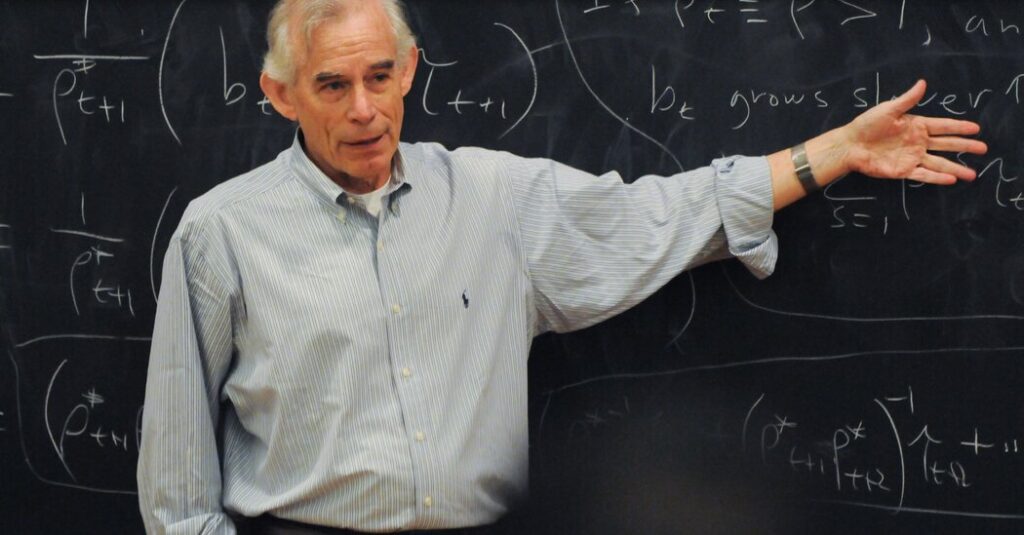
Christopher A. Sims, a Nobel Prize-winning economist who devised sophisticated statistical models to guide central bankers and other policymakers in their attempts to steer the economy, died on Saturday at his home in Minneapolis. He was 83.
His death was confirmed on Tuesday by his wife, Cathie Sims, who said the cause was injuries from a fall.
Dr. Sims, a professor at Princeton and the son and nephew of prominent economists — he recalled discussing economic issues at family gatherings when he was young — shared the Nobel in economics with Thomas J. Sargent of New York University in 2011.
In awarding them what is formally called the Sveriges Riksbank Prize in Economic Sciences in Memory of Alfred Nobel, the Nobel Foundation cited their “empirical research on cause and effect in the macroeconomy.”
Dr. Sims and Dr. Sargent’s research in the 1970s and early ’80s came amid surging inflation and stagnant growth, a condition sometimes called stagflation. The economy wasn’t behaving the way economists thought it should, raising questions about whether policymakers had lost their way.
Economists known as monetarists, whose leaders included Milton Friedman of the University of Chicago, argued that the economy was floundering largely because central banks were failing to maintain a steady pace in money-supply growth.
In response, some policymakers — notably in Britain and the United States — began focusing more on money-supply growth and trying to keep it within narrow bands. Economists of the Keynesian school, who argue for government intervention to stabilize the economy when necessary, disputed the monetarist approach. Statistical models of the economy were too primitive to resolve the argument.
Dr. Sims used a statistical modeling technique known as vector autoregression, which provided more clarity on the effects of policy choices by indicating which changes in economic data were due to those choices and which had other causes, such as fluctuations in oil prices or changes in consumer behavior. Dr. Sargent created models of the economy and used them to test the effects of various policy or structural changes, such as tax cuts or a rise in labor costs.
Their work and refinements by other economists resulted in a better understanding of how policy choices, such as the raising or lowering of taxes or official interest rates, affect the economy. These advances led most economists to reject the notion that central banks should focus on tight control of money-supply growth.
Dr. Sims distrusted reliance on theories and favored the testing of economic-policy prescriptions by subjecting them to analysis over long periods.
Though statistical models of the economy improved, they still couldn’t always provide reliable forecasts or guidance for policymakers. A notable failure was the 2008-9 financial crisis, which few economists saw coming. One reason was that models weren’t very good at reflecting changes in financial markets, such as a huge increase in the trading of options and other so-called derivative contracts that provided more opportunities for speculation.
In an interview for this obituary in 2024, Dr. Sims said that since 2009, models had been improved in tracking changes in financial services.
“We’re much better at that than we were,” he said, adding that economists were likely to continue to find better ways to model the economy, perhaps aided by artificial intelligence.
One challenge for economists, Dr. Sims said, is that people sometimes expect too much from forecasts. Economists who acknowledge the degree to which unexpected events can throw off their forecasts are sometimes seen by the public as less credible than those who seem to know precisely what will happen.
Dr. Sims was also a leader among economists working in an area known as the fiscal theory of the price level. These economists focus on the risk that central bankers and other policymakers will work at cross purposes. For instance, efforts by central bankers to lower inflation by adjusting interest rates can be undermined if the government runs huge budget deficits that will eventually devalue the currency.
“Monetary policy always has fiscal implications, and vice versa,” Dr. Sims told The Wall Street Journal in 2011. “It’s dangerous to think that one of the two policies can by itself take care of an economic crisis.”
Dr. Sims and Dr. Sargent were colleagues in the economics department at the University of Minnesota in the 1970s and ’80s and had a friendly, bantering relationship. In a news conference held shortly after they were awarded the Nobel in 2011, Dr. Sargent said Dr. Sims had been generous in reviewing other economists’ scholarly articles.
“I have a large set of his comments on my papers,” Dr. Sargent said, “and they start like this: ‘This paper is deeply flawed.’”
But then, Dr. Sargent said, Dr. Sims would typically offer a glimmer of hope by adding something like: “You may think I’m completely negative about your paper. This is not necessarily true.”
Christopher Albert Sims was born on Oct. 21, 1942, in Washington, D.C. His father, Albert Sims, was a diplomat whose State Department career took the family to Germany for two years. They later settled in Greenwich, Conn. His mother, Ruth (Leiserson) Sims, led the Connecticut League of Women Voters. In 1977, she was the first woman to be elected first selectman of Greenwich, the town’s highest executive position. She was the first Democrat elected to that post in more than 70 years.
Dr. Sims had an early introduction to economics. His maternal grandfather, William Morris Leiserson, was a Jewish immigrant from Estonia who became an economist and served on the National Labor Relations Board. One of his uncles, Mark Leiserson, a labor economist who taught at Yale, encouraged his teenage nephew to study economics and engaged him in debate over the causes of inflation.
“There was talk about economic policy issues in family gatherings,” he recalled in a 2012 interview recorded at the Federal Reserve Bank of Atlanta.
At Greenwich High School, he played trombone in the band and developed an appreciation for advanced mathematics. He majored in math at Harvard, where he also played club rugby and protested against the testing of nuclear weapons.
He switched to economics for graduate school after concluding that “I probably didn’t want to spend my life with pure abstractions,” as he put it. He began his graduate studies at the University of California, Berkeley, and completed his Ph.D. at Harvard in 1968. He taught there and at Minnesota, Yale and, since 1999, Princeton.
Dr. Sims and his wife were married in 1967. In addition to her, he is survived by three children, Benjamin and Nancy Sims and Jody Nelson; a daughter-in-law, Katherine Prestridge; four grandchildren; a sister, Jennifer Sims-Gallucci; and a brother, William.
Before dawn one morning in October 2011, the telephone rang at Dr. Sims’s home in Princeton. Suspecting that it was a crank call, he didn’t answer. When the phone rang again, his wife picked up the phone and then whispered to him, “If it’s a prank, they’re doing a pretty good Swedish accent.” The call proved genuine, and he collected his award in Stockholm two months later.
Eric Leeper, an economics professor at the University of Virginia, said in an interview in 2024 that Dr. Sims had been an inspiring mentor at the University of Minnesota. Dr. Sims, a registered Democrat, was always open to evidence that his own views were wrong, Dr. Leeper said.
“His political views played absolutely no role at all in his research,” Dr. Leeper said. “That’s much more rare than it ought to be in economics.”
Ash Wu contributed reporting.
The post Christopher A. Sims, 83, Dies; Won Nobel for Modeling Economic Policy appeared first on New York Times.