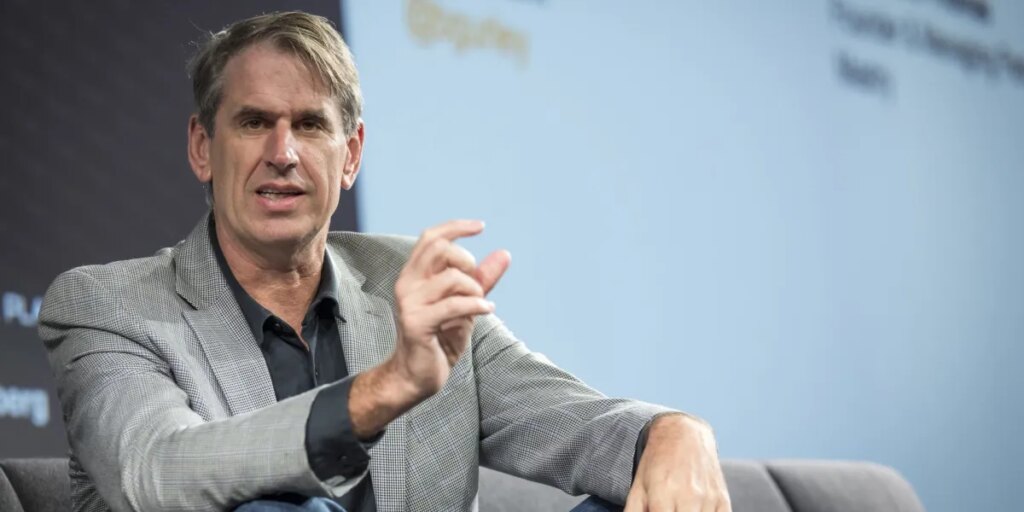
The AI boom helped make the world’s 500 wealthiest people $2.2 trillion richer in 2025. To Bill Gurley, one of Silicon Valley’s sage investors and a general partner at Benchmark, those astronomical gains in wealth are a sign of an inflating AI bubble that is bound to pop.
The AI boom is following the pattern of other eras of technological growth, in which early gains for some tech firms have sparked a wave of spending that will ultimately be unsustainable for dozens of companies, Gurley said in an CNBC interview on Monday. Companies will soon have to curtail their spending and revise their valuations, or otherwise risk failing.
“When people get rich quick, a whole bunch of people come in and want to get rich too, and that’s why we end up with bubbles,” Gurley said. “One day we’re going to have an AI reset, because waves create bubbles, because interlopers come in.”
The venture capitalist added that investors should “start gobbling [software-as-a-service stocks] up” following the reset. The sector has been hit particularly hard by AI disruptions as a result of AI agents being able to automate workflows more cheaply than existing SaaS tools. Salesforce and ServiceNow stocks have lost more than 20% of their respective value since the start of 2026.
Signs of AI strain
Gurley said the exorbitant amounts of money being spent on AI are a warning sign for a potential bubble burst.
“One day, I just think we trip and run out of money on those things,” he said. “I do think that moment stands in front of us.”
This wave of AI spending is set to exceed the capital expenditure-to-sales ratio from the dot-com era as a result of hyperscalers pouring money into data centers used to train and deploy vast large language models and other AI systems, according to Morgan Stanley analyst Todd Castagno. In a note to clients last month, Castagno said capex-to-sales will reach 34% this year and 37% in 2028, dwarfing the 32% recording near the turn of the century. That spending, about $2 trillion between 2026 and 2028, would represent 40% of the Russell 1000.
Hyperscalers may push this ratio even higher, to 38% this year and 45% by 2028, if they continue to finance data centers with leases, the note said. Indeed. Amazon, Meta, Alphabet, Microsoft, and Oracle amassed nearly $1 trillion in total undisclosed future lease commitments, or leases for data centers that have yet to be built, according to a February report from Moody’s Ratings. About $662 billion of that total is for leases that have yet to commence, which companies are not required to recognize as liabilities on their balance sheets under generally accepted accounting principles.
These infrastructure buildouts are often in partnership with startups like OpenAI and Anthropic, which have fuelled these ambitious data center investments. Last month HSBC estimated OpenAI would need an additional $207 billion in funding by 2030 in order to afford its cloud computer rental from Microsoft and Amazon. Analysts estimated $280 billion in total cash burn by 2030. Anthropic’s CFO said in a recent court filing the company spent more than $10 billion training models that generated half that total in cumulative revenue.
Gurley compared those figures with Uber’s annual burn rate of $2 billion when he was involved in the company—a sum he said gave him “high anxiety.” (Benchmark was an early investor in Uber, and Gurley served on the company’s board of directors at the time of ex-CEO Travis Kalanick’s 2017 ousting.)
“God bless them,” Gurley said of OpenAI and Anthropic. “It’s a scary way to run a company.”
AI’s impact on labor
AI companies’ astronomical spending has been accompanied with bold claims about the future of the labor market, with ServiceNow CEO Bill McDermott anticipating an eventual 30% unemployment rate for Gen Z college graduates as a result of the technology
Tech companies have already attributed mass layoffs to AI, including Oracle, which is reportedly reducing thousands of roles, touting efficiencies of its AI tools. Meta will lay off about 20% of its workforce following heavy AI spending, according to a Reuters report. Gurley said these claims and attributing mass layoffs to AI productivity is overdone.
“I’m not that big of a doomer, he said. “I think these waves come, and especially with AI, there have been a lot of people pumping kind of miracles into it … .They get this kind of apocalyptic view. We’ve had technology disruption before.”
Gurley noted CEOs announcing layoffs are going to blame AI, rather than take responsibility for “being bloated” or making tactical missteps. Analysts say companies like Oracle are slashing headcounts as a way to conserve cash following massive waves of investment. To Gurley, these cuts will become the new normal.
“We’re going to see a ton of these announcements,” he said. “But it’s a normal thing that we’ve been through before.”
The post Benchmark’s Bill Gurley: the AI bubble is about to burst—and a reset is coming appeared first on Fortune.