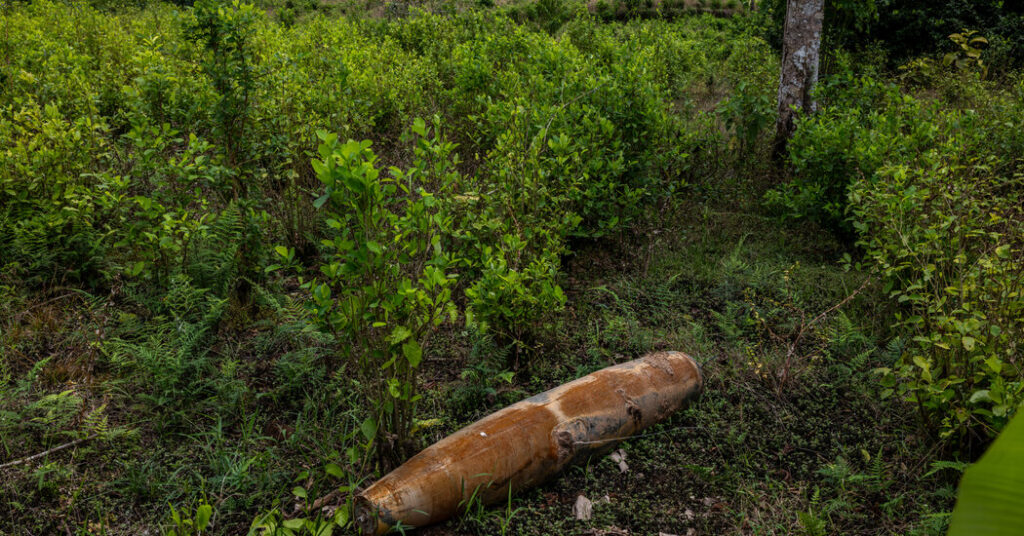
A team of New York Times journalists on assignment at the Ecuador-Colombia border last week learned from local farmers about an alarming development: they told us that they had stumbled upon a large, unexploded bomb on a farm.
The farmers, in the Putumayo region of southern Colombia, less than a mile from a river that divides Colombia from Ecuador, led us to a field. There, between coca crops and banana trees, lay a nearly 6-foot-long, cigar-shaped steel cylinder, its rusted olive-green paint peeling under a scorching sun.
Farmers gathered around the munition, joking nervously.
They inspected the large crater that the munition appeared to have left when it landed.
The bomb in their backyard would soon spark a diplomatic dispute between Colombia and Ecuador.
Experts consulted by The Times identified the munition as an American-designed Mark-82, a 500-pound bomb widely used in modern aerial warfare.
The family living in a farmhouse just a few hundred feet from the explosive said they discovered the bomb in early March, around the time the Ecuadorean military said it was conducting air bombing operations against drug trafficking groups nearby in northern Ecuador.
The Times interviewed witnesses, photographed the munition and, concerned for the safety of residents, alerted the Colombian government about it on Monday night.
Shortly after, on national television, President Gustavo Petro of Colombia suggested that Ecuador had dropped the bomb in Colombian territory.
Mr. Petro did not provide evidence for the claim, but said the bomb did not belong to Colombia’s army and ruled out Colombian armed groups, saying they did not have airplanes.
“We have to investigate this well,” said Mr. Petro, who ordered the Colombian military to dispose of the bomb.
“The bomb is active,” Mr. Petro added. “It is dangerous.”
An arming wire still hung from one of the bomb’s suspension lugs, thick metal loops connecting the weapon to a warplane’s ejection rack.
Ecuador’s President Daniel Noboa quickly responded on Tuesday morning. He said Mr. Petro’s accusations were false and maintained that Ecuador keeps its military within its airspace.
“We are acting in our territory, not yours,” Mr. Noboa said in a post on X.
A 13-year-old girl who lives on the coca farm, Daisy Toro, said she saw two planes fly over the farm on March 3, the same day residents reported seeing and hearing Ecuadorean aircraft conducting military operations along the San Miguel River.
Daisy said the planes dropped at least two objects over the family’s farm: “I just ran.”
The family discovered the munition a few days later when a neighbor went to pick bananas.
It was rusty, making it seem like it had been there for years.
Experts said that general-purpose bombs of this type typically have a thin coat of paint that will scrape off in places upon impact. It is normal for rust to develop quickly when sitting in a damp area or when exposed to rain.
Farmers said they believed a second munition could be somewhere in the fields, but they were not sure.
The bomb had been fitted with a fuze protruding from its nose. Most of it was found nearby, stuck in a coca plant after shearing off on impact. The base of the fuze, which contains sensitive explosives, remained inside the weapon — a hazard that disposal teams would have to contend with before moving the munition for disposal.
Had the bomb exploded, it would have done so with the force of 192 pounds of TNT.
According to U.S. government publications used by military bomb disposal personnel, the fragmentation from its steel casing would have been hazardous to life as far as 750 feet away. It would also have created a wave of pressurized air capable of harming people over 1,900 feet away.
“It is very dangerous for that ammunition to be there,” said César Gabriel Cedeño, a military analyst based in Ecuador who added that it would require a “specialized team” from the Colombian army to dispose of it.
The coca farm is in a region of southern Colombia where experts say cocaine cultivation and smuggling have thrived under the control of a drug trafficking group known as Comandos de la Frontera, or Border Commanders.
“You know who is in charge here,” Rosa Toro, 37, Daisy’s mother, said when we arrived.
The bomb’s tail fin section was found lodged nearby in a coca plant, a green shrub that is harvested and mixed with chemicals to turn it into cocaine, though it is also used for medical and religious purposes across the Andes region.
Made of relatively thin sheet metal, fins like these are typically found heavily damaged after impact with the ground, separated from the bomb they were attached to. The individual fins in this instance were smashed flat.
Markings on the bomb and its tail fin, which use metric weight measurements, are not consistent with those produced in the United States.
The tail fins are consistent with those used on unguided bombs.
Which company, or country, manufactured this particular Mark-82 bomb is unclear.
The Mark-80 series of airdropped bombs, which also includes the 250-pound Mark-81, the 1,000-pound Mark-83 and the 2,000-pound Mark-84, has become standard in NATO as well as the militaries of many countries outside of the trans-Atlantic alliance.
In addition to the United States, Mark-80 bombs are also manufactured in Australia, Brazil, Canada, Colombia, France, India, Israel, Italy, Jordan, Pakistan, Spain, Switzerland, Saudi Arabia, Turkey and the United Arab Emirates.
José María León Cabrera contributed reporting from Putumayo, Colombia.
Luis Ferré-Sadurní is a reporter for The Times based in Bogotá, Colombia
The post An Unexploded Bomb on a Colombian Farm Leads to a Diplomatic Clash appeared first on New York Times.