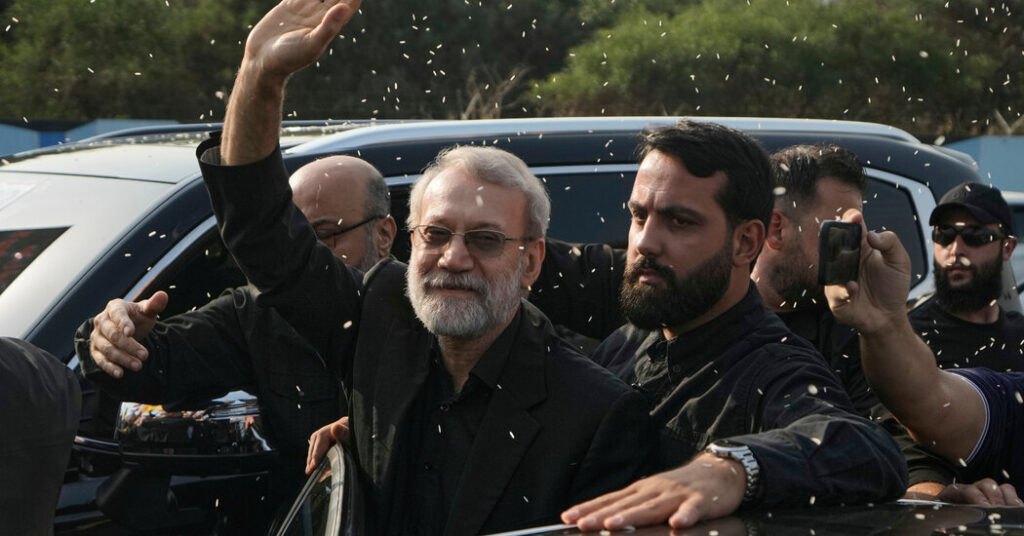
The news that Israel killed Ali Larijani, Iran’s top national security official and its de facto ruler during the war, immediately fueled anxiety among Iranians about the direction of the war and the country.
Israel, again, demonstrated it was a step ahead of Iran when it came to the security of its officials. Iranian officials have been under extra security protocols since the U.S.-Israeli strikes began more than two weeks ago, killing the former supreme leader Ayatollah Ali Khamenei. Still, a wave of targeted assassinations of top officials followed.
Two Iranian officials described their security concerns. One said he received calls from other officials, worrying about the safety of Iran’s leaders, as well as their own safety. They all wondered who would be next to be targeted, he said.
Another official said he shook when he received a call with the news of Mr. Larijani’s killing. There was a pervasive sense of anxiety, he said, that Israel would not stop until all of Iran’s leaders were killed and the Islamic Republic toppled.
Both officials spoke on condition of anonymity to discuss a sensitive matter.
On Monday, a day before Mr. Larijani’s killing, Iran’s first Vice President, Mohammad Reza Aref, narrowly escaped an assassination attempt when Israel bombed a building in the Bonyad Shahid compound as Mr. Aref was visiting, Iranian media reported.
Iran has not yet officially announced Mr. Larijani’s assassination, but reactions to the news quickly started trickling out. He was a veteran politician, the head of the country’s National Security Council and, since January, the de facto ruler of Iran
Hatef Salehi, a conservative Iranian political analyst who is close to the government in Tehran, acknowledged Mr. Larijani was killed in a social media post saying he was the most important and capable interlocutor between Iran’s defense and political leaderships.
“His absence at this critical and dangerous juncture will cast a deep shadow over diplomacy to end the war and decrease the chances of finding a low-cost political solution to end the war, said Mr. Salehi.
Iranian analysts close to the government shared Mr. Larijani’s photograph on social media, along with a handwritten note of condolence he had written for young navy officers killed when the United States struck the Iranian vessel, the IRIS Dena, off the coast of Sri Lanka during a naval exercise.
“Larijani was viewed as a moderate politician, and he was expected to bring some level of change. In the end not only could he not deliver, but he became a victim himself,” said Ali Akbar Mousavi Khoeini, a former Iranian lawmaker who worked with Mr. Larijani when he was a politician in Iran, and is now a senior fellow at George Mason University.
One conservative analyst, Reza Salehi, argued that the killings would not stymie Iran in the war.
“The great supreme leader of the country was martyred and the country is still standing,” he said. “This proved that there is no figure in this country whose death will really change the course of the war.”
Farnaz Fassihi is the United Nations bureau chief for The Times, leading coverage of the organization. She also covers Iran and has written about conflict in the Middle East for 15 years.
The post Ali Larijani Killing Fuels Anxiety in Iran appeared first on New York Times.