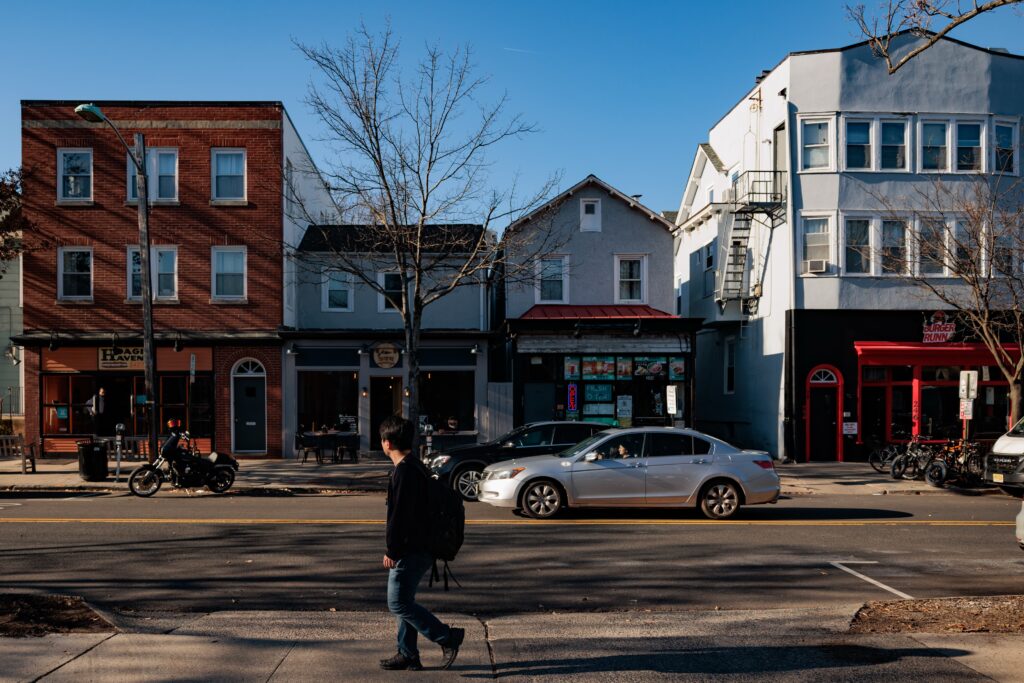
PRINCETON, N.J. — Mia Sacks gets angry stares at the grocery store. Some neighbors no longer speak to her. And her son worries his mother’s work might cost him friends.
Sacks is one of six council members trying to reimagine Princeton’s affordable housing options. The plans, which are mandated by the state, include building new apartment buildings with hundreds of units for low-income residents.
But disagreements about whether the developments will crowd a town rich with Revolutionary War-era history have turned personal.
“People direct a great deal of animosity, vitriol and hostility at me,” said Sacks, a Democrat, as she drove through Princeton last week. “People feel like we are trying to make their lives miserable, and it’s just been awful because they are really vicious.”
Across New Jersey, both residents and officials find themselves on the front lines of a nasty battle over future growth that is rooted in a landmark 1970s law to stamp out racial segregation.
The constitutional requirement, known as the Mount Laurel Doctrine, requires each of the state’s 564 municipalities to come up with a plan every decade to build an adequate share of affordable housing. Developers often build apartment complexes that set aside about 20 percent of units for low- and moderate-income households.
For decades, the doctrine was not aggressively enforced by state leaders, allowing many municipalities to skate around the requirements.
But a shifting political culture, including housing changes enacted by the state legislature in 2024 and the November election of Gov. Mikie Sherrill (D), has once again thrust local officials into polarized clashes over housing. The tension in New Jersey is being closely watched as lawmakers from Massachusetts to California consider ways to alleviate housing costs in their states.
New Jersey municipalities had to submit their 10-year plans for building affordable housing targets to the state by Sunday. Most have complied with the deadline, relieving housing advocates who believe the state is poised to become a nationwide leader in the construction of new affordable units.
Others have been fiercely opposed. About two dozen towns and cities have sued to block the mandates from taking effect, launching one appeal that made it to the U.S. Supreme Court.
Those opposed said they’re worried about traffic, preserving history or losing farmland and green space to blacktop and high rises. In turn, some have accused them of trying to keep lower-income residents and minorities out of predominantly White neighborhoods.
“We are being accused of being racist,” said Sean Wilentz, a Princeton University history professor who is leading the campaign against a new 238-unit apartment in his neighborhood. “It has really gotten crazy and shows you just how misleading and demagogic this all is.”
A bitter feud
Zoning laws have been used to keep some New Jersey communities predominantly White since after the Civil War and, for much of the 20th century, local governments tried to limit construction that could have enticed the poor, including racial minorities, to move in.
Several Black residents sued the town of Mount Laurel in 1971 after officials there blocked construction of affordable units. The case made it to the New Jersey Supreme Court, which issued the landmark ruling in 1975 that stated all municipalities must build their “fair share” of affordable housing.
But enforcement of the doctrine was uneven for decades, leading to court battles. Now advocates said the 2024 reforms, which imposed stricter deadlines on municipalities, combined with support from the governor, will finally lead to change.
“For many years, this whole thing about Mount Laurel was an epic struggle,” said Adam M. Gordon, executive director of Fair Share Housing Center, an advocacy group. “But really over the past 10 years we have seen a sea change to realize its promise.”
Princeton, home to an Ivy League university, is a liberal town where struggles over affordable housing have been on display.
In a place where the median home price is about $1 million, nearly everyone agrees that more housing is needed. But the town also relishes its history, including being the site of a major battle during the Revolutionary War.
Alexander Hamilton and James Madison both lived there at times during the 1700s. Former president Grover Cleveland is buried in the town’s cemetery, and Albert Einstein lived there from 1933 until his death in 1955.
A decade ago, Princeton clashed with advocates over its obligations under the Mount Laurel Doctrine, resulting in a lengthy case that eventually yielded a settlement that it build more affordable housing.
Since that dispute, Sacks and other council members have embraced the need for more housing to attract low- and moderate-income residents.
Sacks, who was elected to the council in 2019 and leads a housing and planning committee, helped shepherd through the construction of more than 1,000 housing units in Princeton in recent years.
That developments were heavily focused near a shopping district that was struggling with high vacancies. It has since become a vibrant residential and community hub.
Now, as it plans the next decade of Princeton’s growth, the town council is pushing for new housing near several historical districts, testing the will of residents in those communities.
Plans include new apartment buildings near the Jugtown Historic District, where 18th-century houses were constructed near colonial-era pottery shops. Housing is also planned at the site of the former Kopp’s Cycle, which dating from 1891 was the nation’s oldest bicycle shop.
An apartment building is also planned for an underutilized office building and parking lot near hoagie, burger and pizza shops frequented by Princeton University students. Another could rise near the Whole Earth Center, a beloved 50-year-old organic market on the town’s main thoroughfare, Nassau Street.
Sacks said council members want to build up Princeton’s urban core using a “smart growth model” that will help give low-income residents easy commuter rail access to New York City and Philadelphia as well as Princeton University, the town’s largest employer.
“If your point is desegregation, and you put them on the outskirts of town, then you are not truly integrating the neighborhoods,” Sacks said. “Socially integrating these people into the hub of your town is interspersing into the most populated and accessible neighborhoods.”
But a few blocks from Nassau Street, Princeton’s plans to redevelop part of local seminary’s property have touched off a bitter feud with neighbors and a coalition of historians.
The 23-acre property abuts several stately homes built as early as the 17th century, including a stone house where Madison and Hamilton once lived. Several four-story apartment complexes are planned for the site, drawing the ire of local homeowners who say the property would denigrate the neighborhood.
Wilentz, who has taught at Princeton for more than 40 years and lives about a block from the site, said the proposed development “would ruin one of the most historic districts in the country never mind New Jersey.” The seminary property would include about 238 units, including 48 for low- and moderate-income residents.
“This is not a real solution to affordable housing,” Wilentz said. “You are trying to squeeze them into luxury housing and that is no way to do affordable housing.”
Throughout the neighborhood, residents have displayed signs stating, “Defend Historic Princeton.” Last year, Wilentz also organized a group of prominent historians, including filmmaker Ken Burns and Vanderbilt University professor and author Jon Meacham, to pen a letter in a local newspaper opposing the project.
“We are distressed to learn that this remarkable neighborhood is now threatened,” the letter states.
The community opposition resulted in a terse response from Leighton Newlin, the Princeton town council’s only Black member. In a letter to Town Topics, the local newspaper, Newlin accused the opponents of the project of having “a plantation mentality in progressive clothing.”
“The language has evolved — but the intent remains. Keep those who ‘don’t belong’ outside the gate, off the land, away from opportunity,” Newlin wrote. “‘Defend’ Princeton from what? From being equitable? From becoming accessible? From reflecting the true diversity of this country? … This is how exclusion works now.”
The letter outraged Wilentz and many of his neighbors, he said, including several other Princeton University professors.
“He basically called a whole swath of his constituents basically racist,” Wilentz said. “This was really the first integrated neighborhood of Princeton. We had Black people living on this street in 1850.”
Although a judge rejected an initial legal challenge against the project, Wilentz vows litigation will continue. Sacks, meanwhile, said she will keep fighting to add density to Princeton to fulfill her obligations under the Mount Laurel Doctrine.
“I’m so done with liberal hypocrisy,” Sacks said, referring to people who say they support more affordable housing except when it’s located near their residence.
‘Struggling to find space’
Other New Jersey communities have been able to adopt affordable housing targets without neighborhood clashes like those playing out in Princeton.
Many intend to redevelop underutilized 1980s-era office parks, shopping centers and motels that line highways throughout much of the state.
In Evesham Township, outside Philadelphia, leaders recently approved a plan to build 125 new affordable units over the next 10 years. Deputy Mayor Heather Cooper said one of the projects will include redevelopment of garden-style office park.
“We have done a very good job of explaining the needs and what it was important to build it,” Cooper said. “So as far as opposition, it was very limited.”
Still, Evesham Township Mayor Jaclyn Veasy said she understands why officials in other cities might struggle to sell their plans to constituents.
“A lot of these towns are smaller towns that are struggling to find space, and it feels like an undue burden,” said Veasy, vice president of the New Jersey Conference of Mayors.
That’s the case in Montvale, said administrator Joseph W. Voytus, who’s leading an effort with about two dozen other municipalities to try to delay implementation of the latest Mount Laurel requirements.
“Our town is a four-square-mile municipality,” he said. “The problem is you have these entities pushing housing that are single-issue entities. We don’t have that luxury. We have to balance our tax base, balance traffic and all of these other concerns.”
Montvale and the other municipalities sued the state, arguing the doctrine and subsequent 2024 reforms put the burden of the state’s affordable housing challenges on suburban communities and gave too much power to judges to dictate housing policies.
The lawsuit included an emergency appeal to the U.S. Supreme Court. Justice Samuel A. Alito Jr. denied the appeal last month.
To fulfill state requirements, Voytus said the city is now expected to add about 205 affordable units over the next 10 years.
But he said Montvale, where the median family income is about $180,000 per year, doesn’t “have enough land on which those units can be developed.”
“There is nothing truly vacant in Montvale,” Voytus said.
Gordon, with the Fair Share Housing Center, remains wary of municipalities resisting their obligations, suspecting some, which tend to be overwhelmingly White and affluent, prefer “racial and economic segregation.”
“They want to keep their communities the way they are,” Gordon said. “And the essential element of keeping communities the way they are, for most of these towns, is keeping them racially and economically not reflective of what the state is.”
The post A state’s rule for housing that promotes diversity is dividing neighbors appeared first on Washington Post.