Andrew O’Shaughnessy, a history professor at the University of Virginia, is author of “The Men Who Lost America: British Leadership, the American Revolution, and the Fate of the Empire.” He is currently a visiting fellow at the Rothermere American Institute and Oxford University.
A joy of studying history is the way it can still make news after 250 years.
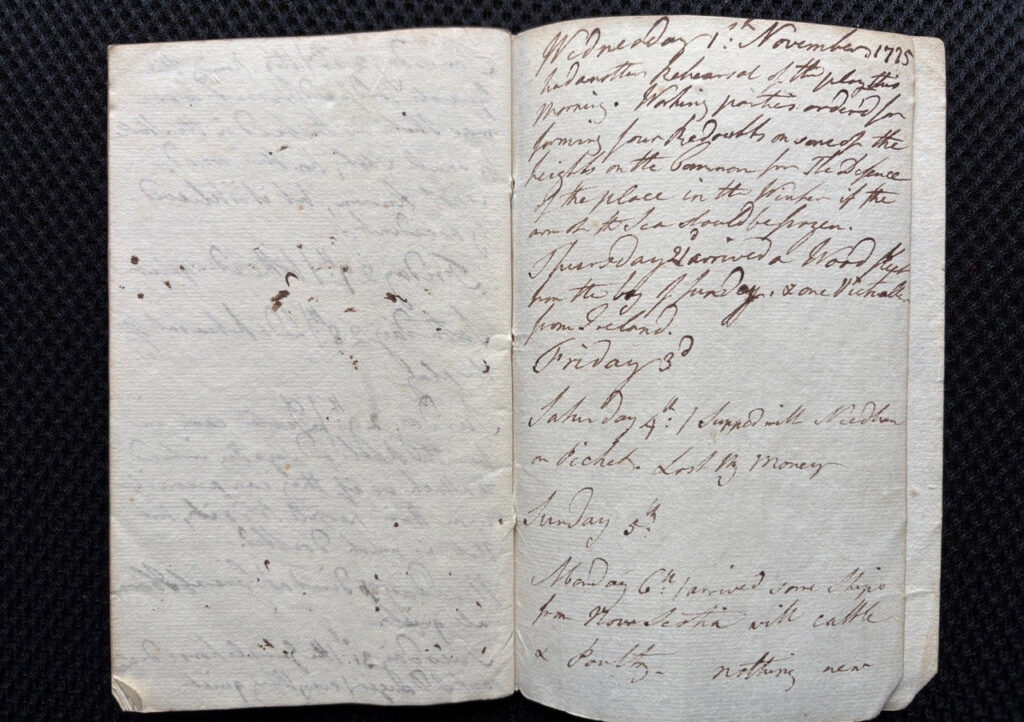
Burgoyne arrived in America in late May 1775, but the newly discovered journal — it was stumbled upon in an innocuous cupboard called “6B” — does not begin until June 30, after the Battle of Bunker Hill. We already know from Burgoyne’s correspondence that he was frustrated that there were fewer troops under his command than he’d had at a more junior rank earlier in his career.
Burgoyne’s account of the siege opens with a midnight attack on Roxbury, where British soldiers burned a tavern and a few houses. It records other attempts to break out of the American stranglehold. There are continuous references to skirmishes and attacks by the people he always dubs “rebels” — the implication being that they are to be coerced and destroyed, without negotiation.
On July 31, 1775, in a typical entry, Burgoyne describes how “early this morning the Rebels having assembled in a number of Whale Boats came down to the Light House, attacked the guard of an officer & 20 men who were placed there to defend some barracks. … The officer with his men left his post & got on board a small schooner, were attacked, & the officer & most of his men killed.”
There is frequent mention of American deserters, some of whom brought intelligence. One gave “an account that the Rebels are very sickly & want bread & salt, that there are about twenty thousand & talk of giving us a general attack.” There is only one reference to desertion on Burgoyne’s own side. The offending soldier was shot.
As ever in war, some of the information that reached the British leaders was false. A report came that the British had been defeated in Canada, and there was word “that General Washington had lost his leg.”
Burgoyne also writes of infighting among the British, including two duels; one of these, between marine officers, ended in a fatality. A fistfight broke out between Vice Admiral Samuel Graves and Benjamin Hallowell, a loyalist commissioner on the Board of Customs in Boston. Each man came away with a black eye, and the admiral’s sword was broken in the “shameful” episode, Burgoyne writes.
Toward the end of the journal, there is a growing sense of the deteriorating situation of the army. Burgoyne describes constant attacks by rebels, including days of cannon fire, the severity of the bitter winter and a shortage of food.
Still, despite the danger and privation, there are descriptions of a complex ongoing social life, including dances, theater and gambling. Burgoyne notes several dinners with Gen. William Howe, the top commander, Gen. Thomas Gage, Gen. Henry Clinton, Gen. Hugh Percy and the loyalist Gov. John Wentworth.
The oddest feature is Burgoyne’s obsession with putting on plays. The journal’s three final entries concern rehearsals for a performance of “The Tragedy of Zara,” an adaptation of Voltaire’s “Zaïre” featuring a prologue by Burgoyne. On Dec. 1, he describes holding a final rehearsal and putting his bags on board a naval ship for his passage back to England, where he remained till returning to help lead the British force in Canada in May 1776. The play was performed the next day, shortly before his departure.
Knowsley Hall history is linked to one of the most storied events on the American sports calendar. Burgoyne was close to his nephew the 12th Earl of Derby, who in 1780 founded the classic horse race for colts named after him. The race was reproduced in the late 19th century at Churchill Downs in Kentucky and has been run ever since.
This is not the first time Knowsley Hall has offered a new window on a consequential time. Other recent discoveries include an 1820-1822 European journal and an 1824-1825 American journal of the 14th Earl of Derby, who was three times prime minister to Queen Victoria. “The Derby Collection really is a collection that just keeps on giving,” wrote the current countess, Caroline. “Even after 30 years here, I am still discovering extraordinary exhibits. The Library at Knowsley Hall really is a treasure trove.”
The post A general’s lost journal reveals life inside the British siege of Boston appeared first on Washington Post.