CHARLOTTE — Joshua Byers was hopeful when he voted for Donald Trump in 2024. The 26-year-old document clerk believed the former and future president when he said he would lower prices and improve the lives of the working class.
Over a year into Trump’s second stint in the White House, and overwhelmed with concern about the war with Iran, buyer’s remorse has set in for Byers.
“I feel betrayed,” Byers told The Washington Post after participating in a focus group of young voters outside Charlotte. “I don’t know why we are fighting [in Iran] if we have never been attacked,” Byers told the group of around two dozen young people. “I just don’t understand why.”
Byers’s concerns highlight a growing sentiment among younger Trump supporters. Many in the focus group said they believed Trump’s pitch in 2024, helping catapult him back to the White House by drawing more support from young voters than any Republican presidential candidate in two decades. But with prices stubbornly high, a belief that Trump is overly focused on international conflict and concerns about how federal officials are implementing the president’s immigration policy, they also said they are questioning why they voted in the first place.
The young voters’ frustrations signal a broader vulnerability for Republicans with a key prong of the unique coalition that powered Trump’s political comeback. The focus group in North Carolina, polling and a growing chorus of criticism from the male influencers who endorsed Trump suggest the rightward shift among men in their late teens and 20s in 2024 may have been an isolated incident.
“I wouldn’t even say it’s living,” James Wiest, a 23-year-old arcade technician from Mooresville, North Carolina, said of his life during the focus group organized by Harvard University’s Institute of Politics. “It’s more survival.”
A Washington Post-ABC-Ipsos poll released last month found 70 percent of 18- to 29-year-olds disapproved of Trump’s handling of the presidency, compared with 29 percent who approved. Young people who supported Trump are also notably less enthusiastic about voting in the midterms, with 51 percent of 18- to 39-year-olds who voted for Trump stating they’re certain to vote this fall, compared with 77 percent of Kamala Harris voters in that age group.
“I don’t really want to vote anymore,” Byers said. “I’m really starting to just think it just won’t matter. … I don’t want to feel responsible for taking a vote and feeling misled, or misjudged, or making a wrong move.”
Young voters are also more likely to disapprove of the Iran war, according to a Washington Post poll released on Tuesday. A majority of voters between the ages of 18 and 29 say they oppose the military campaign in Iran, compared to 40 percent of all adults.
Republicans overwhelmingly support the operation, but the generational divide also exists within the party. The same poll found that 51 percent of Republicans and Republican-leaning independents under age 40 support military action, compared with 73 percent of those ages 40-64 and 86 percent of Republicans 65 and older.
John Della Volpe, the director of polling at the Harvard Kennedy School’s Institute of Politics and the moderator of the focus group, said it was clear to him that young people aren’t buying the need for American involvement in Iran.
“Gen Z grew up in the shadow of the Iraq War,” Della Volpe said. “They know how it ended — and they’re skeptical when they hear politicians say this time it will be different.”
The White House said in a statement that the war in Iran is consistent with Trump’s campaign promises.
“President Trump campaigned proudly on his promise to deny the Iranian regime the ability to develop a nuclear weapon, which is what this noble operation is seeking to accomplish,” White House spokesman Davis Ingle said in a statement. “The President does not make these incredibly important national security decisions based on fluid opinion polls, but on the best interest of the American people.”
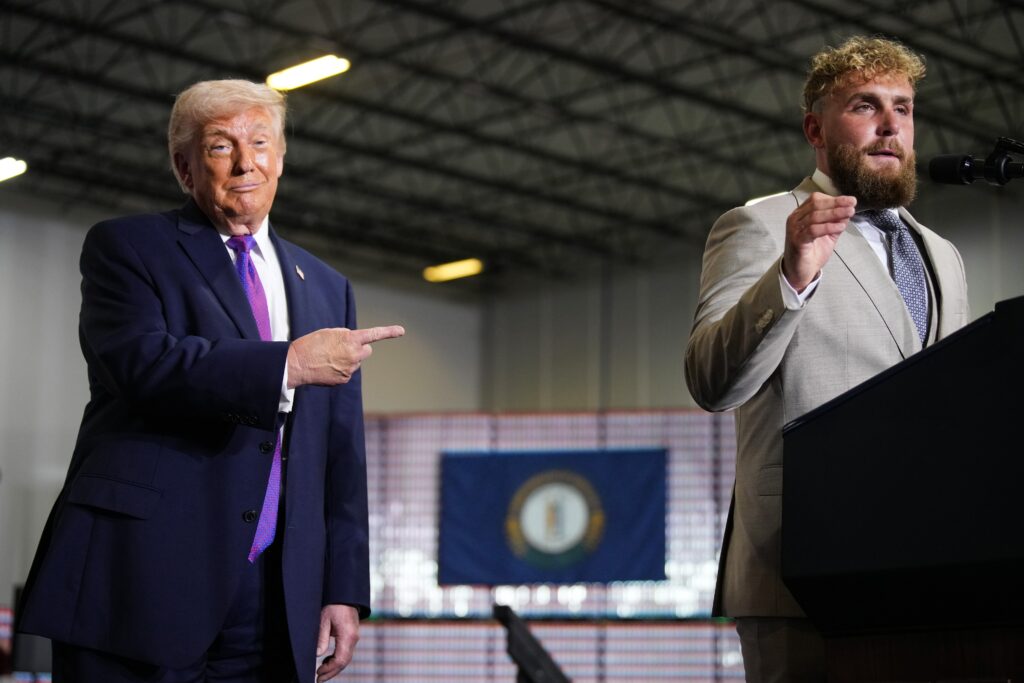
Last week, Trump sought to shore up his message to young voters during a visit to Kentucky, where he touted his efforts to lower costs in front of a crowd of supporters that included some men in their late teens and 20s. In front of banners that said “Lower Prices” and “Bigger Paychecks,” Trump invited the YouTuber and boxer Jake Paul onstage. Paul spoke about how Trump has taught him “his courage,” and the president predicted Paul would run for political office in the “not too distant future.”
Backstage, Paul and Trump recorded a TikTok of themselves doing the president’s signature “YMCA” dance. Trump also appeared on Paul’s new podcast, discussing the critical role that influencers played in his reelection, reincarnation and watching Paul’s fights on Air Force One, among myriad issues. After sharing career advice for young people, Trump presented multiple explanations for the “excursion” in Iran, casting the U.S. strikes as preemptive and intended to wipe out Iran’s nuclear program.
He did not discuss the economic impact of the war in detail.
“The economy’s great,” Trump said. “We take a little winding road for a little while, but we have to wipe out the evil.”
The question is whether an appeal to podcasters will be enough to keep young voters on his side through the months ahead.
“We are stepping into World War III,” Wiest said, reflecting the focus group’s broader concerns about the war. “We just get closer and closer every year.”
Lilly Burrow, a 23-year-old teacher from Charlotte who voted for Trump in 2020 and 2024, said at the gathering that she initially supported the strikes because she thought they were intended to change the regime in Iran. But her view has since shifted, and now she believes the United States is “doing Israel’s dirty work.”
“It does change how I feel about Trump,” said Burrow said. “He said there would be no new wars, and he said that gas would be below $3 a gallon. … I am not happy with him right now.”
Wiest, a Republican, said he feels demoralized and is unlikely to vote in the 2026 midterms.
“I agree with his idea of making America great again, but the way he is going about … it’s not who I thought would be running this country,” he said after the focus group. “He is really focusing on stuff that pertains to him, that he is mad about, and he does not care about what we are mad about.”
Many political strategists once viewed voters between ages 18 and 29 as liberal by default, but men in this group shifted rightward in the 2024 election after the Trump team’s years-long campaign to reach the most testosterone-fueled corners of the internet.
Byers and others in the focus group said they got much of their news about the 2024 election from social media, including online influencers. Byers said he recalls how a constant stream of pro-Trump content on TikTok convinced him to back him over Harris, the Democratic nominee.
In the run-up to Election Day, the controversial streamer Adin Ross gifted Trump a Rolex and a Tesla Cybertruck wrapped in an image of the president during an interview. Trump spent more than three hours riffing about his false claims of election fraud, life on Mars and prophecies on the end of the world in a conversation with popular podcaster Joe Rogan. And he talked about surviving a July 2024 assassination attempt with the four-man comedy team behind the podcast “Flagrant.”
Those same influencers who helped Trump connect with young voters during the election are now using their platforms to criticize the war in Iran and reconsidering their actions in the election. Rogan, who endorsed Trump after his 2024 interview, on Tuesday called the Iran War “so insane” and said Trump had “betrayed” the Americans who supported him.
“He ran on no more wars: End these stupid, senseless wars. And then we have one that we can’t even really clearly define why we did it,” Rogan said.
Andrew Schulz, one of the co-hosts of “Flagrant,” has criticized Trump since last year for doing the opposite of what he promised on the campaign trail. In an early March episode of the show, he and his co-hosts expressed bewilderment at Trump’s decision to start a war.
“Naturally, Americans are furious about it, right?” Schulz said. “Because we’re like, ‘How the f— does this benefit me? I can’t afford to pay for college. I can’t buy a home. I can’t pay for health insurance. And we’re going to spend billions of dollars on a war in a country I can’t even point out on a map.”
Ross, who wore a white MAGA hat during his 2024 stream with Trump, also has expressed regret for having associated himself with the campaign.
“Now that I look back on it, I really, really wish I never got into politics,” Ross told his audience in 2025. “So many people just tie me to it, and no matter what, they don’t even get to know who I am. I don’t think I’ll ever care enough again for any other politician.”
Trump’s success with young voters was not limited to men, with the campaign also winning over young women like Faith Peavey, a 21-year-old American Sign Language interpreter and Republican who said she voted for Trump in 2024 with “caution” because she felt like Harris’s campaign was too chaotic.
“It has definitely been frustrating to see him doing things that were not things he promised to do and not doing things that he promised to do,” Peavey said.
Peavey said she didn’t blame all Republicans for her feelings about Trump, but said she would like to see more checks on him, an argument Democrats are already making in their attempt to win back the House and Senate. Her concerns exemplified the view that Trump is not focused on the right issues, a view shared by other young voters.
“Did you mention that you were planning on attacking these countries?” she said, rhetorically asking the president a question. “We are fighting the wrong battles.”
The post Young voters helped elect Trump, but some have regrets over the Iran war appeared first on Washington Post.