Nicholas A. Christakis is a physician and sociologist who directs the Human Nature Lab at Yale University. He hosts “For the Love of Science” on YouTube.
I’d never taught in a war zone before. But when the rector of the Kyiv School of Economics called last autumn, I found it impossible to say no. Three days in a nice hotel with a fortified bomb shelter while the rest of the country endured daily attacks? The visit seemed like a small show of solidarity with scientific colleagues and the Ukrainian people.
It felt, too, like an opportunity to witness theory in practice. Having spent my career studying the biological and social roots of collective human behavior, I understood that wider circles of people exchanging ideas can make groups tighter and more inventive. I also knew that shared adversity leads to cohesion. Still, I was amazed at what I saw.
My first impression of the Ukrainian people came during the journey from Warsaw to Kyiv, a 12-hour road trip. Entering a country at war is bracing. Sandbags, anti-tank defenses, burned-out buildings and fresh burials with black crepe in newly enlarged graveyards lined the highways. Cars stopped on the roadside as a military hearse with a police escort passed. My driver got out and fell to his knees in respect for the fallen soldier.
When I arrived at my hotel late in the afternoon, it felt as if I’d stepped into “Casablanca.” Soldiers, dignitaries and waiters traversed the lobby. A saxophonist played “La Vie en Rose” with a computer as her backup band. A regular later told me she performed alone because “the men are off fighting.”
As my chaperone from KSE, Alina Shmaliuk, came to escort me to the university, the first air raid of my stay sounded. “It’s just a little Shahed drone,” she said breezily, adding that you can hear them coming from far away, “like old crappy Russian motorcycles.” The ones you really have to worry about, she averred, her voice dropping, are “the missiles, which you don’t hear at all.”
We felt safer thanks to her countrymen’s genius and altruism. The ever-resourceful Ukrainians have developed a system — a sort of crowdsourced Waze app — for weapons detection. Using Telegram channels, residents on the eastern frontier report a drone’s trajectory, which observers in the following villages update as they watch its path.
Relying on this local knowledge, we left the hotel for the university as night was falling. Once there, I was met by Sergiy Kozerenko, a professor of computer science, and a few of his students, who gave me a tour. Having long complained about scheduling and space constraints in the United States, I was immediately humbled. My hosts told me of a wartime law requiring Ukrainian universities to provide room for all students to relocate underground in the event of an air raid. To maintain a proper student-to-shelter ratio, KSE has had to double the length of its school day, meaning the university is in session for more than 12 hours at a stretch.
On the hallway monitors used to announce campus events, one image recurred. It was a black-and-white photograph of a young woman — and her obituary. Her name was Daria Lopatina, 19, a KSE student who had died while volunteering on the frontlines three weeks earlier. Her death had a big effect on the student body, prompting a number of young men to consider interrupting their studies to enlist. Several KSE professors told me they were struggling to balance a commitment to the Ukrainian cause with their duty to mentor students and prevent them from making rash decisions.
I soon found, though, that the student body’s interest in defending their country was matched by their yearning to learn. Whatever anxiety I felt by the raids was overtaken when I saw the university in action, buzzing. The campus was unfazed. Students occupied every available space — classrooms, hallways, cafeterias, even the stairwells. Their resolute faces immediately energized me.
My teaching began on day two. In the middle of a lecture that afternoon, the sirens began to wail. The university’s rector, Tymofii Brik, calmly announced that we would move from the lecture hall to a nearby shelter. Two IT technicians appeared instantly to pack up my computer. We walked across the street to an underground bunker — a facility dating to the days when the Soviets feared a chemical attack from the U.S.
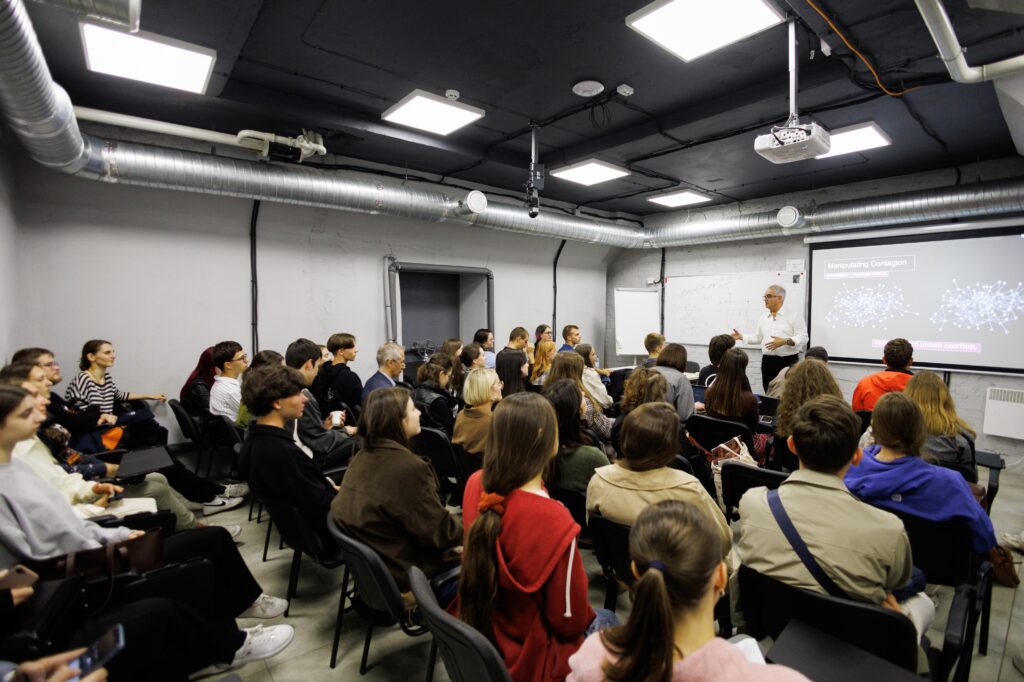
After winding our way down two stories of musty cement stairs, the technicians got us up and running. I delivered the rest of my remarks behind a thick blast door. There we were, more than 100 of us squeezed together under fluorescent lights. And the students were positively beaming as I shared my research on how groups arrayed in certain types of networks can take on properties like cooperation that transcend the attributes of individuals.
It dawned on me that this group was the embodiment of my work. They were engaged, leaning forward, rapt, eager to ask questions in accented but fluent English, listening to their peers and building on each other’s comments and energy. As a social scientist, I could see that they were also animated in part by the presence of an outsider who had come to witness their experience, one who could see what their lives were like as they were going to college each day, worrying and grieving for their families and country.
After we exited through the blast doors, I had more meetings with faculty and students, punctuated by more air raids, loudly announced by the app on my phone. “Overconfidence kills; take this seriously,” it warned, displaying an image of a red bomb falling.
After only 48 hours, I could see how one might start to ignore the messages, inured to relentless bombardment. One professor told me about a recent visit to Kharkiv — Ukraine’s second-largest city, 20 miles from the front lines and heavily damaged by Russian attacks — where he saw people going about their business, sitting outside and drinking coffee during raids.
The contrast with the U.S., where for years people have debated how to make the university a “safe space,” was striking. The American desire for safety cuts across a surprisingly wide swathe of ideologies and backgrounds. Increasingly, it seems, students in the U.S. like to be comfortable, surrounded by like-minded peers. Not so in Ukraine, where students seek a different kind of safety — to be able to learn, to imagine a future.
I’m now home, 4,500 miles from Kyiv, yet our shared work continues. My Ukrainian colleagues and I are researching how artificial intelligence might be harnessed to build social cohesion or to counter Russian propaganda.
Since my visit, their circumstances have become more perilous. They log on to our Zoom calls from darkened cafes — or miss them entirely if the internet cuts out. More than 350 students and staff at KSE have been without heat during the winter thanks to Russian strikes on the country’s energy infrastructure. A bomb destroyed the top floors of the apartment building one of my colleagues lives in. Still, they keep going.
My time in Kyiv wasn’t merely an opportunity for good science. It allowed me to see what was happening to ordinary people at war, and to bond with fellow humans under attack. The Ukrainian students and faculty demonstrated that learning and discovery are transcendent values — worth reaffirming in a time of chaos and fear, even in our own country.
The post Ukraine is at war. Its students won’t stop learning. appeared first on Washington Post.