Despite more than two weeks of relentless airstrikes, U.S. intelligence assessments say, Iran’s regime likely will remain in place for now, weakened but more hard-line, with the powerful Islamic Revolutionary Guard Corps security forces exerting greater control.
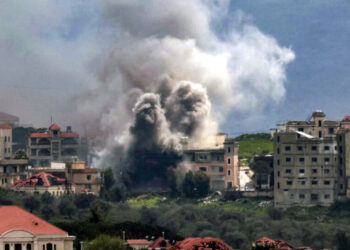
The United States and Israel have significantly degraded Iran’s missile capability and navy, removed the supreme leader Ayatollah Ali Khamenei and wiped out scores of top military and intelligence leaders. But the war’s costs are mounting — at least $12 billion so far and 13 U.S. troops killed. Iran’s viselike grip on the Strait of Hormuz has slowed shipping traffic to a trickle, creating a historic oil disruption.
Western officials and analysts who study Iran said they see little near-term prospect of a “regime change” end to the 47-year-old Islamic republic or the rise of a more democratic government. The latter is a goal cited by Israeli Prime Minister Benjamin Netanyahu and sometimes by President Donald Trump, who has said he’ll know the war is over “when I feel it in my bones.”
U.S. intelligence assessments issued since the war began predict Iran’s regime will remain intact and possibly even emboldened, believing it stood up to Trump and survived, according to two people familiar with the assessments, who spoke on the condition of anonymity because of the issue’s sensitivity. U.S. Arab allies in the Persian Gulf, meanwhile, are angered and alarmed at being the targets of retaliatory barrages of Iranian ballistic missiles and drones.
One European official said the likeliest postwar scenario is a “rump IRGC regime” in Tehran that will retain some nuclear and missile capability as well as the support of regional proxies, though the regime will be “degraded enough that we’re in a better place than we were.”
Trump has been receiving “very sobering briefings” on the U.S. intelligence, said one of the two people familiar with the assessments. And he was told of the likelihood of a more entrenched IRGC before he gave the go-ahead to jointly launch the war with Israel, this person said.
“It wasn’t just predictable,” they said. “It was predicted. He was told in advance.”
U.S. allies in the Gulf say they are furious with the Trump administration as the conflict roars into a third week.
“They started this war for Israel and then left us to face the attacks by ourselves,” said a senior Arab official from the Gulf. In the lead-up to the conflict, he said, Trump administration officials told allies that any military confrontation would be quick, but now it’s clear Iran wants to draw out the conflict to inflict pain on its neighbors.
“We don’t have a plan for a long war. We need to finish it as soon as possible,” the official said. As the conflict has drawn on, the rate of Iranian retaliation has slowed, but Iran has steadily widened targets in the region.
U.S. allies in the Gulf have deployed attack helicopters and warplanes to shoot down Iranian drones targeting their territory but have not taken offensive action against Iranian territory, fearful that such a move would spur Iran to target more Gulf civilian infrastructure.
Trump on Monday expressed surprise at the breadth of Iran’s retaliation. “They hit Qatar, Saudi Arabia, UAE, Bahrain, Kuwait,” he said. “Nobody expected that. We were shocked. … They fought back.’’
Iran’s stranglehold on the Strait of Hormuz is shaping up to be the decisive factor in the war, roiling global energy markets over concerns that it could remain closed to major shipping traffic for an extended time. The White House was advised by the intelligence community that Iran might seek to close the waterway, said one person familiar with the assessments.
“This war is now about the status of the Strait of Hormuz. Full stop,” Eurasia Group Iran analyst Gregory Brew posted on X.
Tapping a massive supply of relatively cheap drones, as well as a dwindling cache of missiles, Iran is exercising control over who can transit the strait, Brew said in an interview.
Iran’s strategy is to hold firm, use its leverage over the strait to force the U.S. to de-escalate and hope Trump does not have the stomach for a long fight.
Trump, Defense Secretary Pete Hegseth and other top administration officials have repeatedly lauded the destruction that the U.S. and Israeli militaries have inflicted on Iran’s military and leadership, hitting more than 15,000 targets as of Friday.
That day, U.S. forces struck Kharg Island, the centerpiece of Iran’s oil-based economy, and Trump posted on social media: “Iran’s Military, and all others involved with this Terrorist Regime, would be wise to lay down their arms, and save what’s left of their country, which isn’t much!”
An Israeli strike on the war’s first day, Feb. 28, killed Khamenei and other top leaders, including the IRGC commander and defense minister. The strike wounded Khamenei’s son, Mojtaba, according to Western officials. Mojtaba was later named to succeed his father.
Iran’s remaining decision-makers are confused, paranoid and having difficulty communicating with one another, said one Western security source, speaking on the condition of anonymity to discuss intelligence assessments.
Nonetheless, officials and analysts say, there are no overt signs of cracks or defections within Iran’s power structure. A classified prewar intelligence assessment by the National Intelligence Council concluded that even a large-scale assault on Iran launched by the U.S. would be unlikely to oust its entrenched military and clerical establishment.
The Islamic Revolutionary Guard Corps, founded in 1979 by revolutionary leader Ayatollah Ruhollah Khomeini to safeguard the new Islamic republic, has steadily gained power in recent decades, including over vast swaths of Iran’s economy.
“The IRGC has got economic power,” said Richard Nephew, a senior adviser on Iran in the Biden and Obama administrations who is now a scholar at Columbia University. “They’ve got political power. They’ve got the domestic repression apparatus. They are essentially now the centerpiece of the power system inside the country.’’
Far from cowing the IRGC, the war likely has only steeled its resolve, he said. That’s not to say that some months from now the water and energy shortages and economic crisis in Iran don’t renew the popular protests, but the regime’s crackdown in January “has demonstrated it’s not going to let that happen the same way it did before,” Nephew said.
Ali Khamenei was the central figure on top of a shifting set of alliances within the regime. Mojtaba Khamenei will likely be more of a partner with the IRGC than a fully independent supreme leader like his father, said Jonathan Panikoff, former deputy U.S. national intelligence officer for the Near East.
The best-case scenario is that the regime is so shaken that once the conflict stops, “there is meaningful competition for power,” said Panikoff, now at the Atlantic Council think tank. “I’m skeptical,” he added.
Panikoff said he sees little likelihood of a popular uprising in Iran at the moment, or signs of cracks behind the scenes in the regime. “Somebody with guns fundamentally has to switch sides or stand aside,” he said.
The Trump administration has begun to press other nations to further isolate the IRGC. In a Monday cable to all U.S. diplomatic posts, the State Department instructed diplomats to urge host governments to designate the IRGC and Lebanon’s Hezbollah as terrorist organizations.
Diplomats were told to deliver the message by Friday “at the highest appropriate level,” according to the cable, which was reviewed by The Washington Post. They were also told to coordinate with Israeli diplomats at the discretion of each mission.
The multilateral outreach is notable for the second Trump administration, which has often favored unilateral foreign policy moves. The cable said broader international designations — resulting in sanctions and visa bans — could deter Iranian retaliation, noting Tehran is “more sensitive to collective action than unilateral action.”
Trump and his top aides have offered shifting rationales for launching the war on Iran, sometimes citing a desire to topple the Islamic republic, sometimes pointing to Iran’s missile and nuclear programs as a looming threat. Netanyahu initially promised to “remove the existential threat” posed by Iran but lately appears to have moderated, emphasizing the war’s degradation of Iran’s missile and nuclear capabilities.
And while the regime is still in place, the Israeli-led effort to topple it is welcomed by some inside the country.
One human rights activist in Tehran, communicating through an encrypted messaging app, said that Israeli attacks on checkpoints manned by the Basij, the IRGC’s paramilitary force, and the killing of IRGC members, have cheered her and her fellow activists “because far more military personnel and regime leaders have been killed in this war than ordinary people.’’
“We can’t imagine life with this regime after the war — how dreadful that could be,” said the activist, who spoke on the condition of anonymity out of fear of retaliation.
Inside Iran, regime supporters have grown more hard-line in two weeks of war, according to Aliasghar Shafieian, an adviser to Iranian President Masoud Pezeshkian. Initially, he said the punishing tempo of U.S. and Israeli airstrikes — much greater than the attacks during the 12-day war with Israel in June — was terrifying but now people are less afraid.
“You see the people are there and standing their ground,” he said in an interview.
A number of senior Iranian leaders including Pezeshkian made their first public appearance since the start of the war on Friday, joining thousands marching in the streets of Tehran to commemorate Quds Day, the last Friday of the holy month of Ramadan.
Shafieian, speaking through a videoconferencing app, said he was at a similar rally last week, a funeral for military commanders killed in the war. Crowds “were chanting no compromise, no surrender, they want to fight to the end,” he said. “They may not be all of the people in Iran but they are part of society.”
The security establishment has used the country’s wartime footing to expand its influence, according to a second European official.
“The region is in flames, and the regime is still standing,” he said. Internally, he said, Iranian retaliatory attacks against its Gulf neighbors have been celebrated as a sign of strength, while the Iranian officials who had supported diplomacy have been discredited.
“The regime is now even more radicalized and more hardened than it was before,” he said.
Adam Taylor and Noah Robertson contributed to this report.
The post U.S. intelligence says Iran’s regime is consolidating power appeared first on Washington Post.