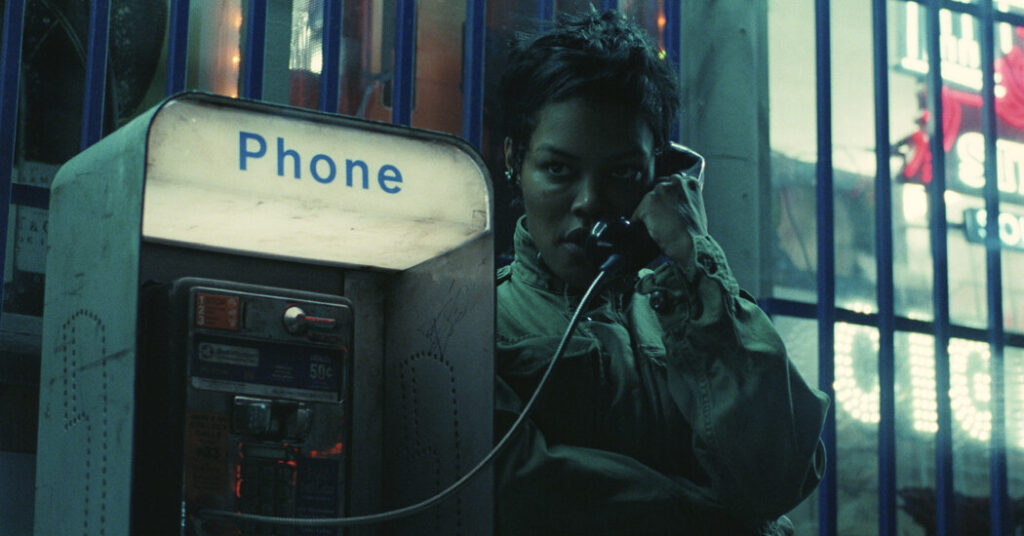
There are several memorable characters and performances in the Oscar best picture-winning film “One Battle After Another,” but the ferocious, gun-toting Perfidia Beverly Hills (played by Teyana Taylor) is the incendiary force behind the movie’s first act. Perfidia is the leader of a militant revolutionary group called the French 75, and one of her defining features in her abbreviated time onscreen is that she’s aroused by the violent nature of their protests.
As “One Battle” unfurls, it speaks to how revolutions carry on into future generations more than it does about any specific politics or ideologies. But in one major sense, the film does send a nuanced political message embodied in the brief and mysterious arc of Perfidia Beverly Hills: that the success of a contemporary American political movement is inextricably tied to the sexual freedom and agency of Black women.
The first third of the movie serves as a kind of long prologue, showing Perfidia at work with the rest of the French 75, including her lover, “Ghetto” Pat Calhoun (Leonardo DiCaprio). They issue threats, set off bombs, shoot guns and make declarations. During a takeover of an immigration detainment facility, Perfidia meets Col. Steven Lockjaw (Sean Penn), with whom she enters into a secret sexual relationship. When she’s later arrested after a botched bank robbery, she rats out several of the French 75 in exchange for Lockjaw’s protection and implied companionship.
Sixteen years later, Perfidia is long gone, having dipped on Lockjaw and escaped witness protection. And Pat, now going by the name Bob Ferguson, is a paranoid stoner raising Perfidia’s teenage daughter, Willa, who he believes is his. When Lockjaw is offered entry to an elite white nationalist group, he targets Bob and Willa for execution, just in case the teen girl is actually Lockjaw’s daughter by Perfidia.
Perfidia is an electrifying character, portrayed with devastating command by Taylor. (She came up short in the best supporting actress category, with Amy Madigan from “Weapons” winning.) Though her relationships with Bob and Lockjaw are what initiate the rest of the action in the film, Perfidia herself never reappears. Wholly defined by her political ideology, she is a callback to the impressive women of the Black Panther movement, and their fictional analogues in Blaxploitation cinema like Foxy Brown and Cleopatra Jones. She’s brusque, independent and in charge, a lethal force of righteousness unafraid to be on the front lines.
And she’s undeniably sexual. She seduces Pat as he explains to her how to wire a bomb; later she pleads for sex as a bomb they’ve planted is about to go off. That doesn’t mean she can’t also be fetishized, like when Lockjaw creepily ogles her body from a distance. Historically, a Black woman’s sexuality was something to be exploited or subdued. Here, the Black female revolutionary reclaims her sex, and even wields it as a weapon.
Perfidia herself declares that her sex is not meant for fun or pleasure, but for war. It follows that she conflates her sexuality with her militancy, especially in her initial confrontation with Lockjaw. As the French 75 successfully overtakes Lockjaw’s base, Perfidia is the one who faces off directly with him in his quarters. She snatches his hat and wears it herself. She takes his gun, emasculating him, only for him to casually objectify her in return. “Sweet thang,” he utters belittingly in response to her declaration of war, slowly licking the left corner of his mouth. Perfidia commands that he then “get it up” as she points her gun at him, putting him back into a submissive position. Later, in a hotel room, she points a loaded gun at him as they have sex.
The suggestion is that Perfidia is using sex to her advantage with Lockjaw. Even though her relationship with Lockjaw, who doesn’t stop her actions or report her, may be purely opportunistic on her part, how her true desires and intentions actually fit into the equation remains an open question. Lockjaw insists that she loves him and envisions something of a future with her. Even after she slips away from him with a pointed one-sentence rejection note, his belief in her need for him holds strong all those years later.
So Perfidia’s sexual relationship with Lockjaw, and her betrayal of the French 75, ultimately transform her into a morally ambiguous character whose actions are questioned for the rest of the film. And yet the film never villainizes or shames her, as is often the case in depictions of Black women who are free with their sexuality.
Bob tells Willa that her mother was a hero. Others tell Willa that her mother was a rat. Lockjaw calls her mother a warrior, and also a witch. But Perfidia’s relationships with two white men, each on an opposite end of the political spectrum, suggest that her character does stand for more than the vague politics of the fictional French 75; by the time Perfidia has escaped, her sexual independence has become a kind of political independence. She, a Black woman who has chosen neither white man and has opted out of motherhood and domestic life, is her most revolutionary self when she chooses herself above all others.
The morality of her choice is beyond the point. Perfidia’s story is one of sexual agency, independence and power. Perfidia may be absent in her daughter’s life, yet her autonomy as a Black woman is nevertheless passed down to Willa as a birthright.
Maya Phillips is an arts and culture critic for The Times.
The post The Politics of ‘One Battle After Another’ Are Clear on One Point appeared first on New York Times.