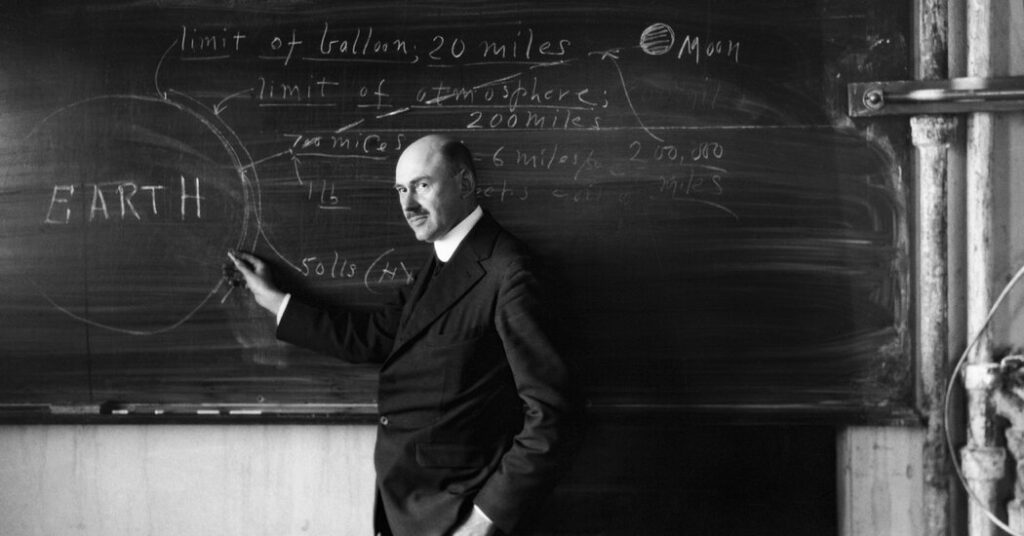
Robert Goddard arrived at his aunt’s farm in Auburn, Mass., on a cold, snowy morning 100 years ago.
The wide-open spaces of the farm became on March 16, 1926, a rudimentary Cape Canaveral for an event never witnessed before on Earth: the launch of a rocket that would become a trailblazer for vehicles capable of sending satellites, probes and even humans beyond our planet’s atmosphere.
“The Wright Brothers took us into the air,” said Kevin Schindler, a historian at Lowell Observatory in Arizona and co-author of “Robert Goddard’s Massachusetts.” “Goddard took us beyond.”
First in Spaceflight
Goddard, born on Oct. 5, 1882, in nearby Worcester, had grown up with a deep interest in science and was fascinated by the works of the science fiction authors H.G. Wells and Jules Verne. As a 17-year-old in 1899, he climbed a cherry tree and imagined developing a vehicle to travel to Mars.
From then on, he devoted his studies and work to the pursuit of rocketry, becoming a physics professor at Clark University in 1914, at age 31. Here, alongside his teaching, he started to conduct rocket experiments.
Rockets had been around for centuries, stretching back into ancient China, in the form of fireworks. However, these rockets were rudimentary, relying on “solid” rocket fuel. Such fuel, once lit, could not be extinguished.
“A solid engine is basically a stick of dynamite,” said Wendy Whitman Cobb, a professor of strategy and security studies at the School of Advanced Air and Space Studies at Air University in Alabama. “Once you light it, there’s no way of stopping it.”
Goddard and two other scientists, Konstantin Tsiolkovsky of Russia and Hermann Oberth of Germany, independently realized in the early 20th century that liquid fuels were the key to space travel. A propellant like liquid hydrogen had more oomph than solid fuels. It could also be shut off and its flow controlled, providing greater precision.
The question was, would it actually work?
Goddard faced scorn and criticism from a variety of corners, including this newspaper.
In an editorial titled “A Severe Strain on Credulity,” writers of The New York Times said that Goddard “seems to lack the knowledge ladled out daily in high schools.” Rockets, the editorial claimed, would not work in the vacuum of space with nothing to push against.
Goddard found supporters few and far between, and had earned the unwanted nickname “Moon Man.”
“It certainly bothered him,” Mr. Schindler said. “He didn’t like to be made fun of.”
Cabbage Patch
Goddard experimented with his design. He had opted for gasoline as a propellant because liquid hydrogen was unavailable. He named the rocket Nell after the main character in the play “Salvation Nell.”
The shape of his vehicle resembled the crude outline of a rocket drawn by hand. Fuel lines traced the body, allowing liquid oxygen and gasoline to combine and produce explosive thrust from the rocket’s nozzle at its top. Goddard would relocate the nozzle to the rocket’s base on future launches for stability, a design that remains favored today.
The rocket was transported in parts and then assembled near a cabbage patch on the farm by Goddard; his wife, Esther; and two assistants. So was a stand that was anchored into the ground to stabilize the rocket before it launched. Once finished, the launcher stood 10 feet tall above the frozen ground.
Goddard’s team was small in part because of some of the criticism he had received.
“Goddard worked in pretty much isolation,” Mr. Schindler said. “He had a team he worked with, but he had them sign waivers” to prevent them from sharing information.
Over the course of his life, Goddard would file more than 200 patents to protect his work.
“He was very protective of his technology,” said Chuck Agosta, a professor of physics at Clark University. “He had a lawyer come in every afternoon and notarize his pages of his lab book for that day.”
That meant it was only this handful of people who were on hand to witness the launch.
By midday, Nell had been safely installed on the launch stand. The team then began filling the gasoline tank of the rocket by hand, using a funnel, while the liquid oxygen, stored inside a vacuum-insulated flask at minus 297 degrees Fahrenheit, was poured into the oxidizer tank.
What Goes Up
Rocket launches are now routine. There were more than 300 in 2025 alone.
Today’s space launchers carry thousands of Starlink internet satellites from SpaceX; powerful space telescopes that study the early universe; probes that hurtle toward the sun and beyond Pluto; and people to and from the International Space Station and the Chinese Tiangong space outpost.
The space programs of the United States and China also plan to send humans to the moon in the coming years.
But some aspects of rockets haven’t changed much since Goddard’s day.
They are essentially still long, pointy vehicles with nozzles that direct an explosive force outward and produce thrust. While attempts have been made to reach space in other ways, including space planes and even kinetic launchers, rockets have remained ever-present.
“It’s almost like cars,” said Brian Weeden, director of civil and commercial policy at the Aerospace Corporation in Virginia. “We still have four wheels and a steering wheel. There are other options, but they’ve all largely failed. We’ve taken the Model T and largely kept the form intact.”
Yet there are key differences. The engines of today’s rockets are much more complex than anything Goddard designed. They have advanced guidance and navigation systems, and some can even land back on the ground by reigniting their engines.
“It’s evolved to be much bigger than just how do we get a rocket from here to space,” Dr. Weeden said. “We now have rockets that come back from space. We’re thinking about different technologies for launch than what Goddard had invented.”
For all the leaps and bounds in launches over the past century, modern rockets had to get off the ground somewhere.
No Countdown
With the rocket set up, all that remained to do was ignite it.
Goddard’s assistant, Henry Sachs, did this by using a blowtorch attached to a long stick. It lit an igniter at the top of the rocket and an alcohol tank at the bottom. Sachs then took shelter behind a nearby wooden barrier before Goddard turned a valve to open the fuel lines, mixing the liquid oxygen and gasoline in a combustion chamber.
There was no formal countdown.
Instead, Nell slowly burst to life, burning off excess fuel before it flew off, as Goddard described it, “at express-train speed” at about 2:30 p.m.
Esther Goddard had a camera, but it only worked for seven seconds at a time before the film needed to be replaced. The rocket did not lift off as quickly as anticipated, so the camera missed the actual launch. Footage taken before and after showed the ignition and the rocket’s smoky trail.
It climbed about 41 feet into the air, vertically at first but then tilting sideways into an arc because it had no guidance system. The vehicle crashed into a cabbage patch 184 feet away, skidding to a halt, with a total flight time of just 2.5 seconds — shorter than the first flight of the Wright Brothers in 1903.
Transformational as the event would prove to be, it received barely a mention at the time.
“Nobody was really interested,” Mr. Schindler said.
Even Goddard was “pretty low-key about it,” he added, simply recording in his diary that the launch was successful.
“The next day, maybe upon reflection, he wrote a bit more about it, and he recognized that this was a turning point in the development of rockets,” Mr. Schindler explained.
Modern Rockets
Goddard conducted three more launches from his aunt’s farm, reaching altitudes up to 90 feet while improving the fuel system of the rockets and even experimenting with parachute recovery.
The launches continued to receive little fanfare until 1929, when he was forced to move elsewhere after neighbors raised alarm about a fire caused by one of the tests.
The locals would later embrace Goddard’s work.
“You really can’t turn around in Auburn without seeing a rocket somewhere,” said Stephen Coleman, the town’s assistant manager. The high school sports team is the Rockets. The Pakachoag Golf Course, built over Goddard’s aunt’s farm, has a memorial to the location of the first launch on the ninth fairway.
With help from the aviator Charles Lindbergh, Goddard, his wife and his team relocated to Roswell, N.M. (yes, that Roswell), to continue his work. He would launch some three dozen rockets in total, with one reaching an altitude of 8,000 to 9,000 feet, until his death from throat cancer on Aug. 10, 1945.
Goddard died without receiving the acclaim most say he deserved, perhaps because he was “a little early” to the scene, said Dr. Whitman Cobb of Air University.
“Nobody really believed this was something that was doable,” she said. “Goddard is almost this thrown-away visionary.” Yet his work undoubtedly laid the foundations for most of modern space travel.
His research found other uses on Earth. Goddard worked with the military on rocket-assisted launchers for aircraft in World War II later in his life. He was also alive to witness the use of Germany’s V-2 rocket in 1942, the beginning of the use of liquid-fuel launchers in combat, a practice that continues today to devastating effect.
While Goddard never commented publicly on the use of rockets as weapons, Mr. Schindler said he would not have been surprised.
“He was always looking to continue to expand rocket development in any way possible,” he said. “He just wanted to keep being a scientist, testing and experimenting.” Military interest was another way to do that.
Goddard’s dream, however, was always for rockets to one day take humans to the stars. And principles from his patents still inform NASA’s designs to this day. In 1959, the agency named the Goddard Space Flight Center in Maryland in his honor.
Wernher von Braun, who developed the V-2 for the Nazis and later the Saturn V rocket for NASA, said that for all the crudeness of Goddard’s designs, his rockets “blazed the trail and incorporated many features used in our most modern rockets and space vehicles.”
Goddard died long before Yuri Gagarin reached space with a Soviet rocket in 1961, and it was longer still until Neil Armstrong and Buzz Aldrin would walk on the moon in 1969. Mr. Aldrin’s father studied under Goddard at Clark University, and the NASA astronaut carried a small copy of Goddard’s autobiography during his journey.
The moon mission prompted editors at The Times to address the dismissiveness of the earlier editorial writers.
“Further investigation and experimentation have confirmed the findings of Isaac Newton in the 17th century and it is now definitely established that a rocket can function in a vacuum as well as in an atmosphere,” the paper wrote on July 17, 1969, the day after Apollo 11 lifted off. “The Times regrets the error.”
The post Spaceflight Started 100 Years Ago in a Massachusetts Cabbage Patch appeared first on New York Times.