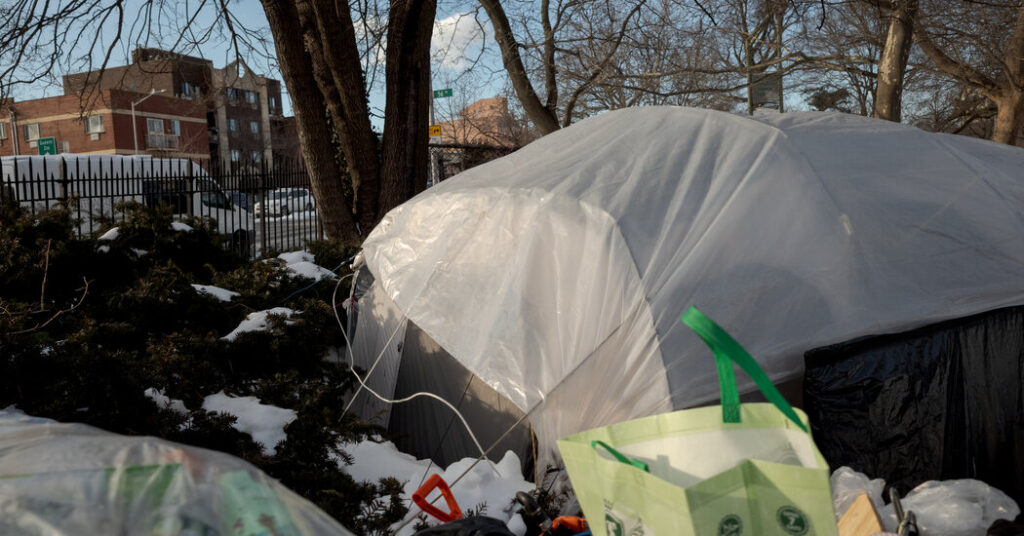
More than a quarter of New Yorkers lived in poverty in 2024, and more than 50 percent said high costs prevented them at least once that year from doing things like buying food, paying their utility bills or seeing a doctor, according to a report released on Monday on the affordability crisis in New York City.
The Poverty Tracker report, a partnership between Columbia University and the anti-poverty group Robin Hood, found that the poverty rate in New York City had inched higher for the third consecutive year, with a record 2.2 million New Yorkers living in poverty — 26 percent of the city’s population, and double the national figure of 13 percent. This comes as cuts to the federal safety net are beginning to take effect, threatening to push more people into poverty.
“I want people to understand that this is not a marginal issue; this is most of us,” said Richard R. Buery, Jr., the chief executive of Robin Hood. “This is most of the people you see on the train. At the end of the month, they don’t know if they’re going to be able to feed their families.”
That New York City had become even less affordable in 2024 was not a foregone conclusion. Inflation slowed that year, and the economic fallout from the pandemic continued to subside. But the cost of basics like housing and food rose while incomes and other resources, like public benefits, did not keep up.
New Yorkers felt it. 2024 was also the year Mayor Zohran Mamdani announced his campaign for mayor, which was laser-focused on making the city more affordable.
The Poverty Tracker is a long-term study of 3,000 households, made up of a representative sample of the New York City population. It examines poverty using a metric that takes into account variations in the cost of living across the country, which the federal poverty level calculation does not. It also explores additional vulnerabilities, like physical and mental health problems, and a metric called material hardship, which is an inability to afford basic needs like food or rent, or running out of money between paychecks.
The report found that a family of four in New York City with up to $100,000 in income, or a single adult with up to $47,000 — a group of nearly five million people — struggled almost as much those living in poverty. Thirty-four percent of them often couldn’t afford their basic needs, compared with 38 percent of New Yorkers who were considered poor.
Even those making up to $150,000 for a family of four struggled to make ends meet. Twenty-two percent of the group experienced some kind of material hardship.
“The big takeaway is that in 2024, economic hardship in New York City was the norm,” said Sophie M. Collyer, the research director at the Center on Poverty and Social Policy at Columbia University’s School of Social Work.
In addition to employment income, the research also takes into account public benefits like the Supplemental Nutrition Assistance Program, or SNAP. But the federal government, as part of the so-called One Big Beautiful Bill Act that passed last year, has limited eligibility for SNAP and cut about 20 percent of its funding, according to the report.
In order to receive their benefits, more SNAP recipients will have to work. Exemptions were eliminated for adults between the ages of 55 and 64, for example, as well as young adults who have aged out of foster care, veterans and those experiencing homelessness. More than half of working-age SNAP recipients already work, according to the Poverty Tracker, or live with a partner who does. Among those who were not working, most had a disability or were in poor health.
With those federal cuts, the report found that about 70,000 people each year are expected to slip into poverty in New York City. (Those estimates don’t take into account significant cuts to Medicaid, which were also part of the One Big Beautiful Bill Act.) It said that the city and state could help offset some of the federal cuts by creating a state-funded supplement to SNAP for certain households, expanding housing vouchers and increasing the state child tax credit.
Martina Santos, 67, who lives near Lehman College in the Bronx, volunteers regularly at the West Side Campaign Against Hunger and City Harvest, where she teaches classes on how to cook healthy, inexpensive meals. This week, she prepared salmon patties made from canned salmon, along with salad and brown rice.
Ms. Santos receives SNAP benefits, and she said even with that support, she still sometimes has to skip meals.
“I eat breakfast,” she said. “I don’t eat lunch — I drink a lot of water — so I’ve got something to eat in the evening.”
As a diabetic, Ms. Santos keeps tiny Milky Way squares around in case her blood sugar gets too low. She keeps oranges in the house when she can, but cannot always afford to buy healthy food.
Mr. Buery said the fact that so many people had to make these kinds of decisions, choosing between paying rent and buying groceries, should concern all New Yorkers.
“This is a crisis because what we’re ultimately talking about is the economic stability of the city,” Mr. Buery said. “These are not only problems for people who are on SNAP, but problems for the entire economy.”
Elizabeth A. Harris covers books and the publishing industry, reporting on industry news and examining the broader cultural impact of books. She is also an author.
The post Poverty in New York City Inched Higher in 2024 for Third Year in a Row appeared first on New York Times.