I blame Joan Rivers, the O.G. of the red carpet fashion police, who scared celebrities out of trusting their own taste, but for years there has been a predictability to Oscar-night dressing. Even beyond the standard tuxedo.
You can pretty much bet on seeing a variety of princess or mermaid gowns. A lot of ruffles, cleavage, corsets; a lot of structure in general. A lot of trains. If sitting down, or even taking normal steps, or figuring out what to do with all that material, seemed as if it might be a problem, who cared? The point was the pose.
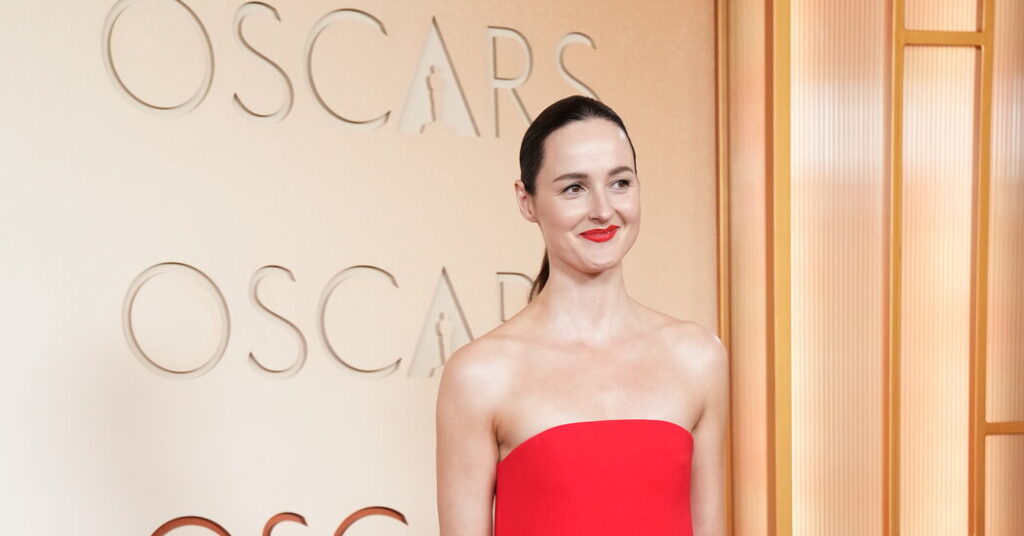
Which is why it was such a shock at the Academy Awards on Sunday night to see a group of actors subverting expectations and doing more with less. Women who looked as if they could walk, sit, clap, climb the stairs if necessary, and, even better, breathe. What an idea.
Renate Reinsve in a strapless, red Louis Vuitton column that was essentially a single piece of fabric wrapped around her body and joined at the seam on one side (where it was slit to the hip) led the way.
Then there was Wunmi Mosaku, in a free-form but form-fitting emerald green dress — also Vuitton — that stretched easily over her nine-months-pregnant stomach: less earth mother than galactic queen mother. Gwyneth Paltrow, in a white Armani Privé dress that was so minimal it didn’t seem to have any sides. And Kristen Wiig in what was essentially a very fancy beaded tank top and peasant skirt by Elie Saab.
They stood out against the retro looks of their peers, and there were, still, plenty of those. See Barbie Ferreira in a sapphire blue Gap Studio gown with a corset, a bustle and a Scarlett O’Hara vibe; Elle Fanning in Cinderella-worthy Givenchy by Sarah Burton; and Audrey Nuna in an oceanic Thom Browne skirt. Not to mention Nicole Kidman (in Chanel) and Demi Moore (in Gucci) channeling the white swan and the black swan in strapless, feathered corsets. No, they didn’t coordinate, but the sheer fact that they ended up in essentially identical silhouettes reinforces the fact they are stuck in the same old-fashioned rut.
Those dresses were indubitably striking. But they didn’t seem modern, in part because they harked back to increasingly hackneyed clichés of femininity, and in part because they didn’t seem concerned with the comfort of the person within. (At least Jessie Buckley’s graceful Chanel remake of a Grace Kelly dress from 1956 seemed to come without any internal casing.)
The red carpet has famously become a marketing initiative at which fashion brands and their well-compensated celebrity partners seize the moment of peak eyeballs to promote their wares — and themselves. You can understand the drive to stand out and go to extremes. The longest train! The tiniest waistline! The most hours of beading! The best way to show off all the work that went into your body.
Women suffering for fashion is an old trope and one that seems less and less relevant. There’s more than enough pain going around without hobbling by a skirt. Ms. Reinsve and Co. modeled a different way to dress — one that was even more elegant than ye gowns of olde because it freed them to do and move as they wanted. One that gave them agency. And, perhaps, pointed a way forward that focuses more on liberation, rather than containment or control.
Vanessa Friedman has been the fashion director and chief fashion critic for The Times since 2014.
The post It’s Nice to See (Some) Actresses Wearing Dresses They Can Breathe In appeared first on New York Times.