In seventh-grade history, the topic was Hannibal’s invasion of Italy. In science class, a teacher dropped a chalkboard eraser to demonstrate the gravitational potential of energy. Down the hall, 16 third graders fielded questions about dhikr, a form of Islamic worship using repeated phrases to glorify God.
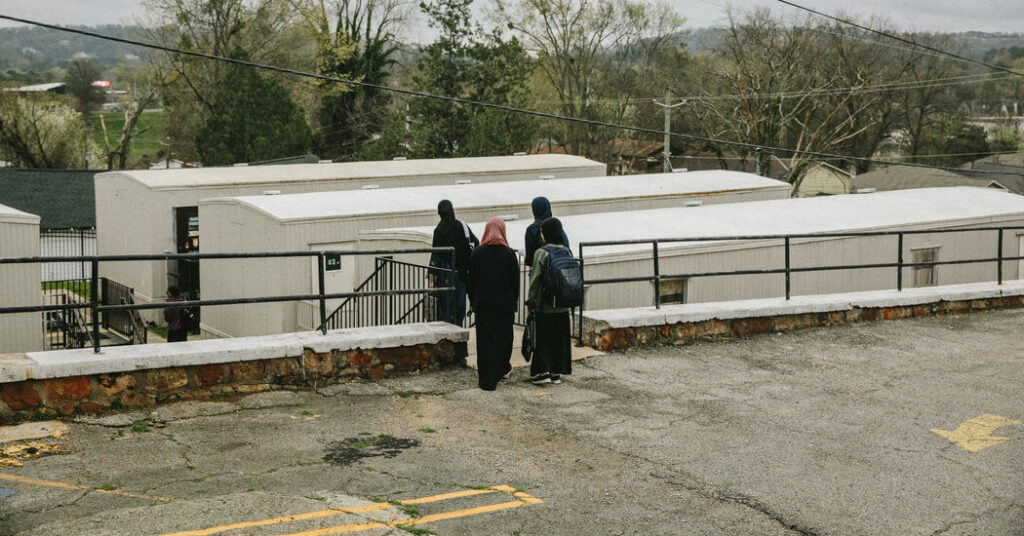
The school, the Islamic Academy of Alabama, has occupied the same small cinder block building in the Birmingham suburb of Homewood for the past three decades. It is considered one of the state’s highest-performing K-12 institutions, with graduation and college acceptance rates close to 100 percent. Located on the same campus where a school for Black children was burned down twice in the 1930s by the Ku Klux Klan, it had long gone without attracting controversy.
Until last summer, that is, when school officials found a larger building to house its 270 students, in an office park in the nearby community of Hoover.
“The response was, ‘I didn’t even know these people are here, and now they need a bigger building?’” said Bryan Dawson, a Birmingham right-wing podcast host and chief executive of the Alabama outlet 1819 News. “That’s the alarm that went off in Hoover.” Mr. Dawson helped lead a grass roots campaign against the building, and late last year Hoover city officials voted against the school’s relocation.
“The only place this ‘Islamic Academy’ should be moving is OUT OF ALABAMA,” Alabama’s senior U.S. senator, Tommy Tuberville, a Republican, chimed in on social media at the time. “Islamic Indoctrination Centers have NO PLACE in our state.”
The pushback against the Birmingham school plan reflects anti-Muslim sentiment and growing Islamophobia in conservative enclaves in America as well as among G.O.P. officials in Washington.
In Oklahoma, a proposal by Tulsa Muslims to establish an Islamic center on a 15-acre plot in nearby Broken Arrow was scuttled in January following outcry from local conservative leaders and residents. “Oklahoma needs leaders who will stand against evil,” said T.W. Shannon, a former state House speaker and now a candidate for lieutenant governor.
In Texas, the proliferation of mosques in a rapidly diversifying state was characterized last month by the Texas Family Project, a socially conservative group, as “a loud warning shot for Texans everywhere.”
In Georgia, where Muslims constitute 1.2 percent of the state’s population, a Republican candidate for lieutenant governor, Greg Dolezal, released a campaign ad this month with A.I.-generated images of jihadists invading a suburban neighborhood.
“London has fallen, Europe is under siege,” Mr. Dolezal said in a social media post alongside the ad. “In America, the invaders who would rather pillage our generosity than assimilate are roaming Minnesota, New York, and L.A. As Lt. Governor, I will fight the enemy before they’re within the gates and keep Georgia safe and sharia free.”
Representative Randy Fine, a Florida Republican who is one of the most brazenly anti-Muslim voices in Congress, said in an interview that “being afraid of Islam is not irrational.” He added, “Does that mean that all Muslims are terrorists? No. But too many of them are. The radical ones are the ones who don’t want to kill us.”
Although the recent spasm of Islamophobia on the right is hardly new, it comes as President Trump has revived his anti-Muslim rhetoric from his first term. He has referred to Somali immigrants as “garbage,” and recently said that the two Muslim Democrats serving in Congress, Representatives Ilhan Omar and Rashida Tlaib, should be sent back “from where they came.” His administration’s indefinite pause on immigrant visa processing now includes more than two dozen majority-Muslim nations.
The White House declined a request to comment for this story.
The Trump administration’s war against the overwhelmingly Shia Muslim nation of Iran could exacerbate such sentiments, said Matthew Dallek, a political historian and expert on right-wing movements at George Washington University. “As American casualties mount and the bombing campaign creates more chaos in the Middle East, this kind of anti-Muslim bias on the right is likely to intensify,” Mr. Dallek said.
At least 13 American service members have died in the first weeks of the war.
The rising tide of Islamophobia on the right has not materialized out of nowhere. Its antecedents date back to the taking of 66 American hostages at the U.S. Embassy in Tehran in 1979, the terrorist attacks of Sept. 11, 2001, and, a decade later, the nativist underbelly of the Tea Party movement.
The sentiments also coincide with Muslim populations moving into even the reddest of states, “which has helped generate the view that immigration is bad and that immigrants are to be feared,” said Mustafa Akyol, a senior fellow on Islam at the libertarian Cato Institute.
Republican politicians hoping to unify Mr. Trump’s base, which has been convulsed with bitter infighting over Israel, the release of the Epstein files and the administration’s economic policies, have pushed the incendiary rhetoric against American Muslims. The rhetoric is in contrast to former President George W. Bush’s efforts after the Sept. 11 attacks by Islamic extremists to distinguish between religion — “Islam is peace,” he said at the time — and terrorists who he said were “traitors to their faith.’’
Times have changed. “Whipping up anger against the Muslim world is a useful foil in this moment,” Mr. Dallek said. “It enables all of the factions on the right that are beginning to splinter to come together and remind one another why they were allies to begin with.”
In recent weeks, prominent conservatives have taken to the airwaves and social media to attack Muslims with undisguised bigotry. “Muslims do not assimilate,” Katie Miller, the podcaster and wife of Stephen Miller, the architect of Mr. Trump’s restrictive immigration policy, declared on social media in December. “They aggregate, infiltrate, & conquer.”
“You can never trust an Arab,” Laura Loomer, the right-wing media personality, said on social media in January. On at least three occasions this month, Ms. Loomer has written on X, “Deport all Muslims from America.”
Representative Andy Ogles, Republican of Tennessee, posted online last week, “Muslims don’t belong in American society.”
Mr. Tuberville followed his attack on the Islamic Academy of Alabama with a more sweeping broadside later in December. “Islam is not a religion,” he wrote on social media. “It’s a cult.” Commenting on a photograph of Ghazala Hashmi, Virginia’s newly elected lieutenant governor, taking her oath of office with her hand on the Quran, Mr. Tuberville wrote, “The enemy is inside the gates.”
He repeated the same line last week in reference to an image of Mayor Zohran Mamdani of New York, which Mr. Tuberville posted on X alongside a photograph of the World Trade Center in flames on Sept. 11.
Mr. Tuberville declined to be interviewed for this article. Instead, a spokeswoman referred to remarks Mr. Tuberville made on the Senate floor on March 5 in which he described Islam as “a political ideology that encourages Muslims to kill all infidels — in simple terms, that means Americans and Christians.”
Senator Chris Van Hollen, Democrat of Maryland, called Mr. Tuberville’s attacks against American Muslims a “vile” new development. “Bigots like Tuberville are trying to launch a religious war against American Muslims under the guise of protecting Western civilization,” Mr. Van Hollen said in an interview. “The KKK used the same Christian nationalist pretensions to go after Black Americans. This is a modern-day KKK.”
Baffled Students
In interviews, faculty and students at the Islamic Academy of Alabama expressed bafflement that Mr. Tuberville would denounce the school without having first visited it. “How would he even know who we are or what we do?” said Felicity LeFevre, a second-grade teacher. “My students don’t even know what an infidel is.”
“We’re just normal students who want to learn,” said Nooran, 17, the school’s valedictorian, who asked that her last name not be used for fear of inviting attacks on social media. When asked how Mr. Tuberville’s comments about Islam made her feel, she replied, “Can I skip this question?”
“The two biggest fallacies that have been used against us,” said Stacy Abdein, the institute’s acting principal, “is that we’re teaching Shariah law and teaching our students to kill all infidels, and both of those are blatantly untrue.”
Still, such fears about Islam persist among conservatives. The conservative influencer Allie Beth Stuckey said on social media in October that the greatest concern among her 840,000 Instagram followers is by far “the growing influence of Islam.”
Similarly, the conservative youth activist group Turning Point USA polled its members in December and cited “radical Islam” as the nation’s pre-eminent threat. That same month, conservative Republicans in Congress formed the Sharia Free America Caucus. Its membership includes around 45 House Republicans, among them the majority whip Tom Emmer.
The caucus has stated as its aim “to counter the alarming rise” of Shariah in the United States, although members have offered no data demonstrating such an uptick. “It’s kind of a ridiculous paranoia to think that this immigrant group representing less than two percent of the population is somehow going to take over and impose Shariah law,” said Ilya Somin, a professor of law at George Mason University.
Conservative leaders have countered by saying that such a takeover has already occurred in Europe. As Representative Chip Roy of Texas said in February, “We’re not going to let Dallas or Houston or any other city in this great country become what has happened to London and to Paris.” While some Shariah councils exist in France and Britain, they function primarily to resolve civic conflicts in Muslim communities and possess no statutory authority.
“The European country with the largest Islamic minority is Bulgaria,” said Mr. Akyol. “But you never hear anyone say there’s an Islamic problem in Bulgaria, because they’ve been living there for more than five centuries, going back to the Ottoman Empire. Like the Italians and the Irish in America, they integrated into society over time. It’s happening here with Muslims, too. I see it as a success story.”
Despite Mr. Trump’s anti-Muslim rhetoric, Mr. Akyol said that “we’ve seen him make friends with Muslims.” Those friendly relationships include the Saudi royal family — the Trump family has shattered presidential ethics norms with multibillion-dollar business deals in Saudi Arabia — and Mr. Mamdani.
The president has not used these alliances to promote a more Muslim-friendly outlook among the right. “I vividly remember when George W. Bush after 9/11 went to the mosque in Washington to make the point that here in the U.S. we respect different faiths and we’re all in this together against those who wish to hijack Islam for terroristic purposes,” Mr. Van Hollen said. “Today, you’ve just got deafening silence from Trump and the rest of the Republican leadership.”
The closest thing on the right to a Muslim advocate has been Tucker Carlson, the conservative media personality and close ally to Mr. Trump. Speaking before a large audience at Turning Point USA’s America Fest in December, Mr. Carlson described Muslims as “mostly good” and anti-Islamic sentiment as “evil.” The crowd responded with scant applause.
“Anybody who bows before God five times a day is probably not my main enemy,” Mr. Carlson said in an interview. “These are not the people responsible for thousands of Americans living without homes, addicted to drugs and drawn into prostitution.”
“I fully expect Tucker Carlson to be the next ayatollah,” said Mr. Fine, the Florida congressman.
‘Don’t Dearborn My Birmingham’
Back in Birmingham at the Islamic Academy of Alabama, school officials have vowed to continue searching for a new location for the academy. For now, at least some students seem content to carry on their coursework where they are. “Personally, I like being on a historic campus that was burned down by the KKK,” said Yusuf Nabi, 16, the president of the school’s student council. “It feels more special than going to school in some new office building.”
But the school’s future remains uncertain. Mr. Tuberville, who said on a radio podcast in December that the school “doesn’t need to be here’’ and “we don’t want people changing us,’’ is considered the odds-on favorite to be elected the state’s governor in November.
Mr. Dawson, the right-wing podcaster who campaigned against the school — including by circulating “Don’t Dearborn My Birmingham” bumper stickers that made reference to the majority-Arab city in Michigan — applauded Mr. Tuberville’s views. “There’s not another senator in the U.S. that cares more about his people, which is why he’s going to be the next governor,” he said.
For his part, Mr. Dawson vowed that his news outlet would continue to keep an eye on the school. Asked if he would ever consider visiting it to gain a better sense of its activities, Mr. Dawson responded, “No, I don’t have any desire to do that.” He added: “We’re watching the West being absolutely annihilated right now. I’ve seen everything I need to know.”
Robert Draper is based in Washington and writes about domestic politics. He is the author of several books and has been a journalist for three decades.
The post ‘It Doesn’t Need to Be Here’: The Right Vilifies a Muslim School in Alabama appeared first on New York Times.