It seemed as if it was going to be a historically close Oscar night. It turned out to be something of a runaway — but a runaway that crowned a clear champion but left the runner-up feeling pretty good, too.
It might not have been a great Oscar show, with plenty of awkward moments and a trigger-happy approach to playing winners offstage. But in many ways, it was a richly satisfying one in the choices that voters made, which honored great and underappreciated filmmakers and spread the wealth just enough that fans of “One Battle After Another,” “Sinners,” “Hamnet,” “KPop Demon Hunters,” “Frankenstein,” “Sentimental Value” and others could all be happy.
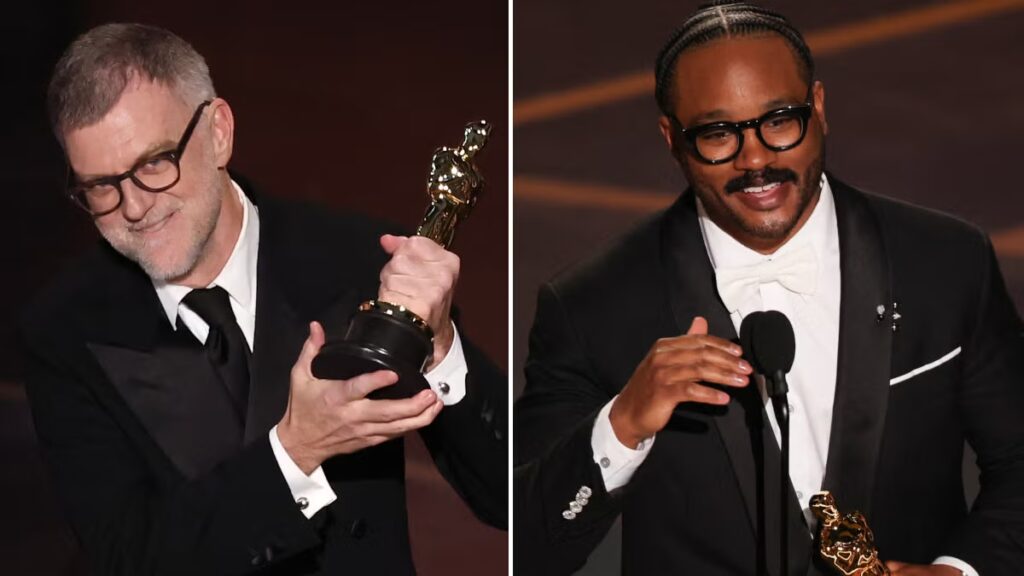
The main message sent by the 98th Oscars was that the Academy finally decided it was time to recognize Paul Thomas Anderson. After going 0-for-11 in previous Oscar nominations for his first nine movies, PTA barreled through Sunday’s show with his freewheeling drama about a couple of generations of revolutionaries winning one award after another.
The key came an hour into the show, when the first-ever Oscar for casting went not to the favorite in the category, “Sinners,” but to longtime PTA collaborator Cassandra Kulukundis for “One Battle.” It wasn’t the first of the record 11 categories in which those two films went head-to-head (that was Best Supporting Actress, in which the nominees from both films lost to Amy Madigan), but it was a significant moment that “One Battle” might have had the upper hand in the showdown between the two frontrunners.
Twenty minutes later, Sean Penn’s victory over Delroy Lindo in the Best Supporting Actor category was another big step for “One Battle,” and the momentum began to seem inexorable – though when “Sinners” cinematographer Autumn Durald Akapaw became the first woman to ever win in her category, it was possible to feel a bit of suspense creep back into the ceremony.
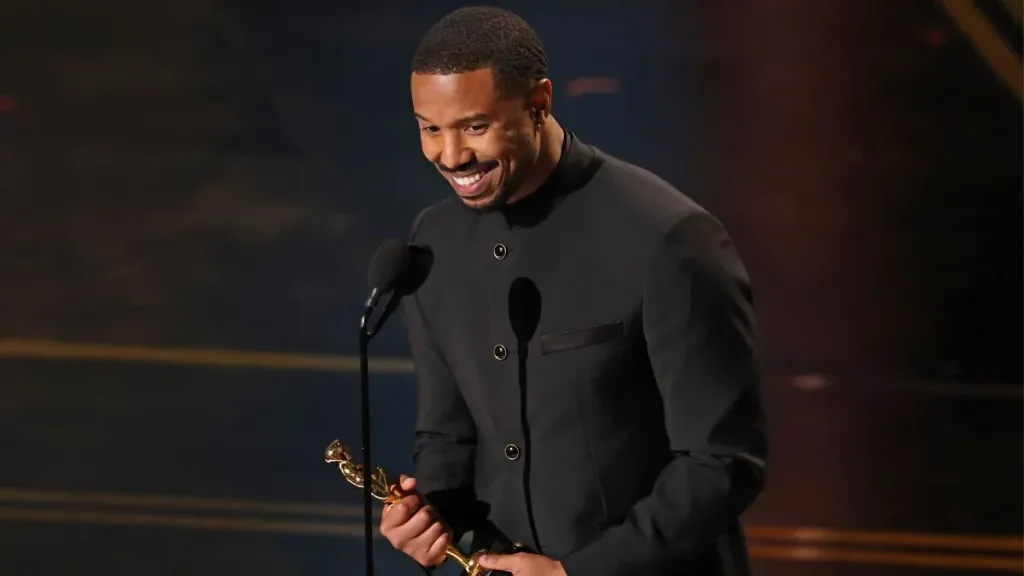
That suspense mostly dissipated when Anderson won for Best Director to go with the award he’d already won for his adapted screenplay — but before he got a chance to win his third award and give his third speech at the end of the night, “Sinners” star Michael B. Jordan got one of the most emotional moments of the ceremony when he won Best Actor, which gave “Sinners” three clear highlights after the previous wins for Coogler’s original screenplay and Autumn David Arkapaw’s cinematography, which made her the first woman ever to win in the category.
The wins for “One Battle” were a sign that maybe precedent does matter after all. After years in which the expanded and international Oscar voters consistently made choices that went against all the time-honored rules of what can and cannot win, this Oscars went back to the old truths, and suggested that if a movie wins all the things it’s supposed to win along the road to Oscar, it is indeed going to win Best Picture.
That’s what “One Battle” did. It won the most important precursor awards, the Directors Guild Award and the Producers Guild Award, along with a whole bunch of others. And then it shrugged off losing to “Sinners” at the Actor Awards, a loss that in many circles caused a massive shift in prediction that Coogler’s film would be the big winner.
But if “Sinners” had the kind of late surge that was indicated at the Actor Awards, it wasn’t enough in a year where Oscar voters may have finally decided that the 12th time was the charm for PTA. “You make a guy work hard for one of these,” he said when he won his second award.
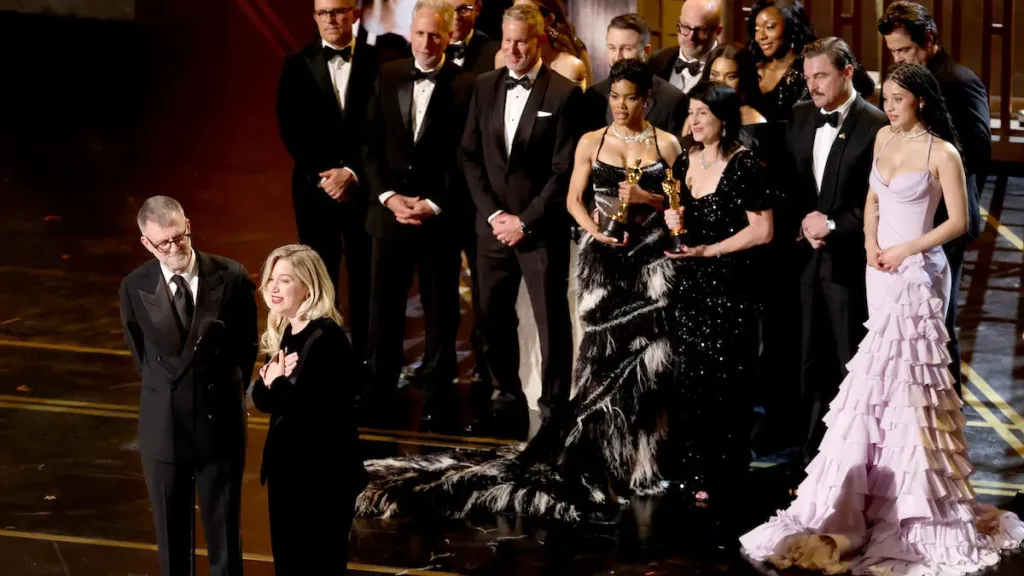
Warner Bros., which released both “One Battle” and “Sinners,” studiously avoided playing favorites, and the four awards won by the latter film were all so significant that it’s hard to view the results as a disappointment for Camp Coogler.
Meanwhile, “Sentimental Value” and “Hamnet” only won a single award each, but their categories — Best International Feature Film and Best Actress — were so significant that it’s hard to feel as if the films were slighted. And while Guillermo del Toro’s “Frankenstein” didn’t cash in its above-the-line nominations, it cleaned up in three crafts categories, as it should.
So the show had a tie, a landmark Oscar to a female cinematographer, a nicely varied slate of winners, a few barbed political speeches, a no-show winner who became the butt of a joke and a couple of overdue auteurs taking home statuettes. Plenty of qualms aside, that’s pretty much what you want from an Oscar show.
And then there was the beautifully moving and super-sized In Memoriam sequence, which reacted to a year of enormous losses in the only way you could – by giving it the time, the words and the images it deserved, from the line of people paying tribute to Rob Reiner to the appropriately tremulous voice of Barbra Streisand singing “The Way We Were.”
Looking back at the end of a strong year for cinema (artistically if not financially), this show wasn’t a bad way to sum up the way we were.
The post Is Everybody Happy? ‘One Battle After Another,’ ‘Sinners’ Trade Awards at Satisfying Oscars appeared first on TheWrap.