A series of economic shocks splintered officials at the Federal Reserve last year and led to some of the most divisive votes on interest rates in the recent past. President Trump’s tariffs and immigration restrictions rekindled concerns about both inflation and the labor market, sparking a debate inside the central bank about which of the two to prioritize.
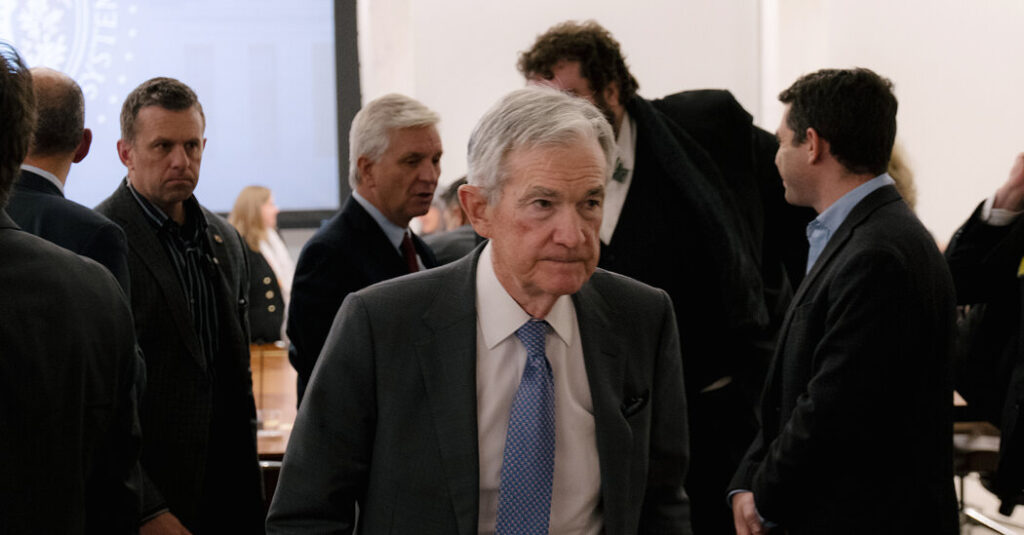
A new shock stemming from the war in Iran now threatens to entrench officials in their previous postures. Sharper divisions risk compounding the challenge of reaching a consensus not only for Jerome H. Powell in his remaining months as Fed chair, but also for Kevin M. Warsh, who is set to succeed him. If confirmed by the Senate, Mr. Warsh will assume the top job amid heightened fears about the central bank’s ability to fend off pressure from the White House to substantially lower borrowing costs.
Oil prices have surged in the nearly three weeks since the United States and Israel first struck Iran, despite steps taken to address a shortfall that is rapidly accumulating as the conflict drags on. Americans are already facing higher costs. Gasoline now retails for an average of nearly $3.70 a gallon across the country, about 70 cents more than it was a month ago.
Much depends on the trajectory of oil prices from their current $103 per barrel level and how long the conflict lasts. But the sizable nature of the shock has already upended forecasts about the economy.
Inside the Fed, the cohort of policymakers who were primarily concerned about inflation, and the slow pace at which it was returning to the Fed’s 2 percent target, are now having to contend with another potent source of price pressures. Those mainly concerned about a softening labor market are having to assess how big a strain there will be on hiring and consumer spending.
“Both sides are going to be able to say that this makes the situation worse, and they’re both going to be right,” said Eric Rosengren, the former president of the Federal Reserve Bank of Boston. “Reported inflation is likely to be higher and reported labor market conditions are likely to be weaker.”
‘No Risk-Free Paths’
Just six months ago, Mr. Powell did not mince words about the bind the central bank was in.
“There are no risk-free paths now,” Mr. Powell told reporters in September after the Fed opted to deliver the first of three consecutive quarter-point rate cuts. “It’s not incredibly obvious what to do.”
At the time, the Fed chair was talking about the dilemma its officials faced after the implementation of sweeping tariffs on nearly all of the country’s trading partners and Mr. Trump’s efforts to sharply shrink the immigrant population through mass deportations. Throughout 2025, inflation moved away from the Fed’s 2 percent target, and the labor market softened even as growth stayed sturdy.
Mr. Powell is likely to invoke a similar message when he speaks this week after the Fed wraps up its next meeting on Wednesday. Officials are widely expected to hold rates steady at a range of 3.5 percent to 3.75 percent, extending a pause that began in January. Most officials believe rates at this level are only modestly restraining growth, if at all, suggesting little rush to change course for the time being.
That approach is directly at odds with what Mr. Trump wants. Days before the Fed’s gathering, the president called on Mr. Powell for a rare inter-meeting move, something the central bank has not done since the onset of the pandemic when financial markets seized up.
The Fed’s standard models advise officials to look through energy shocks, owing to their volatile nature and the fact that price increases of this sort tend to have minimal effect on the underlying inflation measures that the central bank most closely monitors.
Some economists, like David Seif at Nomura, say this is exactly the playbook that policymakers should follow today. Mr. Seif said it would take a much more substantial rise in oil prices — to around $120 per barrel — and for that level to be maintained for an extended period to shift his thinking around the Fed’s policy settings. He has so far left his call unchanged for the central bank to cut rates again in June and September, coinciding with the scheduled start of Mr. Warsh’s tenure as chair.
But for other economists, soaring energy prices have complicated the Fed’s policy options, at least to some degree. Now, traders in federal funds futures markets see no cuts in 2026, having penciled in two in the latter half of the year before the war.
Few economists argue that there is a need for the Fed to raise rates in order to quell emergent price pressures. There is broad recognition that oil price spikes tend to weigh on consumer spending as Americans are forced to offset higher expenses tied to filling up their cars. The labor market is also far more fragile than it was in the aftermath of the pandemic, the last time that a series of supply shocks contributed to skyrocketing inflation and forced the Fed to aggressively raise rates.
“The price increases you saw during the pandemic were accompanied by not only a supply shock, but a pretty tight labor market,” said Patricia Zobel, the head of macroeconomic research and market strategy at Guggenheim Investments and a former senior staffer at the Federal Reserve Bank of New York. “That’s not a situation that we have right now.”
Even so, Ms. Zobel said the Fed was likely to hold rates steady for some time, as officials await clearer signs that inflation is in retreat.
Officials will be more motivated to cut rates again if the labor market starts to more noticeably weaken. Successive months of negative jobs growth, like February’s jobs report showed, coupled with rising unemployment would generate much broader-based support for cuts. Barring that, some policymakers may struggle to see the urgency and opt instead to stand pat for longer.
“You’ve got so much uncertainty, and you’ve got these cross currents that basically point in different directions in terms of the appropriate stance for monetary policy, so there’s a really good case for sitting tight and waiting to see what the dominant forces are in terms of the labor market and inflation,” said Karen Dynan, a professor at Harvard who was the chief economist at the Treasury Department during the Obama administration.
Fed Credibility
The stakes for the Fed are exceedingly high now that it has been roughly five years since officials met their 2 percent inflation target. That has left many policymakers, both current and former, uneasy about being too cavalier when it comes to dismissing inflation risks stemming from the ongoing conflict.
For Loretta Mester, who served as president of the Cleveland Fed for a decade ending in 2024, her top concern centers on inflation expectations. Short-term measures have whipped around in recent years as inflation has fluctuated. Medium- and longer-term market-based gauges have stayed broadly flat, suggesting that investors have not lost faith in the Fed’s ability to eventually achieve its goal.
Ms. Mester warned against being “complacent” about that stability, reflecting in part her worries that companies may more readily pass along price increases to their customers now that they are facing squeezed margins because of tariffs. She also questioned just how significantly an oil price shock would dent demand given the United States is now a net exporter of oil.
“Inflation expectations are not as anchored as they were before the pandemic,” she said. “Because they’re not as anchored, a shock like this, especially one that affects gasoline prices, could mean we might see more of a rise, and that’s just going to make the Fed’s job harder.”
Angst around inflation expectations has also intensified as the end of Mr. Powell’s tenure as chair draws nearer. In his final year, Mr. Powell has been subject to a litany of attacks from the White House over his refusal to cow to Mr. Trump’s demands for lower rates. What began as personal insults quickly morphed into threats of removal and, most recently, a criminal investigation by the Justice Department.
A judge on Friday sought to thwart that investigation and quashed subpoenas issued to the Fed by federal prosecutors. But Jeanine Pirro, the U.S. attorney for the District of Columbia, has already vowed to appeal the matter, a threat that risks delaying Mr. Warsh’s ascension to chair.
Mr. Warsh will face an uphill battle to establish his credibility once he takes over in light of Mr. Trump’s insistence that he would only select someone who supported lower rates. That credibility, in turn, will be crucial to ensuring that inflation expectations do not become unmoored.
Mr. Rosengren warned that every time the Fed pushes out its forecast for when it will reach its inflation goal, it raises the risk that at some point people may start to lose confidence in the central bank’s willingness to do so.
“That’s particularly true at a time of transition,” said Mr. Rosengren. “We’ll have to see exactly how strongly the new chair is going to feel about getting down to 2 percent in a relatively short period of time.”
Colby Smith covers the Federal Reserve and the U.S. economy for The Times.
The post Iran War Risks Sharpening Fed Divisions Over Rate Cuts appeared first on New York Times.