Mojtaba Khamenei’s ascension as Iran’s new supreme leader might have appeared straightforward, even predestined. In fact, it was neither.
His rise came only after a full-on war of succession. The high-stakes process became the Islamic Republic’s version of “Game of Thrones”: an empty throne; a council of clerics; and two dynasties — Khamenei and Khomeini — competing. Political figures vied, military commanders defended their realms, and a former spy master known for plotting assassinations weighed in.
Even in the best of times, the task of finding Iran’s third Supreme Leader — the man who would not only represent God on earth, but wield authority over politics and the armed forces — would have been challenging. Ayatollah Ali Khamenei, after all, had ruled since 1989, through decades of tumult in the country.
But during a war with the United States and Israel, as bombs dropped from the sky and explosions rocked the earth, the selection of a successor with a lifetime appointment became a full-on test of whether the theocracy could survive.
This recounting of the inner deliberations, power plays and rivalries that thrust the ayatollah’s reclusive 56-year-old son into the leadership role is based on interviews with five senior Iranian officials, two clerics, two Iranians affiliated with the supreme leader’s office and three members of the Islamic Revolutionary Guards Corps with knowledge of the selection process. They all asked for anonymity because they were not authorized to speak publicly about internal government deliberations.
By all accounts, Mr. Khamenei most likely would not have risen if his father had died a natural death. Ayatollah Khamenei had given his close advisers three names as potential successors. His son was not among them.
Secret Meetings
On March 3, the Assembly of Experts, 88 senior clerics constitutionally in charge of appointing a supreme leader, held a virtual secret meeting to begin a process that would end when one of the candidates achieved a two-thirds majority. Earlier that day, Israel had bombed the assembly’s headquarters in the city of Qum, where many of the clerics lived and taught at Shia seminaries, killing some of its administrative staff.
Since Ayatollah Khamenei was killed on Feb. 28, in airstrikes on the first day of the war, rival political factions and Guards Corps generals had been scheming to elevate their candidates and secure their own power bases, senior officials, clerics and Guards members said in interviews.
The hard-liners preferred defiance against the internal and external calls for regime change. They wanted continuity, and a doubling down on the ayatollah’s domestic and foreign policies. The moderate faction argued for a new face, a new style of governance and an end to hostilities with the United States.
Mr. Khamenei had powerful allies backing him: The Revolutionary Guards and their newly appointed commander in chief, Gen. Ahmad Vahidi; Gen. Mohammad Ali Aziz Jaffari, a Guards strategist in the current war; and Gen. Mohammad Bagher Ghalibaf, the speaker of the Parliament and a former commander of the Guards. Hossein Taeb, the former head of the Guards intelligence unit and the mastermind of cross-border assassination plots, was also in his camp.
Opposition to Mr. Khamenei surfaced from unexpected corners. Ali Larijani, the head of Iran’s National Security Council and currently the de facto ruler of Iran, told some members of the Assembly of Experts that he believed the country needed a moderate and unifying leader, and that Mr. Khamenei would be a polarizing figure. President Masoud Pezeshkian, a moderate, and several senior officials and clerics also joined the naysayers, according to the senior officials, clerics and Guards members.
The moderate camp was pushing two potential candidates: a former president, Hassan Rouhani, somewhat sidelined but a centrist who had presided over the negotiations leading to the 2015 nuclear deal with the United States; and Hassan Khomeini, the grandson of the founding father of the theocracy, Ayatollah Ruhollah Khomeini. Hassan Khomeini is aligned with the reformist political parties. The moderates also put forth Alireza Aarafi, a scholar and jurist, as a compromise choice: a candidate with solid religious credentials but no sway in policy or military circles, making him easy to manage.
As the assembly debated and discussed the top candidates, officials said, rage against President Trump and the Israeli prime minister, Benjamin Netanyahu, fueled a determination to remain defiant that undermined the moderates’ efforts. As the discussion evolved, the members of the assembly appeared less interested in a leader to rescue the country from its current state of acute crisis than in a reincarnation of their “martyred” leader to avenge his death, senior officials said.
“We were looking at seven criteria for picking a candidate,” Ayatollah Mahmoud Rajabi, a member of the assembly’s board of directors, said in an interview with state television. “Some had very strong social and political vision, another one had more religious credentials, another had strong management, one in wisdom.” He said the assembly tried to meet five or six times in person, but the sessions were canceled for security reasons.
In an initial round of voting on March 3, Mojtaba Khamenei obtained the necessary two-thirds majority, signaling that the Guards Corps generals had gained the upper hand. The Assembly of Experts notified government officials, who in turn, alerted state media to prepare for announcing Mr. Khamenei’s succession with the dawn call to prayer on March 4.
But that was just the beginning.
Power Plays
Mr. Larijani called off the announcement of Mr. Khamenei’s ascension, saying it would be a risk to his life, as President Trump and Israel’s minister of defense, Israel Katz, had threatened to eliminate any successor. He suggested waiting until after the war ended.
On March 6, Israel carried through with the threat, dropping bunker busting bombs on the supreme leader’s compound in downtown Tehran, reducing it to a pile of rubble. But Mr. Khamenei was not there.
The halting of the announcement provided the moderate camp an opportunity to mount a last-ditch effort to pressure the Assembly of Experts to reconsider. But forcing a new election required solid reasons.
Mr. Larijani, a close confidant of the elder Ayatollah Khamenei, argued that the virtual vote for Mr. Khamenei was invalid because the Constitution mandates that assembly members vote in person. Then the assembly was informed that Mr. Khamenei, who was recovering from wounds sustained in the airstrikes on Day One of the war, did not even want the job. For security reasons, communicating directly with Mr. Khamenei was impossible.
But others said his refusing the position was only a formality.
“When they told Mojtaba he was elected, he said, ‘I don’t want to accept it, pick someone else,’” Abdolreza Davari, a politician who is close to Mr. Khamenei, said in a telephone interview from Tehran. “It’s a Shia custom of polite refusal among clerics to say ‘I’m not after power,’ but then they eventually accept.”
The members of the moderate camp then told the assembly that they had uncovered a new and important directive from Ayatollah Khamenei and requested an in-person meeting with the leadership board of the assembly, the senior officials and clerics said.
At the meeting, two of Ayatollah Khamenei’s closest aides, one a top military adviser and the other, Asghar Hejazi, his chief of staff, testified that Mr. Khamenei had told them he did not want his son or any member of his family to succeed him.
They said he had banned hereditary succession because it would violate the essence of the 1979 Islamic revolution that toppled monarchical rule. Then they presented a written will with the same overall message and urged the assembly to rescind its initial vote.
The last-minute effort to undo the assembly’s decision stunned the clerics present at the meeting, according to the officials and clerics. They asked for time to consult with the wider membership. It also alarmed the Guards generals pushing for Mr. Khamenei, who then set in motion a counteroffensive.
In a speech posted on video, Ayatollah Ali Moalemi, one of the assembly’s members, denounced the moderates’ efforts as akin to a “coup.”
“There were efforts to change the minds of the assembly members and drag us in another direction,” said Ayatollah Moalemi. “There were hands from outside the assembly with the intention to infiltrate and influence us.”
The Generals
On March 7, President Pezeshkian announced that Iran would stop attacking Arab nations in the Persian Gulf and apologized. He said the decision to de-escalate with Arab neighbors came from the three-person transition council, of which he was a member, filling in for the supreme leader until a new one was elected.
The Revolutionary Guards generals running the war and backing Mr. Khamenei were outraged, according to the Iranian officials and the three Guards members. General Vahidi, the Guards commander in chief, and General Aziz Jaffari pushed the Assembly of Experts to convene immediately for a final vote and to announce Mr. Khamenei as the new leader.
Mr. Taeb, the Guards’ former spy chief, called all 88 members of the Assembly and urged them to vote for Mr. Khamenei. He said voting for the ayatollah’s son was a moral, religious and ideological duty, according to the Iranian officials and the two clerics.
The Assembly met again on March 8, also virtually, and debated the issues raised by the moderates. Some said they should honor Ayatollah Khamenei’s wishes and cast aside his son. Others argued the Constitution did not require them to make choices based on a predecessor’s will, and that they had the authority to decide independently. Everyone agreed that wartime protocols allowed for a virtual vote to count as legitimate.
Each cleric wrote a name on a piece of paper, folded it into an envelope and sealed it with wax. Couriers then hand-carried the ballots to a committee in charge of counting and validating the votes.
Mr. Khamenei received 59 out of 88 votes, a clear two-thirds majority but still far from unanimous. Shortly before midnight, state media announced that Iran had a new supreme leader. Statements of congratulations and pledges of loyalty to Mojtaba Khamenei flowed, even from people who had tried to derail his rise.
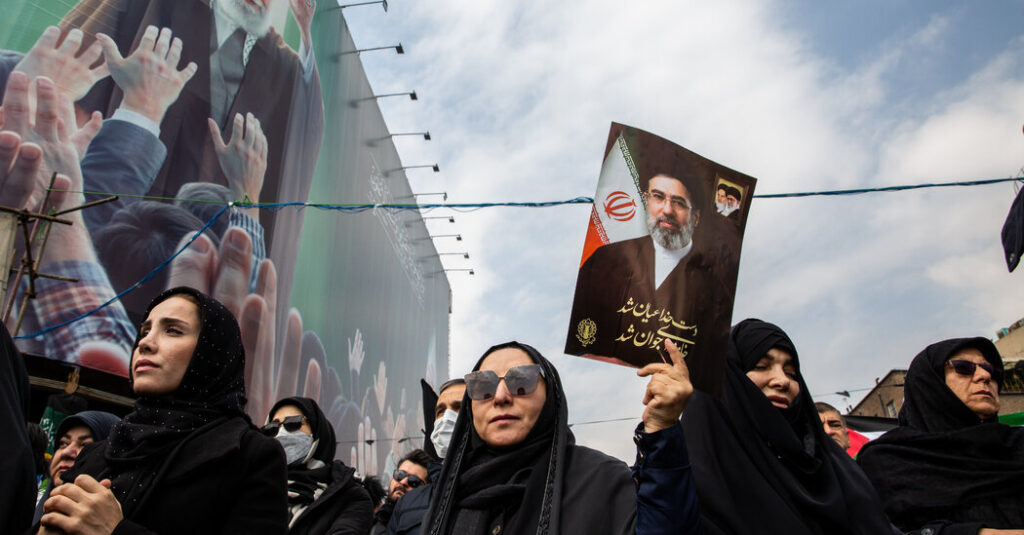
And, at least publicly, Iran’s establishment closed ranks behind the new supreme leader, who has yet to be seen in public.
Farnaz Fassihi is the United Nations bureau chief for The Times, leading coverage of the organization. She also covers Iran and has written about conflict in the Middle East for 15 years.
The post Intrigue, Power Plays and Rivalries: Inside the Rise of Mojtaba Khamenei appeared first on New York Times.