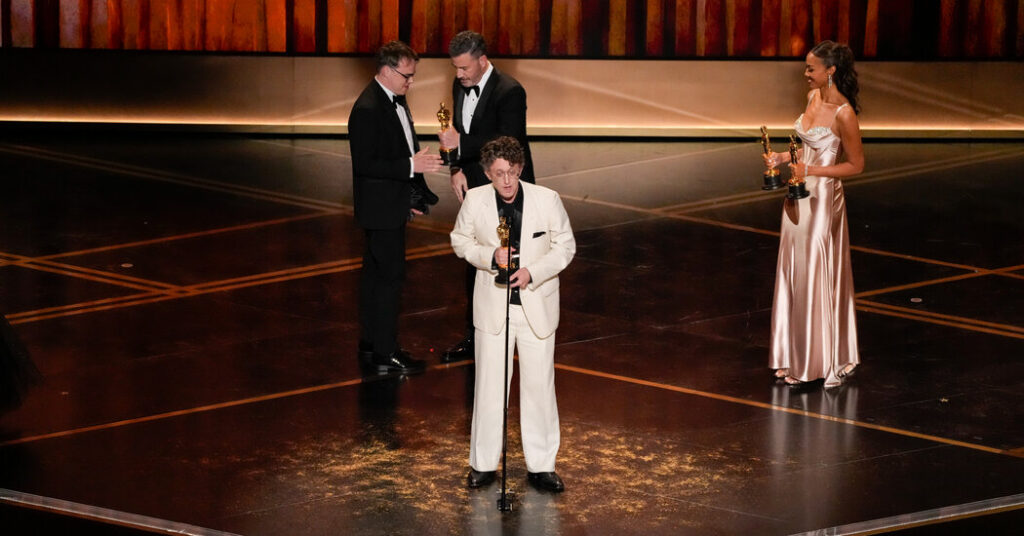
The makers of the film “Mr. Nobody Against Putin,” which won the Oscar for best documentary feature on Sunday, navigated an ethical minefield to expose the military indoctrination that President Vladimir V. Putin has imposed on Russian schools after invading Ukraine.
They wanted to reveal, through the eyes of Pavel Talankin, the coordinator of extracurricular activities at School No. 1 in Karabash, a small Russian industrial town, how students were being flooded with a wave of state-mandated propaganda.
Among the questions they grappled with: Could footage that Mr. Talankin was being asked to record by the school as proof of compliance with the education authorities be used? What about footage of children in their classroom without prior consent from parents? Would the entire project get Mr. Talankin jailed or killed, or bring harm to one of the students?
The American documentary filmmaker David Borenstein, who worked with Mr. Talankin from outside Russia to put together the film, weighed all of this when he was deciding whether to take on the project.
Distraught by the wartime indoctrination he was being forced to record at the school he loved, Mr. Talankin had replied to an open call by a Russian studio for stories about how the war had changed relationships at work. The studio, knowing that the story would be too dangerous for Russian filmmakers to pursue, connected Mr. Talankin with Mr. Borenstein, who brought it to the BBC.
“It was the weirdest pitch ever because I was pitching the film, but at the same time I was saying, ‘But I’m not sure we should do this. It’s an ethical minefield. It’s a logistical minefield.’ It felt very daunting,” Mr. Borenstein said last year during a panel discussion after a screening in Berlin.
The BBC helped the team set ground rules for the production.
Up front, the team mandated that Mr. Talankin ultimately leave Russia for safety reasons, Mr. Borenstein said. The network also said that no one in the film who was remaining in Karabash could be shown saying anything against the Russian state or the war that would endanger them, he added. The team also had to consider the safety of Mr. Talankin’s mother, a librarian at the same school, who has remained in the town.
In the end, Mr. Borenstein said the BBC went frame by frame to cut out anything that could jeopardize the safety of people still in Karabash. An unavoidable byproduct of the editing, Mr. Borenstein said, was a diminishing of the voices of those in the town who agreed with Mr. Talankin. On the question of consent, Mr. Borenstein said, the filmmakers made sure that no one under the age of 18 had any primary speaking role in the film, and they ensured that any other children were depicted in groups.
Everyone who became a primary “character” in the film was an adult at the time of its release, Mr. Borenstein noted, declining to say whether Mr. Talankin had their consent.
Despite those precautions, the film has faced a wave of criticism from some Russians, including those who have also fled Russia and opposed the war.
Some have objected to the way the film presents what is happening in Russia through a Western lens crafted for the documentary circuit. Others have said that some scenes feel hyped or staged to present Mr. Talankin as an against-all-odds hero. Still others have hit out at the filming of children without parental consent.
“It must be acknowledged that collecting material in this way, using personal trust, and then showing it to the Western public without any approval is a moral monstrosity,” Sergei Chernyshov, a Russian education expert in exile, wrote in The Moscow Times.
Supporters of the film and some of Mr. Talankin’s former students have disagreed, arguing that applying that standard would mean that the truth will simply go unexposed.
And the truth is shocking: students competing in grenade-throwing competitions, trying on tactical gear and holding guns, getting lectured by war mercenaries and being told by trusted teachers all manner of lies about Ukraine and the West.
“Regarding filming without permission, it’s a complicated question, because it raises another question: How else can you make a documentary film in this political regime?” one of Mr. Talankin’s former students, who is now 22 years old, wrote on Monday to The New York Times, speaking anonymously to avoid retribution in Russia. The student said there was no way to make the movie if permission was required.
Mr. Talankin, the “Mr. Nobody” of the movie’s title, told The Times in interviews in December and January that as he began making the compliance videos for the school, he started to realize he was witnessing something deeply wrong that few people were able to see and felt obliged to blow the whistle.
“I’m getting this all on camera, and I think I have no moral right to just take it and delete it later,” Mr. Talankin said, noting that schools are generally closed environments in Russia and that even interviews with teachers wouldn’t show what is really happening. He said, “This is the kind of material you can only get from modern Russia once in a lifetime.”
Mr. Talankin built up trust in town over many years. (The school once failed a security check, he said, when someone tested the protocols by smuggling in a Kalashnikov, but officials thought it was just Mr. Talankin with his camera.) That led to otherwise unattainable access.
Speaking to The Times on Monday, another former student of Mr. Talankin’s praised the victory.
“I’m in complete shock, I can’t even believe it,” the student, who is 19 and now studying at a Russian university, said in a voice memo, also speaking anonymously to avoid retribution.
The student, who appears in the film, said all of those shown in the movie knew that they were being filmed by the school for the Russian government. The student added that he didn’t feel that students had been “set up,” as some critics have claimed, because the documentary didn’t share the opinions of any students about the war.
The student added that even some of those who supported the war had seen the film, which has circulated online, and said the fact that schools were being affected in this way was bad.
Mr. Talankin views the film as a warning to the United States about corrosive complicity.
“It’s like a manual, like a lesson,” Mr. Talankin told The Times. “Look what awaits you if you’re apolitical, if you’re weak, if you surrender to self-censorship.”
Dmitri S. Peskov, the Kremlin spokesman, declined to comment Monday on the film’s Oscar win, saying that he couldn’t speak about it because he had not seen it.
The movie is the third Russia-related film to win the Academy Award for best feature documentary in four years. In 2023, the award went to “Navalny,” a film about the Russian opposition campaigner Aleksei A. Navalny, who died in 2024 while in prison. In 2024, the prize was given to “20 Days in Mariupol,” a film about Russia’s siege of the Ukrainian city.
Mr. Talankin rejected accusations by Kremlin supporters that his work was treasonous or anti-Russian, noting that “homeland does not equal Putin.”
“For me, I’m not a traitor to the motherland,” he said. “For me, the biggest traitors to the motherland are those who pretend everything is fine, who pretend everything is all right.”
Milana Mazaeva contributed reporting from Berlin.
Valerie Hopkins covers the war in Ukraine and how the conflict is changing Russia, Ukraine, Europe and the United States. She is based in Moscow.
The post How the Makers of ‘Mr. Nobody Against Putin’ Addressed ‘an Ethical Minefield’ appeared first on New York Times.