A video was circulating on social media last week, of what appeared to be an Iranian Shahed drone flying over the al-Mamzar beach in Dubai on March 8. A fighter jet was in hot pursuit, trying to shoot the drone down. Down below, people were sunbathing under umbrellas. The comments ponged between whether it was more amazing that people were still on the beach during wartime, or whether it was news at all that people kept living their “best lives,” since they trusted their government to keep them safe.
Dubai, which sits near the Strait of Hormuz, was supposed to be safe. Instead, it has been under attack by Iran since Feb. 28. More than 260 ballistic missiles and over 1,500 drones have been detected over the U.A.E.; most have been intercepted, but their percussive booms have become part of the city’s soundscape. The city that had spent decades billing itself as a sleek sanctuary — luxe, apolitical, income-tax-free, floating above and apart from the fractious region around it — was suddenly no longer insulated.
Dubai is on edge. Big banks asked employees to stay away from their office towers. People sheltered in underground parking garages or wherever they could find cover. Parents told their children the explosions overhead were Ramadan fireworks. At least four people have been killed so far in the U.A.E. — including a Pakistani, a Nepali and a Bangladeshi.
Those with means, many of whom had come to Dubai to work in financial firms, hedge funds, family offices, law firms and consultancies, scrambled for commercial flights and private jets out of the Gulf.
The strikes kept coming. On March 11, four people were injured when two drones fell at Dubai International Airport. Since about two-thirds of the world’s population is within an eight-hour flight, it has become an essential transit hub, and Dubai’s airline, Emirates, a global force. Since the war began, the airport has repeatedly suspended its operations for brief periods. Thousands of flights to and from the region have been cancelled.
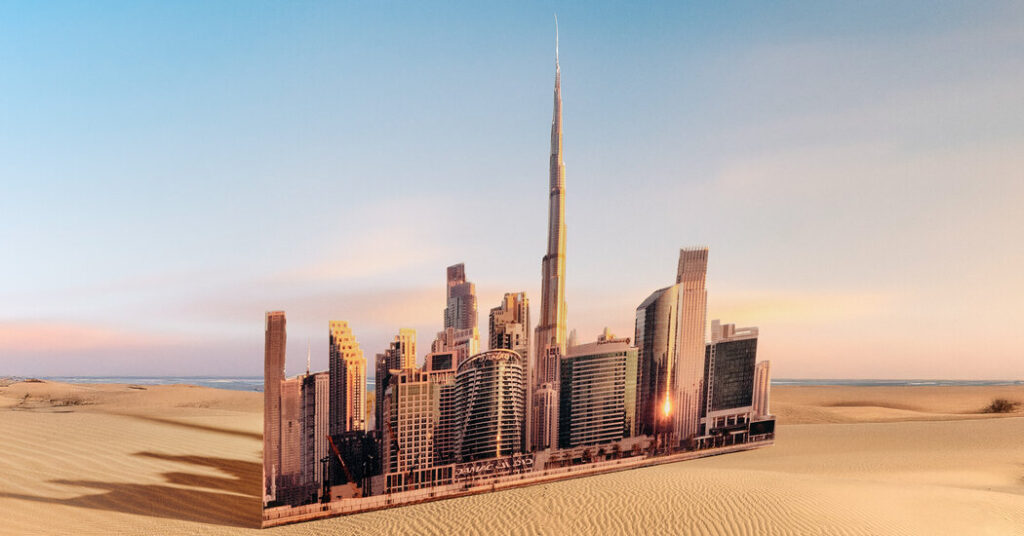
The attacks struck at the fundamental premise of Dubai’s model as a new type of global metropolis. It’s developed into what could be called a city as platform — less a rooted place with people and history than a blank slate for the exchange of capital. Its success has even spawned a term, “Dubaification” — the spread of the same malls and towers, restaurants, airport lounges and luxury brands that make places feel secure and, despite its proximity to Iran and the now blockaded Strait of Hormuz, out of harm’s way. What could ever go wrong when there are a Nobu and a Louis Vuitton boutique nearby?
I first came to the Emirates about a decade ago to teach a course at New York University’s satellite campus in Abu Dhabi called The Global City, which met every day and used Dubai and Abu Dhabi as our classroom. It is part of N.Y.U.’s network of campuses designed to provide “seamless international mobility of students and faculty.” N.Y.U. Abu Dhabi has more than 2,000 undergraduates from over 115 countries who speak more than 75 languages — a campus that felt like a sped-up version of the city itself. The students were remarkable, and they were determined to show me a Dubai and an Abu Dhabi beyond the malls and the towers. They took me to the traditional markets, the old souks, the South Asian neighborhoods — the culture that had been there before the building boom and was now, in places, being overrun or erased. They were fascinated by that tension and wanted me to see it too. They pushed back when they felt Westerners judged the place without understanding how people actually lived there.
For their final project, I asked them to treat Dubai and Abu Dhabi as a case study in how a global city gets made. Their presentations noted that the region was investing tens of billions in cultural districts, green projects and innovation zones to attract global talent. Yet, those foreigners coming to the city had no clear pathway to citizenship or permanent belonging. Looking back, those student projects offered an eerie foreshadowing of today’s potential exodus of high-income expats in the face of continued instability.
My wife is Jordanian and has family who have lived and worked in Dubai and Abu Dhabi for years. During our time in the U.A.E., we ate with them, drank arak, watched them dance the dabke late into the evening. Outside, Ferraris and McLarens idled in front of restaurants while men in white kanduras and women in black abayas moved through malls lined with every luxury brand on earth. They had chosen the Emirates for good jobs and career prospects and the safety, the schools, and the lifestyle it offered their families. But the conversation kept circling back to their visas — mostly two-year employer-sponsored work permits, renewable but never permanent, tied to their jobs. Lose the job, lose the right to stay.
They liked it there, they said, but they were never sure how long they would be allowed to stay. It was merely where they were based— more a platform than a place.
Nearly nine in 10 Dubai residents are non-nationals — by far the highest percentage of any major city in the world. Across the Emirates as a whole, about 10 million of 11.4 million residents are foreign nationals. Many are from the United Kingdom and the United States, but many more are guest workers who do the service jobs on which the city depends and typically come from South Asia, Southeast Asia and the wider Middle East.. Even a traffic violation can trigger deportation. Citizenship is based almost entirely on descent — it’s been intentionally made very difficult for even long-term foreign residents or their children to become Emirati, even after decades of living and working there. The system is designed to rely on migrants while keeping them permanently temporary. That makes it extremely hard to be rooted, to belong, to be attached.
And so it is a city of flows — organized around an airport that connects thousands of routes and a free-trade port that channels global shipping. It is a hub focused on attracting people and their money, and providing opportunities to make and spend more money.
For a time, that model worked exceedingly well. Dubai grew from about 917,000 residents in 2000 to nearly four million today, roughly quadrupling its population in a quarter century — one of the fastest growth spurts of any major city on earth. It has climbed into the top ranks of global financial centers, now around 11th in the leading indexes and serving as the main hub for finance across the Middle East, Africa and South Asia. It is home to more than 81,000 millionaires — a number that more than doubled between 2014 and 2024 — including over 200 centimillionaires and 20 billionaires. In 2025 alone, an estimated 9,800 millionaires were projected to move to the U.A.E., bringing some $63 billion in personal wealth — more than any other city in the world. Dubai now sits just behind New York and London and ahead of established global cities like Tokyo, Singapore, Zurich, Paris, Frankfurt, Los Angeles and Chicago in its ability to attract global white-collar talent, based on LinkedIn data covering more than a billion knowledge workers worldwide.
And the Dubai model is spreading. Other cities, including Riyadh, Istanbul, Miami and Doha, are all attempting to adopt some variation on the same basic formula to compete for the same class.
But that duplication also means these cities can be replaceable. If one falters, another steps up to take its place. The elites can flit between them, because any real attachment they feel lies elsewhere. Dubai has become a gathering place for conferences and art fairs and the types of events that globally mobile people like to attend (some of which are now being canceled, postponed or moved online) — but they can move elsewhere too.
This new kind of city is a sharp break with the past. For most of human history, people lived and worked in the same place, and cities grew up around that basic fact. They transform, rebuild after fires and disasters, become richer and sometimes poorer, but they draw their resilience from their rootedness, the fact that people feel they belong there. To say, I am a New Yorker or a Londoner, I am from Pittsburgh or Detroit, I am Roman or from Barcelona: that is not just a map; it conveys a deep sense of history, belonging and meaning — a personal identity, not just a transaction. Those identities are messy and unequal, but they are substantial. They are one of the primary ways people answer the basic questions of who they are and where they belong. And they are part of what brings people back to hang on and rebuild no matter what.
That kind of identity has deep roots. Long before factories or financial markets, people rooted themselves in where they lived and in the communities they built there. Place, kinship and a shared way of life were the basic materials of human identity. Marx described how industrial capitalism alienated workers from their labor, from one another, from their sense of agency. But there is a deeper form of alienation — one with a far longer history — and that has to do with the identity we draw from place, from home, from community. That source of identity is now being ripped apart.
The more mobile we become — moving across borders and between cities — the more we hunger for the identity that once came from being rooted in place. That simple fracture lies behind much of today’s social and political turmoil, feeding the anger that fuels populist movements and the tribalism that splits societies. It also drives the search for belonging that pours into local politics, online communities and virtual worlds. And it shows up in the search for neighborhoods and communities that can still provide a sense of home — something the pandemic made unmistakably clear.
The Financial Times columnist Janan Ganesh argued recently that Dubai would survive the current turmoil precisely because, even if there have been people living there for hundreds of years, “the bit the world tends to see might be the closest thing on earth to a blank slate.” Such a place makes no demands on your identity or your loyalty, echoing the urbanist James Howard Kunstler’s idea of the geography of nowhere. And yet that could be its fatal flaw — the very quality that makes it useful is what makes it ultimately disposable.
Dubai, conjured out of the desert, dependent on its own reputation for easy living, is probably too big to fail. Still, the U.A.E.’s leaders seem to have recognized the threat to that careful branding. They have even demanded that residents not circulate photographs or videos of the strikes, explaining that they don’t want to reveal the locations of sensitive sites that had been targeted. The government warned that those who don’t follow the rules could face arrest.
The war is a reminder that no city, no matter how go-go and glamorous, can buy its way out of the forces of history and geography. Any serious disruption — a hurricane, a wildfire, a pandemic, a terrorist attack, a popular uprising, a sudden change in tax law — can send the mobile and the unattached off seeking a new safe haven. That is the defining contradiction of this new kind of ephemeral metropolis. For many, it’s not a real home. And so when the going gets rough, why would they stick around?
Richard Florida is a visiting professor at Vanderbilt University, a professor at the University of Toronto and a fellow at the Kresge Foundation. He is the author of “The Rise of the Creative Class” and “The New Urban Crisis” and is writing a book on how digital technology is reshaping cities and the geography of work.
Source photograph by Deejpilot/Getty Images.
The Times is committed to publishing a diversity of letters to the editor. We’d like to hear what you think about this or any of our articles. Here are some tips. And here’s our email: [email protected].
Follow the New York Times Opinion section on Facebook, Instagram, TikTok, Bluesky, WhatsApp and Threads.
The post Go-Go Dubai Was Not Built for War appeared first on New York Times.