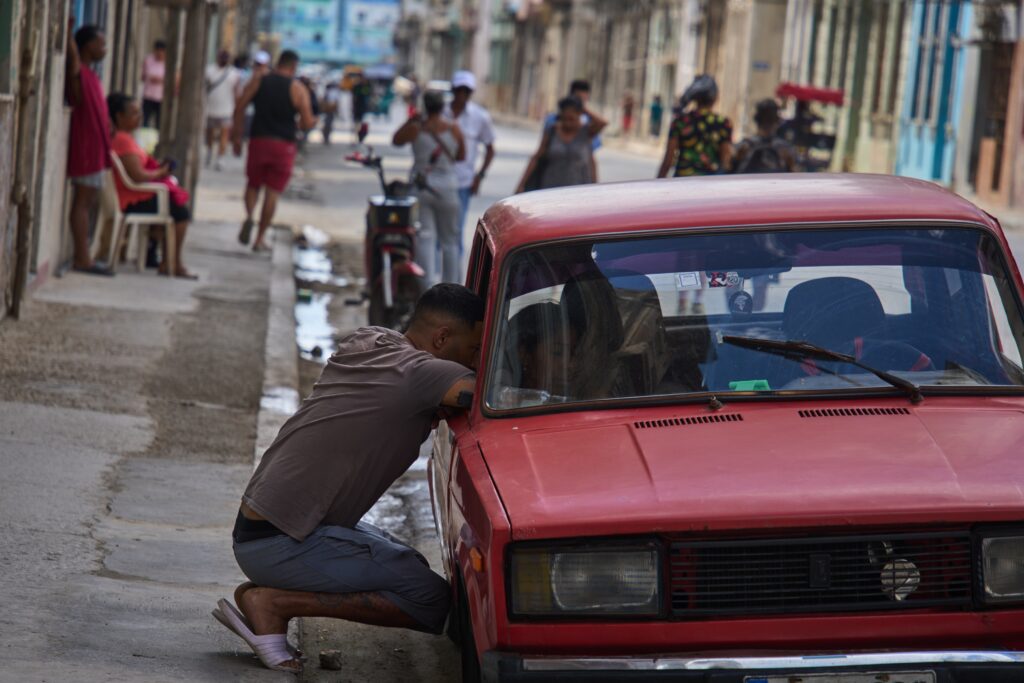
With the Trump administration’s oil blockade cutting off fuel to Cuba, the country’s electrical grid collapsed Monday, causing an island-wide blackout.
President Donald Trump, meanwhile, threatened again to topple the country’s communist government.
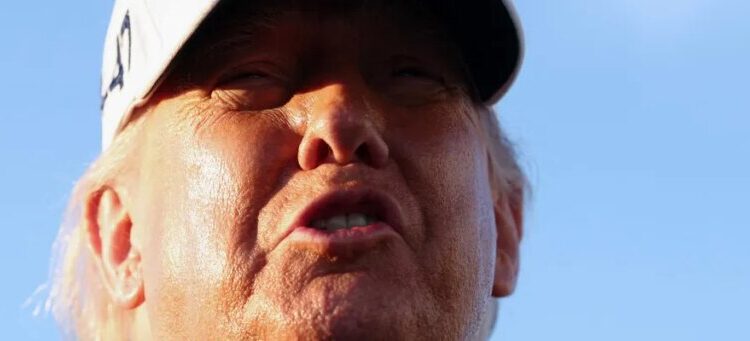
“I do believe I’ll have the honor of taking Cuba,” he told reporters Monday afternoon. Asked whether this meant diplomacy or military action, he said: “I think I can do anything I want with it.”
Cuba’s energy ministry on Monday afternoon reported a “total disconnection” of the country’s national electric system and said it was investigating the cause. Within a couple hours, service in some areas was coming back online, the ministry said.
The Caribbean nation of 11 million has long suffered blackouts, but they’ve grown more common in the months since the administration cut off oil shipments from its longtime supplier, Venezuela, and threatened to raise tariffs on any country that supplied energy to Cuba.
Since capturing Venezuelan strongman Nicolás Maduro in January and asserting new influence in Caracas, Trump has hinted repeatedly that Cuba would be next.
His attempt to strangle the country, denying energy on top of the 65-year U.S. embargo on most trade, appears to be working: President Miguel Díaz-Canel said Friday that no fuel had entered for three months.
Cuba’s energy ministry said there had been no reports of breakdowns or failures in the units that were operating when the grid disconnected.
The repeated power cuts and blackouts have set off rare protests in the communist country in recent days. The protests grew especially chaotic in the central city of Morón, where video images shared on social media showed people throwing projectiles at the Communist Party headquarters and setting ablaze furniture apparently ransacked from the office.
“Every night for 10 days they have gone out to protest in a different area of the country because of the blackouts,” said Norges Rodríguez of YucaByte, a Miami-based website on Cuban affairs. “This is the first time they have protested so many consecutive days in a row.”
In some areas, Rodríguez said, Cubans have lit piles of trash ablaze to protest the suspension of garbage collection. The government has arrested alleged protesters, he said: “The repression has not stopped.”
Amid the growing pressure, Díaz-Canel acknowledged Friday that his government had been holding direct talks with the United States “aimed at finding solutions through dialogue to the bilateral differences between the two nations.”
Trump told reporters Sunday that his government was “talking to Cuba, but we’re going to do Iran before Cuba.” The U.S.-Israeli attack on the Islamic Republic has entered its third week.
Díaz-Canel, in rare outreach to the Cuba diaspora, said his government would create space for Cubans abroad to “participate in our country’s economic and social development.”
Oscar Pérez-Oliva Fraga, Cuba’s deputy prime minister and economic czar, told NBC News that Cuban nationals outside the country would be permitted to invest in the country’s small private sector and own businesses on the island. The communist leadership has long called those who fled the country after its revolution “gusanos” — worms — and “scum.”
The Assembly of the Cuban Resistance, a Miami-based group of Cuban exiles that staunchly opposes the government, rejected the opening.
“The regime must be truly desperate to seek resources from the very people they once branded as ‘scum’ and forced into exile,” said Orlando Gutiérrez-Boronat, the group’s secretary general. “We know this administration despises free Cubans who refuse to be controlled by the Communist Party. It is vital to withhold investment now and wait for a truly free Cuba.”
The post Cuba’s national energy grid collapses, causing island-wide blackout appeared first on Washington Post.