MEXICO CITY — For more than six decades, communist Cuba thwarted every destabilizing measure Washington aimed its way — assassination plots, a trade embargo, sabotage, travel bans and, most notoriously, the Bay of Pigs invasion in 1961, when Fidel Castro’s revolution was still young and the Cold War raging.
Now, many are wondering: Is the death knell finally tolling for the Cuban Revolution?
And is President Trump on track to achieve a goal — toppling the island’s communist rulers — that eluded John F. Kennedy and successive presidents?
Trump has stated repeatedly that Cuba is next in his crosshairs, after his ongoing war against Iran and the overthrow in January of Venezuelan President Nicolás Maduro.
But many experts caution that predictions of communist rule ending have proved illusory.
“A lot of people have lost their shirts betting on the end of these guys over the last 67 years, so I wouldn’t go that far,” said Jorge Castañeda, Mexico’s former foreign minister. “But the only way [Cuba’s government] can save itself is by doing everything on the economic front that Trump and the Miami people want them to do, in exchange for holding on to political power.”
It was oil — specifically, Trump’s de facto energy blockade — that finally forced Havana’s entrenched leadership to go to the negotiating table with its longtime nemesis across the Florida Straits.
On Friday, Cuban President Miguel Díaz-Canel went on national television and confirmed that Havana has been engaged in secret talks with the Trump administration.
Underscoring the gravity of the moment, Díaz-Canel stressed that the talks were directed by him and “the historic leader of our revolution,” Raúl Castro, the nonagenarian younger brother of Fidel, who died in 2016.
Díaz-Canel’s words masked what was, for adherents of a revolution celebrated by the global left, a painful reality.
“Cuba isn’t negotiating out of conviction, but out of asphyxia,” Stephanie Henaro, a Mexican analyst, wrote on X. “Regimes don’t sit down with their historic enemies when they are strong.”
In justifying the bilateral talks, the Cuban president cited the country’s energy collapse, noting that some areas have gone more than 30 hours without power.
Long lauded for its free educational and healthcare systems, Cuba is seeing schools and hospitals shut because of a lack of electricity. The national waiting list for non-life-threatening procedures has almost reached 100,000, including more than 11,000 children, the government says.
Cuba, which imports 60% of its oil, has not received a fuel shipment in three months, Díaz-Canel said.
Once U.S. forces whisked Maduro to a New York prison, Trump cut off shipments of oil from Venezuela — which, under socialist rule, had long provided crude to its ideological ally.
Trump strong-armed other nations, notably Mexico, to stop sending oil to the island. He also pressured countries to expel the cadres of Cuban physicians who had been a linchpin of healthcare across much of the Americas, while providing much-needed cash to Havana.
And with many Latin American countries swinging to the right in recent years, Cuba no longer enjoys the support it once had.
The island is experiencing its worst days since the 1991 fall of the Soviet Union, Havana’s steadfast patron. The Communist Party survived that blow — and outlasted an almost-decade-long “special period” of austerity after the loss of Moscow’s support. Still, the special period saw adults lose an average of 12 to 20 pounds, according to estimates.
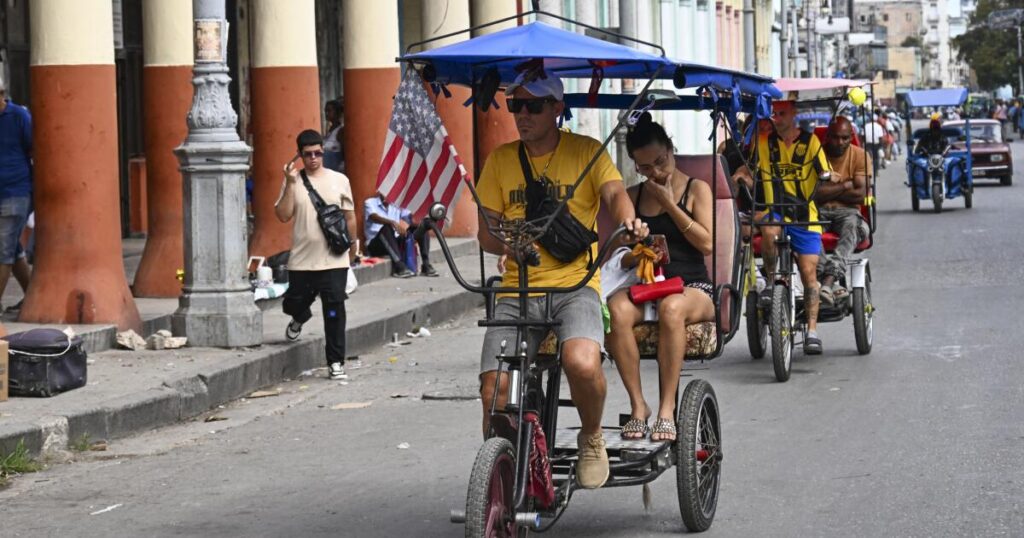
In recent weeks, furious Havana residents have signaled their displeasure with the outages in nightly crescendos of clanging pots and pans. Scattered reports of violent anti-government protests have emerged, despite the hard-line control of security services.
“We are at the limit: The situation is critical and precarious,” Yaima Sardiñas, a manicurist and mother of three, said by phone from Havana. “During the special period, yes, there were blackouts, but one could always find rice, maybe some meat. Now it’s almost impossible.”
“These days,” added Sardiñas, 42, “you see unfortunate people on the streets, picking through the trash. That didn’t happen in the special period.”
When Díaz-Canel unveiled bilateral talks, the tone was distinct from his recent denunciations of Washington’s “suffocation policy” and his vows of “creative resistance” to Trump’s bullying.
The talks will probably focus on an economic and political overhaul. But broad reforms would mean transforming a deeply embedded, command-and-control system that, while faulty, has endured for 67 years, despite unrelenting pressure from Washington.
Secretary of State Marco Rubio — the Cuban American who is Trump’s point man on Cuba — has blamed the calamitous current tableau on the island’s leadership, not on the U.S. blockade.
“The humanitarian crisis is getting out of hand because the Cubans don’t know how to run an economy,” Rubio said in Florida last month.
Others say such comments underplay the consequences of the oil blockade.
“The Trump regime has succeeded in crushing the economy,” said Robin Lauren Derby, a UCLA historian who follows Cuba.
Turning Cuba’s largely state-owned system into a haven for private business — and a welcoming destination for Cuban American entrepreneurs from Florida — implies displacing powerful players in Cuba’s military-industrial complex, which runs much of the economy.
Rubio has spoken of gradual transition in Cuba, and even Trump — who called on Iranians to take to the streets once the United States and Israel began bombing Tehran — hasn’t predicted a large-scale revolt.
Speculation has centered on a Venezuela-style scenario in which current leadership is somehow sidelined in favor of a Trump-friendly replacement.
But many experts see few parallels with Venezuela, which, unlike Cuba, has a recent history of free markets and opposition parties, while lacking Cuba’s ubiquitous security architecture. And after generations of “resistance,” Cubans have a built-in disdain for the country’s “imperialist” antagonist.
“Cuba is not going to be a walk like Venezuela,” Derby said. “The issue of sovereignty really means something to Cubans.”
In his comments, Díaz-Canel hinted at resistance to political change. Talks would proceed, he said, with “respect for the political systems of both states, and for the sovereignty and self-determination of our government.”
Cuba probably will be open to an expanded private sector role and offering U.S. firms preferential access, said Ricardo Torres, an economist at American University. Potentially more problematic will be calls for compensation payments to U.S. companies and individuals — many in south Florida — whose property was expropriated after the revolution.
Another key factor is Florida’s Cuban American population. A crucial base for the Republican Party, they probably will object to leaving the current governing infrastructure in place, Venezuela-style. Cuban exiles have demanded multiparty elections, freedom of speech, the release of political prisoners and other reforms.
“If Trump and Rubio betray Miami, they may get into a lot of trouble,” Castañeda said.
On the other hand, a greatly debilitated Cuban government has few cards to play.
“Cuba has entered these negotiations in a very weak position,” Torres said. “They will have to make concessions.”
There are already some signs. Just last week, Havana announced that it was releasing 51 prisoners “in the spirit of good will and close, fluid relations with the Vatican.”
The Vatican — which helped broker talks that led to a U.S.-Cuba thaw during the Obama administration — has been playing a similar intermediary role with Trump and Havana.
On the U.S. side, some are predicting that Trump will agree to open up travel to the island, which is key to revitalizing the moribund tourist economy. The blackouts and lack of jet fuel have decimated tourism, a key source of revenue.
A return of foreign visitors would be a boon for many, including the likes of Bruno Díaz, 56, a father of three in Havana who makes a living as a cab driver and musician, catering to the tourist trade. He hasn’t worked in weeks.
“We are in such a delicate situation — with people going hungry, so many shortages — that whatever news of a change gives us hope,” Díaz said following news of the U.S.-Cuban talks.
“We just hope it’s not only words, and that we will see real change soon. Because people can’t take it anymore.”
McDonnell and Linthicum reported from Mexico City, Ceballos from Washington. Special correspondent Cecilia Sánchez Vidal in Mexico City contributed to this report.
The post Cuban leaders signal concessions to appease Trump, but also ensure political survival appeared first on Los Angeles Times.