Even as Donald Trump’s war roils global energy markets and runs down stocks of U.S. air-defense weapons, the president’s relentless assault on the Iranian regime has yielded at least one perhaps accidental achievement: It’s undermining the reputation of America’s chief global rival. China is proving to be an unreliable friend to Iran in this moment of crisis, and any authoritarian regime that’s counting on Beijing as its backstop should think again.
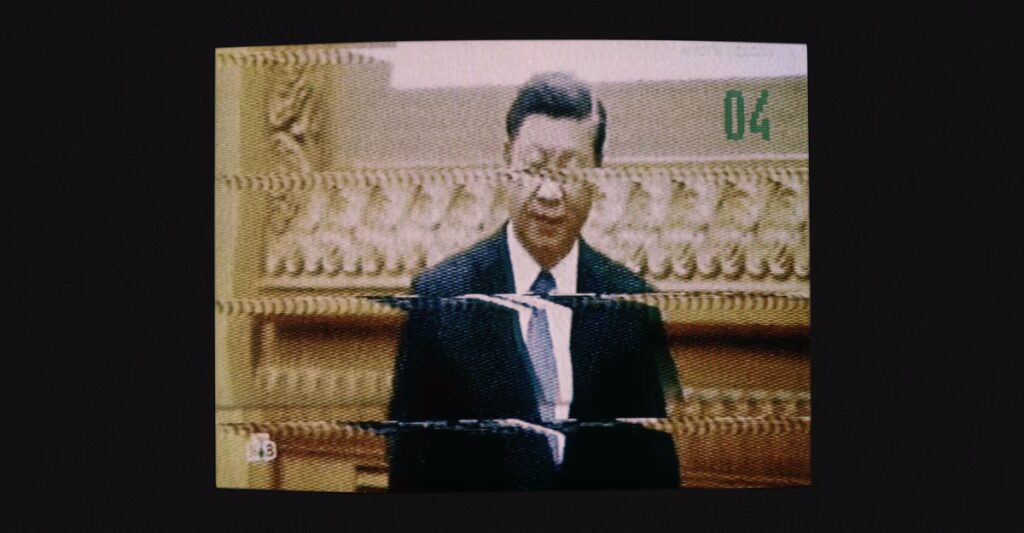
Beijing has grand plans to undermine American power by joining forces with other authoritarian states, including Iran, Russia, Venezuela, and North Korea. Until recently, this scheme appeared to be working. Beijing’s ties with Iran and Russia had blunted America’s efforts to economically isolate Tehran and Moscow, and granted China a ready supply of cheap energy and some well-located partners. At a meeting last year with Venezuela’s then-president, Nicolás Maduro, Chinese President Xi Jinping hailed the two countries as “good partners of mutual trust and common development.”
Trump’s use of a global trade war to alienate friends and abuse neighbors, and his spats with allies over the fates of Greenland and Ukraine, seem to have left room for Xi to grow his power. When Xi hosted Russian President Vladimir Putin, Iranian President Masoud Pezeshkian, and other representatives of the global South in Beijing last summer, he duly pitched a vision that gave autocrats a greater voice in world affairs.
[Read: Why Trump Didn’t Plan for the Strait of Hormuz]
Less than a year on, both Maduro and longtime Iranian Supreme Leader Ali Khamenei are gone, and Khamenei’s son Mojtaba is now struggling to hold the Islamic Republic together. More significant, Xi has hardly rushed to his friends’ defense. Beijing initially condemned Trump’s attack on Venezuela and called for Maduro’s release after his capture by U.S. forces, but then quickly softened, stating that China would continue to work and trade with Venezuela’s new regime. As for Iran, the strongest language China’s foreign minister, Wang Yi, could muster to describe Khamenei’s killing was “unacceptable.”
Chinese foreign-ministry officials rarely comment on media reports, but they moved quickly to deny claims in late February that Iran was finalizing a deal to secure anti-ship missiles from China. Although some evidence supports that China has been supplying crucial weaponry components to Russia, Beijing clearly wishes to squelch any impression that China plans to offer military support to its so-called allies. Beijing remains an economic partner—China is the largest buyer of oil from both Iran and Russia—but Xi is otherwise reluctant to get dragged into a wider war or invite American or European sanctions by arming America’s foes in battle.
Xi’s unwillingness or inability to intervene in events so far from home seems to be harming China’s reputation as a geopolitical counterweight to the United States. Following Maduro’s capture, top political and military leaders in Latin America suggested that China’s lackluster support for Venezuela undercut Beijing’s stature in the region, according to research for a forthcoming paper by Santiago Villa, Thayz Guimarães, and Parsifal D’Sola, fellows at the Atlantic Council. Beijing’s response “exposed a gap between its rhetorical commitments and its actual capacity, or willingness, to defend political partners when confronted with hard American power,” Villa told me. Caught between an aggressive U.S. and an ineffective China, “Latin American countries feel they’re on their own,” he added. Some may respond by looking for new security partnerships, particularly in Europe.
Villa suggests that China’s leaders could burnish the country’s reputation in Latin America by fighting U.S. hard power with soft power, expanding aid and investment in the region. Yet this looks unlikely. Although China is a major trading partner for Latin American countries, Beijing’s generosity can be limited. Villa estimates that even after the Trump administration’s cuts to USAID’s budget, Beijing’s international aid amounted to only 5 percent of what Washington handed out around the world last year. “There’s no indication that China will close that gap,” he told me.
Trump’s attacks may have raised some doubts in China that Xi’s backing of autocrats is wise. Shi Yinhong, an international-relations expert at Renmin University in Beijing, told me that he believes that America’s recent military actions “strongly impressed the leaders here” by demonstrating “nearly overwhelming” U.S. military and diplomatic strength. Shi suggested that China could better protect its economic and strategic interests by seeking to “mitigate confrontation” with the United States and its allies. That could mean cultivating more “distance” from Russia and North Korea and taking a milder approach to China’s other neighbors.
So far, Xi continues to favor struggling autocrats over powerful democrats, and has shown little inclination to change course. In recent visits to Beijing, European leaders seem to have failed to persuade Xi to help end the war in Ukraine. Xi’s continued support for Putin has been a major impediment to improved relations between China and Europe, but the Chinese leader has refused to budge.
Perhaps Xi recognizes that the long-term consequences of Trump’s aggressive foreign policy are less certain. The American president appears to have no clear end game for his war against Iran, and his seemingly impulsive use of military force may in fact enhance Xi’s call for a more balanced, pragmatic global order. Jonathan Fulton, an Abu Dhabi–based expert on China’s relations with the Middle East, recently noted that Trump’s unprompted attack on Iran “creates space” for China “to build a consensus with other countries that share the view of the U.S. as the primary threat to global stability.”
Xi’s larger strategy may be simply to sit back and watch as the Trump administration gets tied up in costly and distracting far-flung conflicts. Support for Ukraine and operations in Iran are depleting American stockpiles of the advanced missiles and other munitions that the U.S. might need to deter or respond to a Chinese attack on Taiwan. Trump’s preoccupation with the Middle East also seems to have diverted his attention away from China’s threat to U.S. security.
[Brynn Tannehill: The dangerous mismatch between American missiles and Iranian drones]
Although some security analysts have suggested that Trump’s moves in Iran and Venezuela are part of a grand strategy to contain China by attacking the country’s friends, Trump himself has suggested otherwise. “We’re really helping China here,” Trump said recently about U.S. efforts to open the Strait of Hormuz. “We have a good relationship with China. It’s my honor to do it.” Although the trip may be delayed, Trump has been planning to visit Beijing later this month, where he is expected to prioritize trade deals over security concerns.
Perhaps Xi expects that an America divided at home and extended abroad will eventually recede, like history’s other overstretched empires. But patience can slip into complacency, and Xi’s reluctance to offer more than lip service and trade deals to allies may prove that China isn’t a suitable alternative to America’s global leadership.
The post China’s Axis of Autocracy Isn’t Looking So Hot appeared first on The Atlantic.