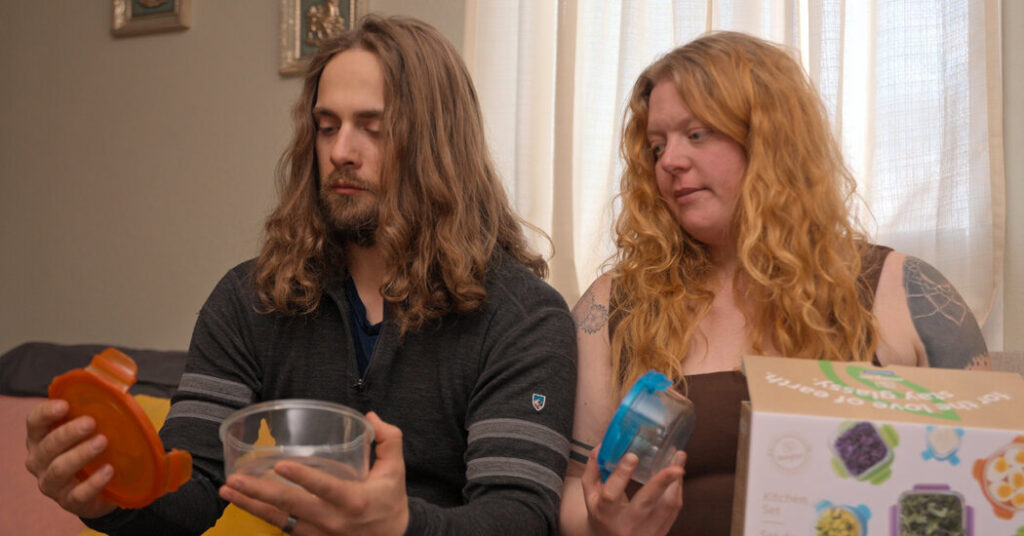
In “The Plastic Detox,” a new documentary out Monday on Netflix, six couples with unexplained infertility work to rid their lives of plastic in the hopes that doing so will improve their chances of having a baby. They toss out air fresheners and cutting boards, and try adopting bamboo toothbrushes and deodorant packaged in paperboard.
“Will we get pregnant because of it?” one participant asks. “I have no idea.”
Their guide on this journey is Shanna Swan, an 89-year-old epidemiologist who has spent much of her career studying the effects of environmental chemicals on reproductive health.
In the film, Dr. Swan, a professor of environmental medicine at the Icahn School of Medicine at Mount Sinai in New York, inventories the sources of plastic in the participants’ daily lives and identifies alternatives. Over a three-month “intervention period,” she measures concentrations of chemicals in their urine and sperm counts.
The premise of the documentary is appealing: Cut plastic chemicals out of your life, and improve your fertility. But it’s not that straightforward. “It’s not a quote unquote ‘scientific study,’” Dr. Swan acknowledged in the film. “We have no control group, it’s very small,” she said. And it’s not clear that reducing daily exposure to such chemicals the way these participants did can increase an individual adult’s fertility.
In the film, Dr. Swan said she didn’t want to scare people but instead educate them. “This is also something we have to pay attention to,” she said.
A Plastics Primer
If you want to take a hard look at the plastics in your life, it helps first to understand what exactly you need to worry about. It’s important to distinguish between microplastics and “plasticizers,” said Matthew Campen, a professor of pharmaceutical sciences at the University of New Mexico. Microplastics are tiny pieces of plastic, commonly shed through wear and tear on larger plastics — for example, single-use plastic bags or clothes made from synthetic fabric. Plasticizers are chemicals like bisphenols and phthalates that are often added to plastics, such as reusable bottles or bath toys, to make them rigid or flexible.
Based on the research, plasticizers are the bigger concern for reproductive health. Bisphenols (including BPA) and phthalates are part of a class of chemicals called endocrine disruptors because they interfere with hormones, said Andrea Gore, a professor of pharmacology and toxicology at the University of Texas at Austin.
Is it possible to cut out plastic entirely?
Probably not, Dr. Swan said. Plastic is everywhere — in our coffee makers, clothes, couches and the materials used to build our homes.
But you can make changes that lower your exposure.
A good place to start is food and water. Buy fresh food when possible to reduce your exposure to phthalates in food packaging. Heat your food in glass or ceramic containers instead of plastic, which can transfer chemical additives into your food when heated. Drink tap instead of bottled water to avoid chemicals that can leach into the water and to reduce plastic waste.
Avoid personal care and home products that list “fragrance” or “parfum” on their labels. These ingredients can signal the presence of phthalates, which are used in items like laundry detergent, hand cream and perfume to retain scents, Dr. Swan said.
Be mindful of less obvious sources, too, such as liners in canned goods and paper receipts, both of which may contain bisphenols.
Not everyone has the resources to make these changes, and reducing exposure broadly will require policy changes, experts noted. Dr. Campen compared it to the systemic change that happened when scientists realized the health harms of lead. “We took lead out of gasoline and paint,” he said. “There’s no quick fix,” he added.
Will cutting out plastics change your health outcomes?
A large body of evidence has linked endocrine disruptors to a variety of negative health outcomes, Dr. Gore said. In addition to infertility, these include cardiovascular disease and neurodevelopmental disorders such as A.D.H.D. Some research suggests that reducing your exposure to plastic and the chemicals in it may not be enough to stop these harms.
“Even very, very low-dose exposure during sensitive developmental periods can have effects, and those effects can be permanent,” Dr. Gore said. A 2015 study by Dr. Swan of nearly 1,000 pregnant women, for example, suggested that exposure to phthalates in utero could interfere with reproductive development in male babies.
What microplastics mean for health is less clear. Some studies, including Dr. Campen’s, have linked them to dementia and cardiovascular disease. Other research has suggested they affect reproductive health. But at this point, that research is “not even in the same ballpark” as the evidence of harm from phthalates and bisphenols, he said.
Three of the five couples in the film did have babies. But it’s nearly impossible to ascribe cause and effect because of the small sample and the fact that the intervention wasn’t a controlled experiment.
Dr. Swan doesn’t want to stop there. She is now planning to apply for a grant to run a larger randomized trial that she hopes will provide more definitive answers.
Nina Agrawal is a Times health reporter.
The post Can You Really ‘Detox’ From Plastic? appeared first on New York Times.