We call it muscle memory, the library of skills imprinted somewhere deeper than the conscious mind. Choreography relies on such memory continually and usually implicitly, but it can also use the body as a tool for remembering.
This usage was the thread connecting two works in the final week of this year’s monthlong Dance Reflections festival. In “Groove,” a solo at New York Live Arts, the French choreographer Soa Ratsifandrihana embodied her own memories. In “We Wear Our Wheels With Pride …” at N.Y.U. Skirball, a childhood memory of the South African choreographer Robyn Orlin was fleshed out by a company of dancers. In different and similar ways, both were theatrically frustrating.
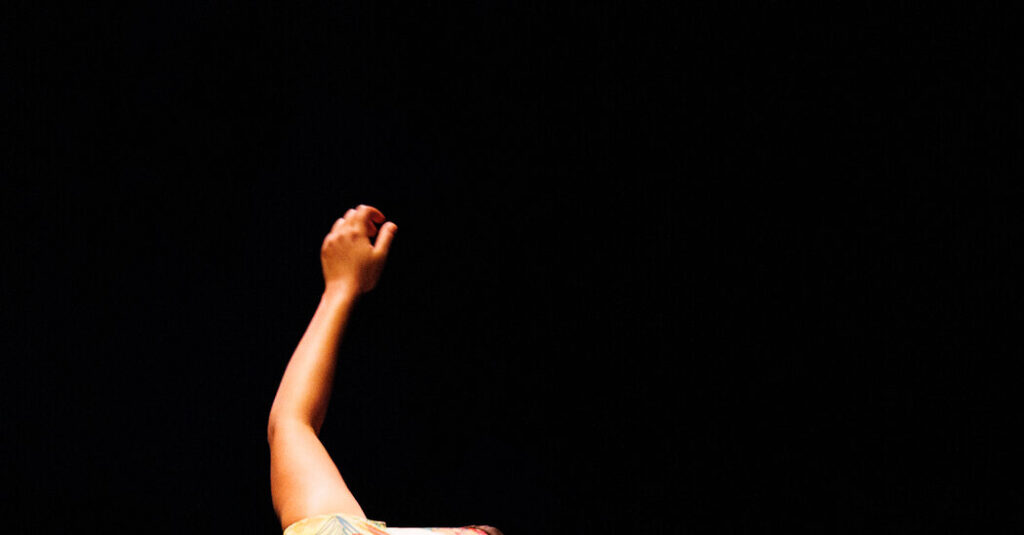
“Groove” begins in darkness. As the lights slowly brighten, audience members, seated on four sides of the stage area, discern a figure groping on the floor. It is Ratsifandrihana — inching around the perimeter, periodically standing, tipping into an arabesque as stable as steel girder beams and sinking back to the floor.
An electronic beep pierces the silence, then more hospital-machine sounds and percussive static. Ratsifandrihana responds with ripples, glitches, gearshift moves. Out of these emerge steps: the step-drag of the 1960s line dance the Madison, the hip-shaking hokey pokey of the Macarena. She dances them to a groove we can’t hear, like someone muttering to herself, remembering. Eventually, near the end of the 45-minute work, she opens up full-throttle and fully gets down.
Ratsifandrihana has explained in interviews that “Groove,” her first solo, is a collage of her dance history: the popping of her childhood in Toulouse, the afindrafindrao of her Malagasy heritage, the postmodernism of Anne Teresa De Keersmaeker. That comes across, but like “Fampitaha, fampita, fampitana,” the ensemble piece she presented at the Powerhouse festival in Brooklyn last summer, “Groove” is stretched thin. The payoff of its slow build is too little, too late.
Thinness is also a fault of “We Wear Our Wheels With Pride…,” but Orlin’s work is extroverted where “Groove” is the opposite. “Wheels” begins with the house lights up, and as soon as they go down, the performers jokingly shout for them to be restored. This happens a few times.
The full title runs on past the ellipsis: “ … And Slap Your Street With Color … We Said ‘Bonjour’ to Satan in 1820.” The work is an evocation of the rickshaw drivers of Durban that Orlin encountered in her apartheid-era youth — Zulu men who wore horned headdresses, festooned with many-colored ribbons, and danced to attract customers. The year, 1820, is when British settlers arrived in the area.
The subject is promising, and the work becomes more engaging as soon as the vocalist Anelisa Stuurman opens her mouth, her impressive skills ranging across clarion call, chanteuse velvet tones and animal growling. The provenance of the dancers also raises expectations. They are members of Moving Into Dance Mophatong, a storied ensemble nearly 50 years old that has produced prominent artists like Vincent Mantsoe and Gregory Maqoma.
But “We Wear Our Wheels” is a rough ride. Walking in a circle and humming, the six dancers take turns in the center, yet their energy is perversely directed to an overhead camera (the image is projected on a screen behind them). They try to get the audience to join the humming — so that our ancestors may also be summoned, they say. At Skirball this was a struggle. “Give us more,” Stuurman kept demanding.
The rickshaws are represented by a horizontal pole that hangs from the fly, an extension of the bar with which a driver pulls passengers. One by one, the dancers, now wearing horned headdresses, tout their services, then hang on the bar, feet wheeling. For each, audience members are requested to add a motion: rocking forward and back, standing up and shaking.
This extended audience activity, risking discomfort and possibly motion sickness, makes full sense only at the end of the performance, through some historical footage of the rickshaws. Vigorous rocking was part of the experience, as in a carnival ride.
The problem with “We Wear Our Wheels,” though, is less the strain on viewers’ bodies than the strain on their attention caused by serial structure. The rides are too similar, as are the solos when the dancers become equine (the Zulu word for rickshaw also means horse) and take turns removing their headdresses and strutting their stuff. Each has a little something special — bird-wing undulations, vogue-like posing — but only Lesego Dihemo, the sole woman, really wakes up the show, and only for a moment.
“I am no longer a rickshaw driver, I am an Uber driver,” one dancer announces. “Same old struggle.” The work conveys some of that struggle, but more an old struggle with an audience: how to entertain without mugging. Orlin gives the dancers too little and asks for too much ingratiation. The show’s joy feels forced.
The recessive “Groove” didn’t have that fault. During the opening-night performance, Ratsifandrihana benefited from unsolicited vocal encouragement from the audience. So encouraged, she smiled and got her groove on for real.
The post At Dance Reflections, Embodied Acts of Memory appeared first on New York Times.