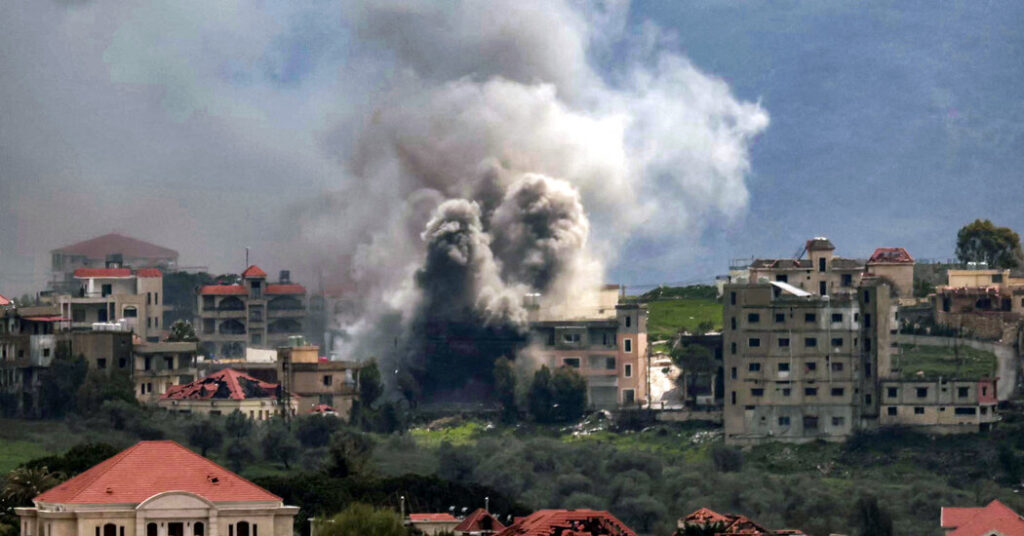
As Israel widens its ground assault in southern Lebanon, the town of Khiam has emerged as a focal point of the escalating offensive.
The town is situated on strategic high ground a few miles north of the border with Israel and has been coveted over decades of conflicts. It has been the site of some of the fiercest clashes between Iran-backed Hezbollah militants and Israeli ground forces as they made incursions into southern Lebanon over the past two weeks.
Israeli troops have not been able to seize complete control of Khiam after facing fierce resistance by Hezbollah fighters. Israel’s ability to do so will be a key indicator of the strength of Hezbollah fighters and how far Israeli forces can push into southern Lebanon.
Khiam is situated on a hilltop overlooking parts of the Upper Galilee in Israel to the south, giving the forces in control of the town a clear view of the surrounding area. It also sits along key roads connecting the interior of southern Lebanon to the towns along the countries’ border as well as the Bekaa Valley in the east, making it a hub for moving forces and transporting supplies to and from other parts of the country.
During the Israeli occupation of southern Lebanon in the 1980s and 1990s, Khiam was one of the most contested towns in the occupied zone and a critical military and logistics base for Israeli forces and their allied militia.
It became home to a notorious military barracks-turned-prison, the Khiam Detention Center, which held hundreds of Lebanese prisoners without trial and was known for its harsh conditions.
When Hezbollah forces took control of the prison in 2000 as Israeli and allied fighters withdrew, it turned Khiam into a powerful symbol of liberation in Lebanon.
In the last major escalation between Hezbollah and Israel, it took Israeli forces weeks to reach the outskirts of the town after clashing repeatedly with Hezbollah forces.
That war erupted after Hezbollah launched rockets at Israeli positions in October 2023 in solidarity with Hamas, another Iranian-backed group, which led a deadly attack against Israel that same month that killed about 1,200 people. The Hezbollah assault prompted Israel to respond with a barrage of attacks that ended in a cease-fire November 2024.
Israeli forces were unable to reach much deeper into Lebanon than the outskirts of Khiam during that war.
Only days into the current war, which erupted this month after Hezbollah fired at Israel to avenge the death of Ayatollah Ali Khamenei, Iran’s supreme leader, Israeli forces were able to enter the town of Khiam at a breakneck pace. Residents say the Israeli forces were then repelled from the town by Hezbollah fighters.
To residents, the fierce fighting in the town is a sign of the scale of the war to come.
“I think this war will be much bigger than the last,” Mohammad Hassan, 28, a resident of Khiam who fled to the capital, Beirut, days after the outbreak of war earlier this month.
“We don’t want to lose our homes, our properties,” he added. “We can’t accept a new occupation of the south.”
Christina Goldbaum is The Times’s bureau chief in Beirut, leading coverage of Lebanon and Syria.
The post As Israel Expands Ground Assault in Lebanon, One Strategic Town Resists appeared first on New York Times.