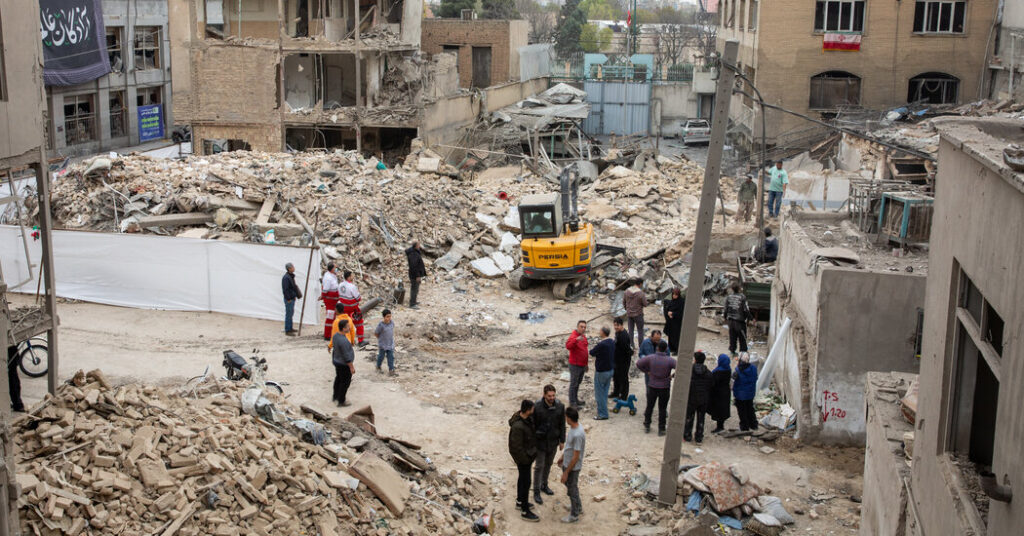
The war in the Middle East is entering its third week. Strikes exchanged by the United States; Israel; and Iran and its Lebanese ally, Hezbollah, have already killed more than 2,000 people, mostly in Iran and Lebanon, according to officials in those countries, and displaced millions more.
We asked readers of The Morning what they wanted to know about the war and our coverage of it. Reporters and editors have already answered some questions, and we have added more to the list. See the complete collection below, and keep the questions coming.
We edited some questions and answers for length and clarity.
The Objectives
What explains President Trump’s turnabout on foreign wars and nation building? — Eloise Gore, Tucson, Ariz.
Peter Baker, who covers the White House, writes:
There are a number of theories, but three factors I think are particularly important: One is that after five years in office, Trump is more comfortable with the use of power, both at home and abroad. The second is that he is now surrounded by advisers who either encourage his most aggressive instincts or see their role as facilitating his desires. And finally, as he approaches his 80th birthday, he seems increasingly focused on his place in history, looking to make sweeping changes here and overseas, toppling foreign leaders, taking over other countries or territories, literally redrawing the map of the planet.
How did the United States get such specific information about where the supreme leader, Ali Khamenei, and his advisers would be, and when? — Dorene Watkins, New York
David Sanger, who covers the White House and national security, writes:
As you can imagine, American intelligence agencies are not eager to explain. But the United States has access to billions of sensors in the world and can track people close to leaders who may be sloppy about the digital dust they leave. That lets spies track the movement of motorcades, the opening of electronic locks and the location of web-connected devices like cellphones and watches. Read my story about these capabilities.
Do Israel and the United States have the same objectives in attacking Iran? — Giovanni Cavarzere, Verona, Italy
Michael Crowley, who covers diplomacy, writes:
Both the United States and Israel intend to devastate Iran’s nuclear and ballistic missile capabilities. But Israel is more committed to a campaign lasting weeks to bring down Iran’s theocratic regime, while Trump’s priorities have repeatedly shifted.
The United States
According to a preliminary investigation, outdated data is at fault in the U.S. bombing of the elementary school in southern Iran. Why was it outdated? Don’t analysts double-check that information? — Tiffany Dale, San Antonio, Texas
Julian Barnes, who covers intelligence and national security, writes:
Absolutely. There is supposed to be a double-check and a triple-check. The strikes on the adjacent Iranian naval base were in the opening moves of the war, so they were precisely the kinds of targets that should have been reviewed. The military officers preparing the strike should have noticed they were potentially working off decade-old data from the Defense Intelligence Agency, and then checked with satellite imagery from the National Geospatial-Intelligence Agency. In the heat of the battle, that is not always done. The stakes of those errors in wartime can be tragically high — in this case, about 175 lives, Iran says.
How badly have U.S. bases in the Middle East been hit? — Kerstin Keough, Castle Rock, Colo.
Helene Cooper, who covers the Pentagon, writes:
U.S. Central Command, which is in charge of operations in that region, has been stingy with information about strikes on bases that house American troops — there are 13 in the area. Many of those troops had already been dispersed to other locations throughout the region. We know that communications infrastructure was damaged at the Al Udeid base in Qatar. We also know that Prince Sultan Air Base in Saudi Arabia sustained damage. Multiple bases in Kuwait have been struck, with the most damage at Shuaiba Port, where six service members were killed. From what we know, parts of those bases are still standing. But whether they can still function as they used to — and, in particular, house troops — is an open question.
Do you have a running tally of how much the war costs and how it’s being paid for? — Jane Jerry, Highlands, N.C.
Catie Edmondson, who covers Capitol Hill, writes:
We have only a limited sense of the price tag. The Pentagon told lawmakers that the war had cost more than $11.3 billion in the first six days alone, and lawmakers expect that number to rise. That estimate doesn’t include several of the costs associated with the operation, such as massing military hardware and personnel in the region ahead of the first strikes. Much of this information has been presented to lawmakers in a classified setting, so more specific details have been difficult to pin down.
The Situation in Iran
We saw people mourning Khamenei’s death in vast numbers — as well as people celebrating under cover of the night. Do we know what share of Iranians support the government and what share want it gone? — Agnès Billa, Montreal
Farnaz Fassihi, who covers Iran, writes:
Over the years, we’ve seen Iranians take to the streets in nationwide protests to demand the end of the Islamic republic, most recently in early January. The protesters come from all over, all age groups, all classes.
I’d estimate very roughly that about 20 percent of voters form a loyal, ideological base that backs the Islamic theocracy. We can draw these numbers from patterns in the latest presidential and parliamentary elections. Turnout was very low, and a majority of eligible voters boycotted the election as an act of protest.
Many Iranians say they are simply fed up with the policies of their rulers and have lost hope that they will ever reform or change.
Is there another political party that could come into power that the United States and its allies would support? — Jennifer Close, Greenfield, Mass.
Erika Solomon, who covers Iran, writes:
It’s probably better to think of this as political forces versus parties. If the government survives, it could go two ways: Reformist figures from within push the country to take a more moderate line, maybe talking to Washington and ending the nuclear program. But the war — particularly if it becomes more chaotic and deadly — could also radicalize people in a hard-line direction.
If the system collapses, a lot of political figures could want to come in. But the opposition in Iran is bitterly divided — which will make it hard for its members to unify under the banner of a clear alternative.
Has the United States ever carried out a forcible regime change that was successful, lasting and (eventually) sovereign? — Abby Peters, Cedar Falls, Iowa
Anton Troianovski, who covers foreign policy, writes:
Do you count Germany and the postwar Marshall Plan that brought it back to life? Some might point to Panama: A U.S. invasion in 1989 deposed the dictator Manuel Noriega. His successor, Guillermo Endara, was sworn in on a U.S. military base and helped lead the country to democracy. But that war involved thousands of American ground troops and left Panama’s economy in such ruins that Endara went on a hunger strike to seek emergency U.S. aid. Panama’s population back then was about two million. Iran’s is 90 million.
The list of efforts that ended in chaos or defeat — Libya, Iraq, Afghanistan and beyond — underlines the huge risks.
Will Iran attack us? How will this campaign affect Americans? Is there anything we need to do? — Eden Jensen, Madison, Wis.
Adam Goldman, who covers global security, writes:
That’s possible as Iran retaliates. So far it has tried to hurt U.S. interests in the region. But Iran has mounted plots on American soil in the past, including a suspected effort to assassinate Trump that the F.B.I. foiled in 2024. (The Pentagon said that it had killed the organizer in a bombardment.) Typically, the U.S. intelligence community increases measures to protect the American public when the country goes to war, relying on electronic surveillance and informants to suss out any possible attack.
Are most of Iran’s soldiers involuntary conscripts? Is there a chance they’ll desert the regime? — Jennica Peterson, Louisville, Colo.
Yeganeh Torbati, who covers Iran, writes:
A large portion of Iran’s military is indeed made up of conscripts. Military service is mandatory for adult men. That includes the Islamic Revolutionary Guards Corps, the most important component of Iran’s military and the force specifically founded to defend the country’s system of clerical rule. As for the possibility of desertion: We haven’t yet seen evidence of that happening in any significant way. Draftees tend to fill low-level, manual jobs and are not typically given sensitive responsibilities, like making battlefield decisions or carrying out important operations.
Our Coverage
Why has The Times so quickly started describing this military action as a war? Doesn’t a war require an act of Congress? Is this responsible journalism? — Jessica Bouchard, Vancouver, British Columbia, Canada
Charlie Savage, who covers national security and legal policy, writes:
The Times strives to use straightforward language to describe what is happening in the world, and “war” is the word for an ongoing armed conflict between nations of this scale and intensity.
That is a separate question from whether President Trump’s decision to direct the United States military to attack Iran, without going to lawmakers for authorization, violated the constitutional provision that vests the power to “declare war” in Congress.
Since World War II, presidents of both parties have increasingly ordered the military into combat unilaterally. Executive branch lawyers have developed a theory that presidents can send troops into hostile situations on their own so long as their anticipated circumstances, nature, scope and duration falls short of what the lawyers say would count as “a ‘war’ in the constitutional sense.” That is, they have treated the word “war” in the Constitution as a legal term of art, distinct from its plain-English meaning, and have interpreted this term narrowly so as not to apply to what the presidents they worked for have wanted to do.
Each president has built on predecessors’ actions, expanding the parameters of warfare that the executive branch has claimed and demonstrated that a president has the power to initiate on his own. While individual lawmakers have complained, Congress as an institution has acquiesced rather than pushed back. These accumulating precedents have opened a growing schism between the founders’ intent that it was for Congress to decide whether the country would go to war (except if there was a need to repel a sudden attack) and how the U.S. government demonstrably often works in practice. Even so, a variety of factors make the current conflict likely to be the most aggressive unilateral presidential initiation of a war since the Vietnam era.
How can you responsibly and accurately respond to a question about President Trump’s motivation for the Iranian war without mentioning the Epstein files? — Blake A. Dickson, Cleveland Patrick Healy, the assistant managing editor for Standards and Trust, writes:
The Times has clear standards here: We do reporting in search of the truth and publish facts that we have confirmed and corroborated. We’ve reported aggressively on how President Trump’s decision to attack Iran is the ultimate war of choice and on miscalculations he and his advisers made. We continue to report and unearth details about the president’s actions, but we don’t speculate, insinuate or opine in our news report. At the same time, we have been covering the Epstein files comprehensively, including multiple major pieces that published on the first days of the war and ran prominently online and on the front page. We continue to publish on Epstein and Trump, and have journalists dedicated to reporting on the files; that has not changed because of the war or any of President Trump’s actions.
How do you choose your military subject experts? — Arthur Milbrath, North Carolina
Greg Jaffe, who covers the Pentagon and the U.S. military, writes:
Military experts help us understand whether the Trump administration is making progress toward achieving the war’s goals. The best experts have firsthand experience serving at the highest levels of the Pentagon or making life and death decisions in combat.
We try to talk to people who have helped write war plans or have participated in debates in the White House Situation Room or the Pentagon’s “Tank,” where the most senior generals gather. And we want to speak with people who have led troops in combat, suffered losses and understand the seriousness of war. Nothing beats real world experience. The best experts can help us identify the questions we should ask or help round out our understanding of really complex military operations.
Are Times journalists on the ground in all of the countries involved? In particular, how do you report on what’s happening in Iran? — Lynn Wirtz, Brooklyn, N.Y.
Adrienne Carter, a senior editor on The Times’s International desk who is leading the war coverage from London, writes:
Iran is one of the hardest places to report. It’s incredibly restrictive for journalists, especially during sensitive times like now. The communications are largely shut down. So unlike in Ukraine and Russia, Gaza, Lebanon and Israel, we can’t be there. We can’t easily reach people. We have a dedicated team of reporters, many of whom have lived in the country, who have extensive contacts and sources. And we rely heavily on verified visual material, user-generated content, social media posts and satellite imagery.
Why do the U.S. soldiers who signed up for wartime action seem to get significantly more coverage than the hundreds of Iranian civilians killed by the bombing? — Mikhalina Solakhava, Berkeley, Calif.
Marc Lacey, a managing editor who has reported from numerous war zones, writes:
Capturing the lives lost in war is an essential part of conflict reporting. Showing the effects on both sides of the front lines is challenging, though, when reporters do not have free access, which is the case in Iran. Believe me, if we were able to traverse Iran right now, we would have interviewed the families of those who lost their lives in the American missile strike on an elementary school in the opening days of the war. Our lack of access means we have to work the phones (here’s a great example) and use other means to capture the significant death toll inside the country.
As for focusing on the death toll of American service members, we’ve received criticism from the Trump administration for that but believe the sacrifices of those sent into war are essential to document.
The post 16 Reader Questions on the War in Iran and Our Reporting, Answered appeared first on New York Times.