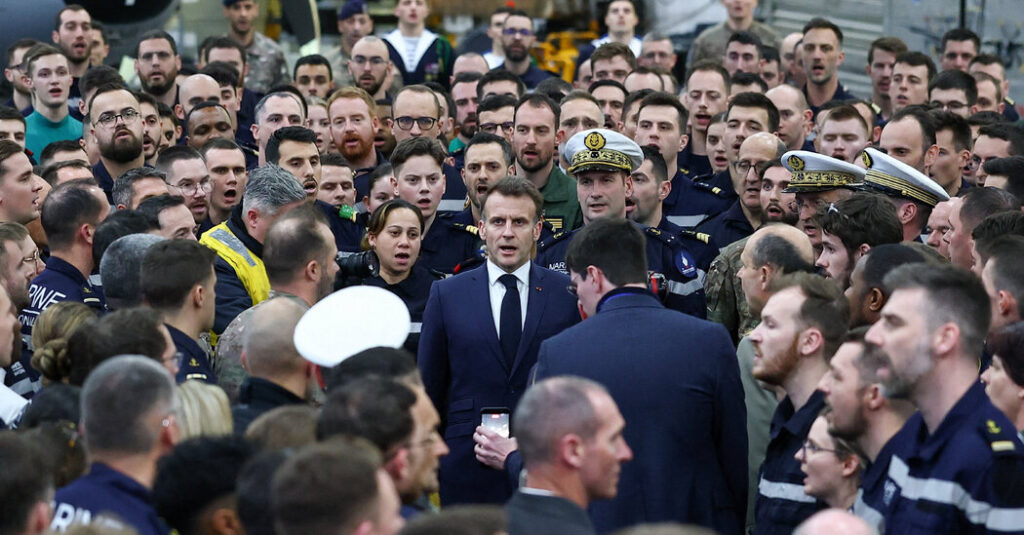
Despite refusing to join the attacks on Iran, Europe’s leaders have responded to the widening war in the Middle East by sending warships, fighter jets and air-defense systems to protect bases and allies in the region.
Yet flexing those military muscles — in one of the continent’s broadest mobilizations in recent years — has also revealed the limits of Europe’s defense abilities, officials and analysts said.
The mobilization is the first major stress test of Europe’s abilities since the continent’s leaders came under pressure from President Trump to increase military spending, increase troop numbers and take more responsibility for their own defense. So far, experts said, the military response has shown that Europe’s rearmament and recruitment is still in its early stages after eight decades of reliance on American firepower.
The deployments have left European forces scrambling to remain fully staffed on other fronts, including in the Baltic Sea, where they had tried to mount a show of force against Russia.
Diverting hardware and munitions to Arab allies in the Persian Gulf has also undercut Europe’s ability to support Ukraine’s defense against Moscow.
“We are very fragile from a warfare point of view,” Carlo Calenda, an Italian senator, said in an interview. “There might be a problem of defending our own country.”
France’s deployment of warships, including its sole nuclear-powered aircraft carrier, to the Mediterranean and the Gulf amounted to more than half of its battle fleet, a show of strength that forced Paris to downscale operations elsewhere. Administrative snags delayed the deployment of a British destroyer to Cyprus by a week and undermined Britain’s hopes of projecting strength.
Italy’s decision to send defense equipment to Arab allies under Iranian fire has left its own arsenal dangerously diminished. And the United States’ use of so much firepower in Iran has drastically reduced a stockpile that Europe had hoped it could depend on in the future.
“If the U.S. is firing off so much ordnance against Iran, then they can’t use it against the Chinese in, say, two years, and it’s not going to be available for the Europeans against Russia,” said Ed Arnold, a European security analyst at the Royal United Services Institute, a research group in London.
Gaps in Europe’s military ability “are well known — we just have not been doing enough about them for a long, long time,” Mr. Arnold added. “And some nations are getting completely found out now.”
Britain
After an Iranian drone hit a British air base in Cyprus last week, Prime Minister Keir Starmer pledged to deploy a destroyer to the eastern Mediterranean, hoping to reassure Britain’s Cypriot allies. He also sent four missile-armed fighter jets, four helicopters and counter-drones systems to defend bases in Gulf states against Iranian counterattacks, and has allowed U.S. bombers to launch defensive strikes against Iran from British bases.
Though intended as a show of force, the moves also highlighted Britain’s diminished military resources. The destroyer departed for Cyprus more than a week after the attack, raising questions about British battle readiness. And a recent analysis by the Royal United Services Institute concluded that Britain’s contribution to the Mideast’s aerial defenses constituted just “pinpricks” in the context of broader American-Israeli efforts to blunt Iran’s response.
Britain’s armed forces are so “whittled down” that “practical realities will constrain what the U.K. can do” in response to the war, according to the analysis.
France
France has sent roughly a dozen vessels, including its lone nuclear-powered aircraft carrier, to the Mediterranean and the Persian Gulf. The force amounts to roughly 60 percent of France’s combat fleet, according to Vincent Groizeleau, the editor of Sea and Marine, a French trade journal. The goal of the mission is to protect French citizens in the region; defend allies including Cyprus; and ensure that ships can safely navigate the Strait of Hormuz, the conduit for about one-fifth of the world’s oil supply.
Some analysts noted that the deployment had forced France to pull out of what a NATO official described as a show-of-force mission to deter Russia in the Baltic Sea.
Others said that France had shown allies in the Arab world, Europe and the United States that Paris was an ally to depend on — and that the speed of the deployment had shown up Britain.
“No European navy has deployed this many assets since the Gulf War,” Mr. Groizeleau said in an interview. The deployment, he said, sent a message to Russia and to the United States that Europe is “not weak.”
“We have assets,” he said, “we are capable of intervening very rapidly, and we are capable of defending ourselves.”
Élie Tenenbaum, a security expert at the French Institute of International Relations, a research group in Paris, said the advantages of deploying to the Gulf outweighed the costs of briefly leaving waters off Russia.
“Sure, they are not in the North Atlantic patrolling or hunting Russian subs in the Sea of Norway,” Mr. Tenenbaum said. “But it’s not like we are facing an immediate attack by Russia.”
Italy
Italy has deployed a missile frigate to defend Cyprus, joining European navies including from Britain, France, Spain and the Netherlands. It has also agreed to send shoulder-fired Stinger missiles, anti-drone artillery and other air defense systems to help defend Gulf allies.
The Italian defense minister, Guido Crosetto, met with more than 100 military industry officials last weekend and asked them to “drain all resources” to help the Gulf states, according to Roberto Cingolani, chief executive of the defense contractor Leonardo, who attended the meeting. “The message was, ‘There is extreme urgency, because Europe is trying to support the Gulf countries,’” Mr. Cingolani later told investors.
But in proving its worth to Arab partners, Italy risks leaving Europe exposed to threats that include Russia. And it has heaped pressure on a weapons industry that was already struggling to meet demand.
To help the Gulf, Mr. Calenda said, Italy was transferring one of its three operational SAMP/T air defense systems to the Mideast, from the Baltic region, where leaders fear attack from Russia.
Mr. Calenda, a center-left opposition politician briefed on the deployments, said that there was now only one SAMP/T battery in Italy, for which only about 200 interceptor missiles were produced each year. “Our capabilities are very, very low right now,” he said.
Mr. Cingolani said that defense contractors were desperately trying to keep up. “To be honest, the number of wars is growing even faster than our capacity-boost program,” he said. “But hopefully it will not be like this forever.”
Ukraine
Ukraine, mired in the war to fend off Russia, sent a team of drone experts and a top envoy, Rustem Umerov, to the Gulf states this past week, according to President Volodymyr Zelensky. The officials will advise on how to counter Iranian attack drones, Mr. Zelensky said, using expertise developed through years of drone warfare against Moscow. The move came as Ukraine strives to prove itself a useful ally and, in the process, sustain global support for its own defense.
European officials are increasingly concerned that the war in Iran has heavily taxed the global supply of interceptor missiles to shoot down drones and other projectiles, several officials said this past week.
They worry that Europe’s allies in the Gulf are running out of those interceptors and that efforts to send more will reduce the supply for Ukraine to counter Russian attacks. In the first week of the war in the Middle East, U.S. allies burned through about 800 Patriot missile interceptors — more than Ukraine has received in over four years of war, Ukrainian officials said.
The Polish foreign minister, Radoslaw Sikorski, said that his country would not contribute to Europe’s military buildup in the Middle East because “we currently have a war on our borders.”
Jim Tankersley and Christopher F. Schuetze contributed reporting.
Lara Jakes, a Times reporter based in Rome, reports on conflict and diplomacy, with a focus on weapons and the wars in Ukraine and the Middle East. She has been a journalist for more than 30 years.
The post War in Mideast Tests Europe’s Military Might. The Verdict? Mixed. appeared first on New York Times.