VATICAN CITY — In the days after President Donald Trump unleashed a military attack on Iran, the Catholic Church was quickly on a war-footing — against the war.
America’s rational for preemptive strikes, Cardinal Pietro Parolin, the Vatican’s secretary of state warned, risked setting “the whole world … ablaze.”
Cardinal Robert McElroy, the church’s top authority in Washington, called the war neither “morally legitimate” nor “just.”
Cardinal Blase J. Cupich, the archbishop of Chicago, dubbed the White House’s Hollywoodesque war posture “sickening.”
One important voice was more circumspect.
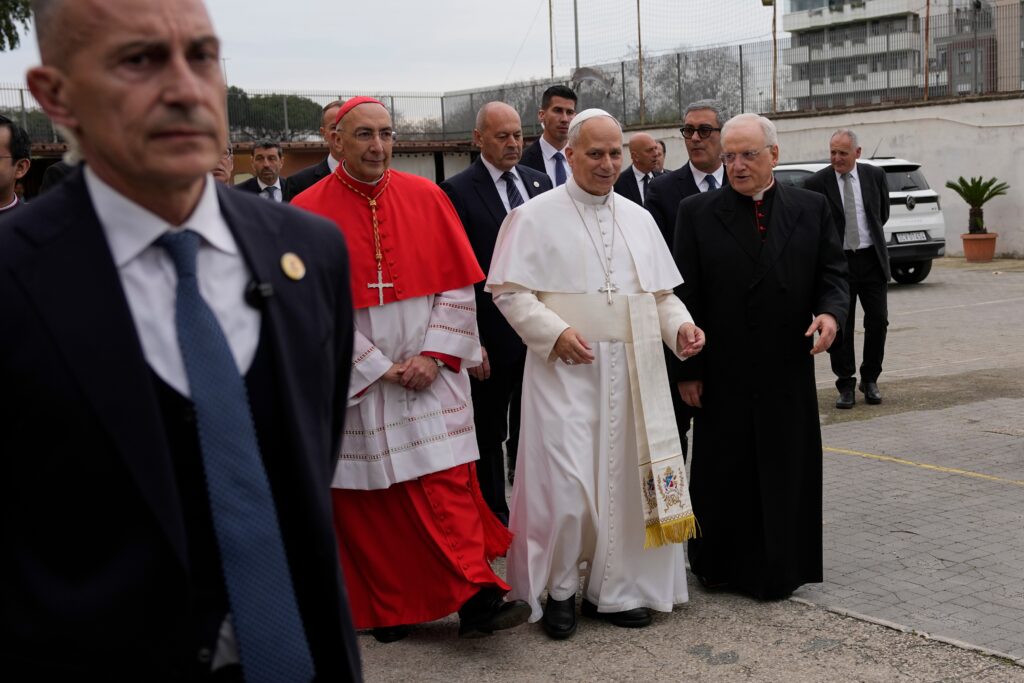
Pope Leo XIV’s first response was a tempered call for peace using a finely honed restraint that he has largely repeated. From a window high above St. Peter’s Square, Leo did not assess blame, and instead expressed his “heartfelt” wish that “diplomacy” would regain “its proper role.” On Friday, without naming anyone, Leo asked whether Christian leaders who go to war “have the humility and courage to seriously examine their conscience and undergo confession?”
The split-screen response shows how the first U.S.-born pope is navigating a minefield as the Trump administration projects American nativism at home and deadly force overseas in a manner not seen in generations. How can Leo, a global spokesman for peace and human dignity, manage messaging on the Trump administration — including actions the Vatican views as contrary to Catholic teaching — while hewing to his expressed wish last year to avoid “partisan politics” and to not “promote polarization in the Church?”
The pope is not interested in a confrontation with Trump, according to four Vatican officials, who spoke on the condition of anonymity to address a sensitive issue, but he will speak up when warranted as he did last fall, when he described a crackdown on migrants in the United States as “inhuman” and criticized the war talk at a meeting of military leaders called by Defense Secretary Pete Hegseth.
Vatican officials describe Leo as a unifier and bridge builder, and his response to war in the Middle East, they say, is an example of his preferred approach: remaining above the fray while allies in the Holy See and U.S. cardinals and bishops more directly challenge the administration. That strategy reverts to a papal tradition of pontiffs having national churches take the lead in addressing their governments.
Pope Francis was an exception. Leo’s freewheeling predecessor was famous for interjections that sent the Vatican into damage control mode — from saying that NATO may have “provoked” Russia’s war in Ukraine to describing Israel’s assault in Gaza as “terrorism.”
In 2016, Francis implied that Trump, then running for his first term, was “not Christian” for wanting a wall on the Mexican border, and years later appeared to call outVice President JD Vance for misinterpreting Catholic teaching.
In an era of an unbridled White House, Leo’s effort to “lower the tone” risks opening him up to criticism — especially given his American nationality. The Iranian Embassy to the Holy See, for instance, sent a letter to the Vatican on Monday, which the embassy provided to The Washington Post, encouraging Leo himself to declare the war a violation of international law.
“People who know will understand that [Leo] is letting the American church speak for him,” said Massimo Faggioli, a professor in ecclesiology at Trinity College Dublin. “But some people could say ‘he’s not naming America because he’s American.’ That’s a new problem for the Vatican.”
Some on the left “find him too diplomatic. They have a nostalgia for the direct approach of Pope Francis,” one of the Vatican officials said. “But he does not want to add to the polarization and the way he words things makes it more difficult to attack the pope. Maybe for the media it is not simple to present this kind of prophecy. But if you read his speeches, he has a strong point of view. Intellectual people will understand what he is saying, and what he is against.”
Leo is not averse to making a statement.
He has opted to visit Lampedusa — an Italian island famous as an arrival point for migrants — on July Fourth, the 250th Anniversary of U.S. independence. That visit stands to create a stark contrast: the president attending what the White House calls “one of grandest displays of patriotism that the world has ever seen” on one side of the Atlantic, while the new American pope highlights the plight of desperate migrants on the other.
Earlier this year, social media posts proliferated in left-leaning circles claiming that Leo had declined an invitation from Trump — hand delivered by Vance last year — to visit the White House for the July Fourth celebrations.
Though the Vatican has said Leo would not be visiting the U.S. this year, a White House official told The Post that its invitation was not tied to Independence Day. Trump’s “letter to Pope Leo had nothing to do with July Fourth America 250 celebrations,” the official said, speaking on the condition of anonymity to discuss the diplomacy surrounding the invitation.
Vatican officials say Leo’s decision to go to Lampedusa was not aimed at the administration. “Reading into the July 4 trip anti-U.S. government messaging is just plain wrong,” a second Vatican official said. “With Pope Leo, the messaging is always positive.”
Gestures like the Lampedusa trip illustrate “another way of being American,” the second official added, “even though it’s not the way of others — it’s the way [of someone] unafraid of the world, of someone who has no preclusion toward the world.”
Leo has made clear his preference to steer clear of national politics. “I think that it would be much more appropriate for the leadership in the Church within the United States to engage him,” he said, responding to questions about engaging Trump for a biography by journalist Elise Ann Allen, 2½ months after he became pope.
That is precisely what is happening now.
Prominent U.S. bishops and their body, the U.S. Conference of Catholic Bishops, have spoken out repeatedly on Trump, often about the treatment of migrants, but also on America’s growing military aggression and the slashing of foreign aid.
Last fall, the conference — which includes many conservatives as well as more liberal bishops — voted, by 215 to 5, to approve a rare communal statement addressing “the evolving situation impacting immigrants in the United States.” The bishops said they “oppose the indiscriminate mass deportation of people. We pray for an end to dehumanizing rhetoric and violence, whether directed at immigrants or at law enforcement.”
After Trump toppled the leader of Venezuela and threatened to seize Greenland, the new U.S. pope addressed his diplomatic corps with a warning about a spreading “zeal for war” — but he did not mention any specific actor. Later that month, however, the three highest-ranking clerics in the United States said America’s moral role in the world was coming into question.
Last month the bishops again challenged the White House. Nearly two dozen bishops from locations along the border published a four-page statement detailing immigration reforms they said honor human dignity. The situation in the U.S., they said, “is detrimental to the human rights of our fellow human beings and not in the best interest of the nation.”
The bishops also lambasted the administration for its plan to spend billions on mass detention centers that will imprison thousands. “Aside from the internment camps used to incarcerate Japanese Americans in the 1940s, such facilities have no precedent in American history,” they wrote.
In an interview with The Post last month, Vance, a Catholic convert, said: “I think the Catholic Church — the institutional Catholic Church — it’s in a difficult spot, because it has to minister to everybody, whether you’re a prisoner who’s committed a crime, or whether you’re an illegal immigrant who’s coming to the country illegally, or whether you’re a father of three expecting a fourth on the way, they have to minister to so many different people. And I admire that spirit. I admire that Christian charity.”
Politicians, however, play another role, Vance added. “I also recognize that I have a different job, and my job is to make sure that the American people are as safe and prosperous as they can be,” he said.
Parolin, the Vatican’s secretary of state who speaks for the pope, delivered a blunt missive against the Trump administration’s preemptive strike on Iran. “If states were to be recognized as having a right to ‘preventive war’ … the whole world would risk being set ablaze,” he told the Holy See’s official news outlet.
In a March 7 public statement, Cupich, a confidant of Leo’s, took aim at “Justice the American Way,” a video clip posted on the official White House X account that spliced scenes from Hollywood movies with real-world strike footage.
Cupich described the clip as “sickening,” especially after “scores of children” had lost their lives in the bombing of Iranian school and he added that U.S. soldiers slain in the war “are also dishonored by that social media post.” Cupich met with Leo during a trip to Rome, three days before issuing his statement.
In an interview with The Post, Cupich declined to comment on the details of his meeting with Leo, but said U.S. bishops were not “getting directions from the Holy Father in some secret way or backdoor way.” Instead, he said, Leo was more broadly directing bishops to “take responsibility for what’s happening in their country.”
“I think that it’s a lot easier when the Holy Father speaks like an American to bishops and gives language to us that is familiar,” Cupich said, adding, “I think that we have come to a new moment in which our conference does see that as a group we have to speak on these issues and the hesitancy … seems now to have evaporated.”
In the months before Leo assumed the papacy, posts by an X account in his name repeatedly criticized the Trump administration. The Vatican has refused to confirm or deny whether the account belonged to the future pope.
Asked about the criticisms expressed in those posts, and Leo’s tone today, Cupich said: “Nobody should be surprised that there’s a difference between what was said before and what is said now. He is now Leo XIV, which is a different role.”
Boorstein reported from Washington. Natalie Allison in Washington and Stefano Pitrelli in Rome contributed to this report.
The post To criticize an American-led war, an American pope turns to allies appeared first on Washington Post.