Her vision went dark. She was facedown, and everything below her chest felt numb. A moment before, two hands had grabbed Emine Yilmaz from behind and slammed her head into a racing E train as she stood on a subway platform in Manhattan.
For nearly three years, she has replayed the brief seconds of that Sunday morning, when her 5 a.m. commute to an extra shift as a barista was disrupted by a random, violent act.
The man who attacked her, Kamal Semrade, was convicted this month of attempted murder and assault. For Ms. Yilmaz, 38, the trial was an opportunity to confront Mr. Semrade, as well as a chance to tell a jury how those seconds in May 2023 changed her life.
“I am unable to work,” she testified from a wheelchair. “I can’t walk. I need 24 hours of assistance. I experience spasms. I have low blood pressure. I feel too much pain.”
The prospect of being pushed in front of a subway train is every New Yorker’s nightmare. There are more than one billion subway rides each year; 19 people were pushed onto the tracks in 2025, according to the Police Department.
This month, a stranger pushed two people onto the tracks at the station where Ms. Yilmaz was attacked. One, an 83-year-old man, was left brain dead. The lives of those who survive are irrevocably changed, as they grapple with trauma both physical and emotional. Ms. Yilmaz’s story offers insight into one person’s struggle.
In a series of interviews spanning two years, Ms. Yilmaz told The New York Times about her recovery. She’s shattered and angry. But she’s learning how to reclaim her life.
“I tried to survive in that situation,” she said. “I’m still doing the same thing.”
On the day she was attacked, Ms. Yilmaz was taken from the subway platform to NewYork-Presbyterian/Weill Cornell hospital. She was then rushed into a 14-hour surgery after it was discovered that her neck had been broken. Within days, Ms. Yilmaz was told that she would be paralyzed for the rest of her life.
She could not move her legs and could only partially lift her arms. She could not shower or use the toilet. Brushing her teeth, eating on her own — all lost to her. And she could not draw, the activity she held most dear.
In the weeks after the attack, the extent of her injuries plunged Ms. Yilmaz into despair.
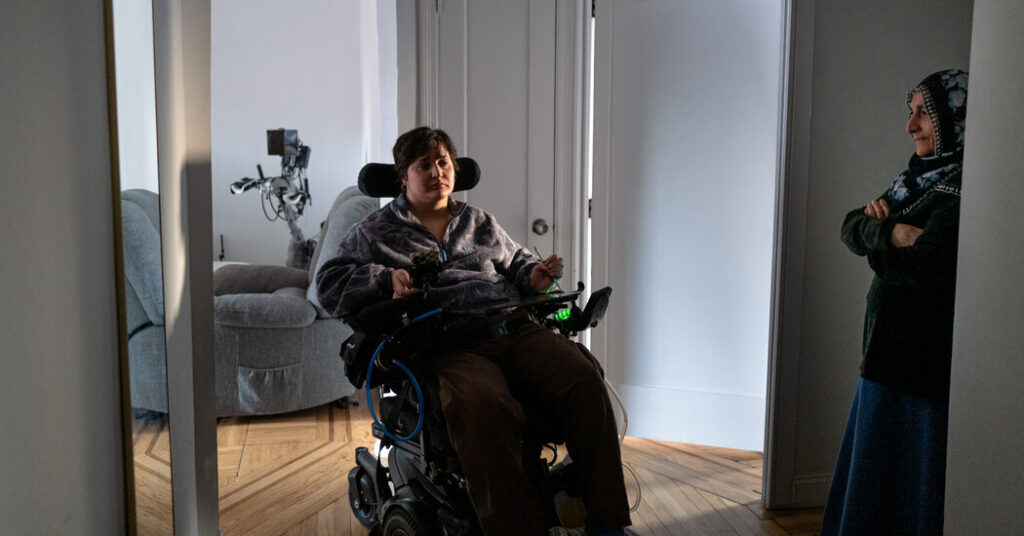
After intensive care, she returned to her one-bedroom apartment in Queens, where a roster of home care aides rotated in and out.
For several months, she laid in bed or sat in her wheelchair, she said, asking “Why me?”
“In that darkness, eventually something bright came out,” Ms. Yilmaz said: “My relationship with my family.”
Ms. Yilmaz’s mother and younger sister moved to Queens to be with her, putting their lives in Turkey on hold.
In the United States on temporary visas, her mother and sister stay with her for several months at a time. And her husband, Ferdi Ozsoy, moved back to Queens to help her, despite the couple being separated.
Her mother, Necude Yilmaz, has shouldered Ms. Yilmaz’s care — waking up early in the morning to give her medicine, massaging her muscles daily and cooking every meal at home.
Under her mother’s care, Ms. Yilmaz began to strive to regain some of her independence.
She mastered voice command on her phone. She bought an adaptive headset to help her navigate a laptop. A native Kurdish and Turkish speaker, she focused on improving her English, expanding her vocabulary by communicating with doctors and watching television. She took over the logistics of scheduling all of her medical appointments.
But the biggest turning point was getting an electric wheelchair.
On a night in May 2024, sitting next to Ms. Yilmaz in her dimly lit living room, Mr. Ozsoy described watching her embrace her newfound mobility. Mr. Ozsoy, who has remained close to Ms. Yilmaz, said she was learning the chair’s features. “We have dents all over the walls,” he said, laughing.
“Going from the manual wheelchair to a power wheelchair, the comfort and difference of both of them, was extremely, extremely noticeable,” Mr. Ozsoy said, adding: “Yesterday, she went out of the house for the first time on her own.”
As Ms. Yilmaz began to venture outdoors, physical therapy became her semiweekly escape from her apartment.
On the basement floor of Mount Sinai Health System’s Upper East Side campus in June, two physical therapists carefully strapped Ms. Yilmaz into a robotic exoskeleton. The machine, called an EksoNR, is designed to help people with spinal cord injuries practice walking. Ms. Yilmaz is one of a handful of people enrolled in a therapy program at the hospital that uses such a device.
Once Ms. Yilmaz was harnessed into the machine, one of the therapists, Jessica Polizzi, programmed the device to move.
Ms. Yilmaz began to slowly march down the windowless room while Ms. Polizzi held lightly onto her back. But halfway across the room, Ms. Yilmaz’s expression changed. Standing upright had made her blood pressure drop. She said she felt like she might faint. The therapists quickly peeled the machine off her and moved her to her wheelchair.
The machine “gives me hope,” Ms. Yilmaz said two months before the therapy session. “I will walk.” In physical therapy and at home, she regularly tests how far she can push her body.
Ms. Yilmaz has undergone six surgeries. Dr. Michael Hausman, an orthopedic surgeon at Mount Sinai Health System, has performed several, including procedures in which he has connected nerves that are still working to paralyzed muscles in order to make them functional again. The surgeries can take up to six hours, he said, and the recovery can last a year or more.
During Ms. Yilmaz’s most recent surgery, which took place last year, Dr. Hausman said he had rerouted her tendons so her hands, which had been stuck palms up, faced down. She was able to type and draw again with her left hand.
Had Ms. Yilmaz not been so highly motivated to improve, Dr. Hausman said, the surgeries would have been less successful.
“There are understandably some people who, after such a devastating injury, just give up,” he said. “And she is not that person.”
Unable to work, Ms. Yilmaz survives off donations from a GoFundMe page launched three years ago — which raised about $280,000 — and government aid, about $600 a month in Social Security payments and $290 per month in food assistance.
Her health care is covered through Medicaid and many of the devices she needs, like the bicycle she exercises on, and some supplies, were purchased with assistance from New York State’s Office of Victim Services, an agency Ms. Yilmaz credits for improving her quality of life.
She pays everything else out of pocket, including $1,500 for her rent-stabilized apartment.
Ms. Yilmaz has filed a lawsuit against the city and the Metropolitan Transportation Authority, which runs the city’s public transit system. The suit claims that the city and the state were neglectful in not installing barriers to keep commuters safe on subway platforms. A settlement, if she receive one, would provide a financial lifeline.
Sill, in a life consumed by logistics, Ms. Yilmaz has managed to find time for fun.
In November, she attended a concert on the Upper West Side with her mother and sister. It was the second time she had seen Aynur Dogan, a Kurdish pop-folk singer, and this time she got to sit in the front row because of her wheelchair.
Ms. Dogan saw her, she recalled, and sang to her directly. “I think she got emotional,” Ms. Yilmaz said.
Ms. Yilmaz, who became a U.S. citizen last year, said the show made her yearn to return to Turkey, her birthplace, and to once again spend time in the Kurdish cities filled with her family and traditions.
In the afternoon of the first day of Mr. Semrade’s trial, the jury was asked to file out of the court and into a back room. As soon as they left, a path was cleared so Ms. Yilmaz could navigate her electric wheelchair through the courtroom and park it in front of the witness stand. Court staff members spent minutes attaching a clip-on microphone to her purple zip-up sweatshirt before escorting the jurors back into the room.
For nearly 30 minutes, Ms. Yilmaz testified, answering questions from a prosecutor with the Manhattan district attorney’s office. She told jurors how she moved to New York City in 2017 and tried to make a living as an artist and graphic designer. When she couldn’t make ends meet, she said she started working as a barista.
On the morning of May 21, 2023, she woke up at 4:30 a.m. to get ready for work, leaving home about an hour later. She walked about 10 minutes from her apartment in Jackson Heights, Queens, to the Roosevelt Avenue subway station to take the E train, which was running on the F line at the time, into Manhattan.
Ms. Yilmaz told the jury that when she got off at her stop, Lexington Avenue and 63rd Street, she paused near a stairwell to double-check the address of the cafe where she was working that day.
“Suddenly everything went dark,” she testified. “I opened my eyes on the platform lying facedown, and my head was covered with blood. And I was terrified.”
As she gestured, describing the series of surgeries she had on her arms, the microphone fell. She paused, looking down at the device dangling from her sweatshirt. Unable to put it back herself, she waited for a court officer to rush over. She took deep breaths and held back tears.
The jury convicted Mr. Semrade one week later.
“I hope he gets life sentence and suffers miserably there,” Ms. Yilmaz said following the verdict.
In the past, Ms. Yilmaz used her art as a form of therapy. In the years after her injury, it became a way to “settle my mind,” she said.
“I know it’s not the same style,” Ms. Yilmaz said of her new art one day as she looked through a book of her fresh watercolors. A self-described perfectionist, her past work had been meticulous. “But I still like it,” she said.
In December, she sat in her wheelchair in her Queens apartment, the sun streaming into her living room. She maneuvered a stylus pen attached to her left hand by a cuff, painstakingly drawing and redrawing an image on her iPad.
If she needed to select a new color, she would call someone over to touch it on the tablet. She often took breaks. She worked for several minutes until the pain shooting up her arm became unbearable.
Slowly, over three days, Ms. Yilmaz drew a portrait that included her, with a new haircut, sitting next to her younger sister. Their mother stood behind them, embracing them.
Hurubie Meko is a Times reporter covering criminal justice in New York, with a focus on the Manhattan district attorney’s office and state courts.
The post She Was Paralyzed by a Subway Train. Today, She’s Reclaiming Her Life. appeared first on New York Times.