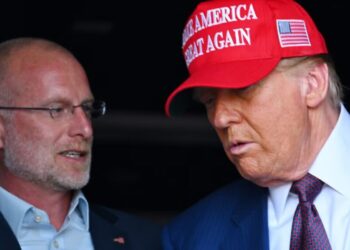
Less than a month into his job, the new United States ambassador to South Africa delivered some harsh words against the government.
He claimed that South Africa had more than 150 laws “aimed against whites,” and that the Trump administration was “running out of patience” with the South African government.
He made veiled comments about South Africa’s president, Cyril Ramaphosa, subtly accusing him of “insulting our president,” an apparent reference to Mr. Ramaphosa’s criticisms of President Trump in a recent interview with The New York Times. And he rejected a South African court’s ruling that an anti-apartheid song was not hate speech. “I don’t care what your courts say,” said the ambassador, L. Brent Bozell III, speaking at a business forum in the Western Cape Province.
After making those statements, Mr. Bozell was summoned by the foreign minister on Wednesday to explain his “undiplomatic remarks.”
This latest clash between the United States and South Africa illustrates how deeply relations between the two governments have fallen. Early last year, South African officials worked hard to explain their policies to the Trump administration, eager to find common ground with their nation’s second-largest trading partner. They sent envoys and requested meetings.
Now, South Africa appears to have given up trying to reason with Trump officials on subjects like the killing of white farmers, government land seizures and laws meant to redress the legacy of apartheid. “We will not be bullied,” Mr. Ramaphosa said in his state of the nation addresses last month and last year.
South African officials have realized that “trying to explain or clarify or debunk those negative narratives is a largely futile exercise,” said Ziyanda Stuurman, a Cape Town-based adviser at Africa Practice, a strategic advisory firm. “Ultimately, right now, I think that the relationship is in a state of managed decline where neither side will climb down from their view of the other.”
This icy posture with the United States carries great risk for South Africa, a much smaller country. But South Africa also has a history of diversifying its alliances with the hope of making itself less reliant on global superpowers. That strategy of seeking out like-minded middle powers has become more pronounced amid global disruptions caused by Mr. Trump, analysts say.
On the same day that Mr. Bozell made his remarks, Mr. Ramaphosa was on a state visit to Brazil, where its president, Luiz Inácio Lula da Silva, suggested that their nations deepen defense cooperation. “I don’t know if Comrade Ramaphosa realizes that if we don’t prepare in terms of defense, one day someone might invade us,” he said during a joint news conference.
“We have a lot to learn from each other,” Mr. Ramaphosa replied.
As the leader of Africa’s largest economy, Mr. Ramaphosa has long trumpeted the role of middle powers on the global stage. In his interview with The Times last month, he criticized what he described as attempts by some countries to dominate others using economic pressure and other levers.
“We’ve now arrived, and it is wrong for us to keep on being locked out of the door,” he said. “Much as we are small or middle power countries, respect us as well and deal with us on the basis of respecting our sovereignty and seeking to advance the interests of all.”
But Mr. Ramaphosa and his government have been accused, even by allies, of not always practicing what they preach. After Russia invaded Ukraine four years ago, South Africa walked back its initial statement that Russian troops should withdraw, a move that angered its European partners.
Mr. Ramaphosa also drew condemnation this month for sending a condolence letter to the Iranian embassy after the country’s supreme leader was killed by U.S.-Israeli bombings.
South Africa’s critics have argued that its claims of nonalignment have been used as a tactic by the governing party, the African National Congress, to maintain alliances with apartheid-era allies that the West now views as enemies, such as Cuba and Russia.
“Nonalignment is used to pretend neutrality as cover for aligning with anti-Western interests,” Joshua Meservey, a senior fellow at the Hudson Institute, a conservative think tank, wrote in a thread on X. “SA has openly aligned against the US on key issues for decades, something the US ignored until recently.”
At the business conference, Mr. Bozell said he was also concerned about “South Africa’s growing engagement with some of America’s greatest adversaries,” an apparent reference to Tehran.
After his meeting with South African officials, Mr. Bozell clarified his remarks on social media on Wednesday, in an effort to bring down the temperature. But the substance of his comments has not changed.
“If the U.S. ambassador sticks to his guns on these issues,” said Priyal Singh, a senior researcher at the Institute for Security Studies, a South African think tank, “it’s definitely going to be a tough couple of years for South Africa and the U.S.”
John Eligon is the Johannesburg bureau chief for The Times, covering a wide range of events and trends that influence and shape the lives of ordinary people across southern Africa.
The post New U.S. Diplomat Was Not So Diplomatic. South Africa Pushed Back. appeared first on New York Times.