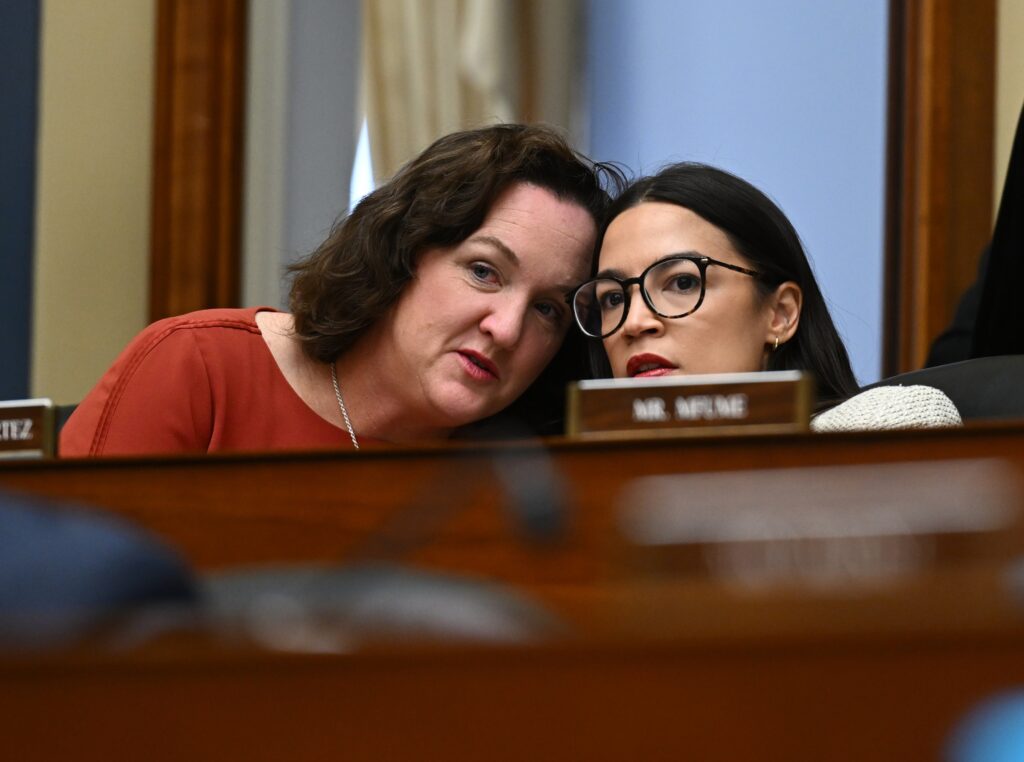
One of the most consequential trends in American politics is that Democrats are increasingly discovering what Republicans have known for decades: Voters don’t like taxes. Now the gubernatorial primary in California has become an experiment in how far tax cuts might take a Democratic politician in one of the country’s bluest states.
Katie Porter, one of the most progressive legislators during her six years in Congress, is running for governor and polling in the middle of a crowded field. To boost her languishing campaign, she has proposed eliminating state income taxes — for households making under $100,000 a year.
“I’ll work the issue at both ends,” she tweeted on Friday. “Lowering taxes for those who are struggling and raising them on the biggest corporations that can afford to pay.”
It’s encouraging to see a California politician acknowledge that high taxes have made the state’s residents struggle, and no doubt families would benefit from having a few thousand dollars more to budget each year. States like Mississippi and Indiana, which already have lower tax burdens, are also trying to phase out income taxes for everyone.
Yet those states are doing so over the course of many years, with deficit targets blocking cuts that wouldn’t be fiscally appropriate. Porter’s idea isn’t a plan so much as a slogan, and it presents plenty of problems.
For one, rather than push for spending cuts to match the tax cuts, Porter simply says she’ll go after corporations to help tackle California’s estimated $18 billion deficit. The state already ranks 48th in the Tax Foundation’s State Tax Competitiveness Index, and it can always get worse.
To her credit, Porter has rejected a disastrous wealth tax that could appear on the ballot in November. Yet that doesn’t mean she wouldn’t go after the “rich” in other ways, even though the top 1 percent of earners in California already contribute about 45 percent of state income taxes. Households making less than $100,000 contribute around 10 percent, though estimates vary.
Further raising taxes on the wealthiest – and most mobile – people in her state is risky and not guaranteed to increase revenue. Even if it does, California already suffers from wide fluctuations because it relies on so few people to pay so much.
Yet Porter also contradicts herself. Ever since President Donald Trump embarked on his tariff campaign, Democrats have rightly pointed out that higher taxes on corporations get passed down to the consumer. Porter herself has vowed to “fight Trump Administration policies like counterproductive tariffs that will only hit you in the pocketbook with higher prices for necessities and make the problem worse.” Why would Trump’s taxes on corporations affect prices but not hers?
The biggest problem, however, is that the plan is dishonest. Rep. Ro Khanna (D-California) responded this way to Porter: “So how will we pay for single payer healthcare? One of the things I admire about Bernie Sanders is he is honest that people need to pay taxes to fund foundational social services in healthcare, education, & childcare. The taxes should be progressive. But the math needs to work.”
Khanna is an imperfect messenger, but he’s right. The reality is that while both parties have tax cut fever, too few politicians on either side of the aisle are honest about how revenue and spending need to balance. Rather than tweaking the tax code to benefit select groups, everyone would be better off if politicians focused on growing the pie rather than dividing it up in increasingly complex ways.
The post Katie Porter’s income tax fever dream appeared first on Washington Post.