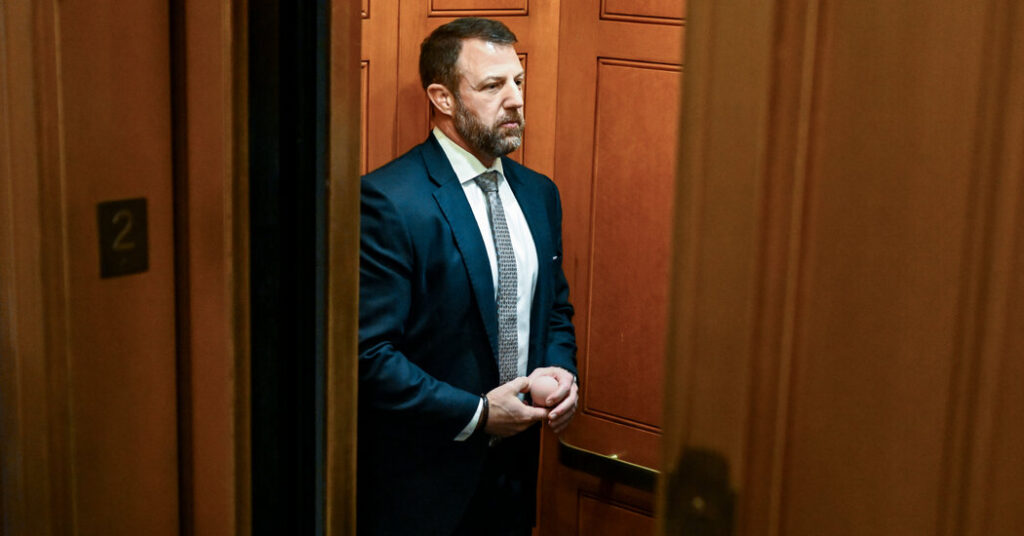
A few days after Christmas, Senator Markwayne Mullin’s expansive stock portfolio got significantly bigger.
Mr. Mullin reported buying shares in Chevron, the only major U.S. oil company producing in Venezuela. Five days after the purchase, President Trump attacked Venezuela, demanding that its leadership give better terms to U.S. oil companies. Chevron’s stock price has since jumped, even as the market as a whole has slipped.
The Chevron transaction, which Mr. Mullin reported in January, was among as much as $2.8 million he invested in 31 companies on Dec. 29 — and part of a pattern of large and frequent trades that has made him one of the most prolific stock buyers in Congress.
There is no indication that Mr. Mullin, an Oklahoma Republican and member of the Senate Armed Services Committee who has said he speaks with Mr. Trump “all the time,” had inside knowledge of the administration’s plans before those stock transactions. Federal law doesn’t prohibit members of Congress from trading stock, even in industries overseen by committees on which they serve.
But Mr. Mullin’s financial dealings take on new importance this week as the Senate is set to consider his nomination to lead the Homeland Security Department, which is issuing billions of dollars in new contracts as part of the administration’s immigration crackdown.
Many prominent leaders, including Mr. Trump, have called for new limits on stock trading by lawmakers and their families, arguing that unfettered trading creates the potential for government officials to make decisions that benefit their private interests rather than those of the public. The previous secretary, Kristi Noem, was ousted by Mr. Trump amid questions about conflicts of interest at D.H.S.
A spokeswoman for Mr. Mullin said the senator does not personally direct or inform his family’s stock purchases and complies with all laws and ethics rules. “Senator Mullin uses an independent, third-party operator firm that manages all stock investments on his behalf,” she said in a statement.
Abigail Jackson, a White House spokeswoman, added that, if confirmed as D.H.S. secretary, Mr. Mullin “will comply with all ethics and conflict of interest rules, just as every cabinet secretary does.”
Mr. Mullin’s frequent trading, which ramped up after he joined the Senate three years ago, has contributed to a level of personal wealth that has ballooned since he arrived in Washington in 2013 to represent an eastern Oklahoma House district. His assets were worth between $29 million and $97 million in 2024, according to his financial disclosure forms, compared with $2.8 million to $9 million in 2012. (Congressional rules only require lawmakers to report the value of their assets within broad ranges.)
Mr. Mullin also reported liabilities — a mortgage and a line of credit — valued at between $6 million and $30 million.
Members of Congress are required to disclose their stock transactions on a regular basis, but have to reveal their wealth only once a year. Mr. Mullin’s 2024 annual report is the most recent available. His spokeswoman declined to share more up-to-date or precise figures for Mr. Mullin’s total wealth.
Frequent stock trading is a recent addition to Mr. Mullin’s investment strategy. For his first eight years in Congress, most of Mr. Mullin’s wealth came from the value of his family’s plumbing company. His financial disclosure documents from that period report just a handful of individual stocks and trades.
After selling his company in 2021, Mr. Mullin reported fewer than 30 stock trades in 2022, which were listed under his wife, according to an analysis of his disclosure forms by The New York Times. In 2023, his first year as a senator, Mr. Mullin reported more than 100 trades, rising to more than 130 trades last year. In the first two months of this year alone, he has reported 40 stock trades. Those figures include trades in Mr. Mullin’s name, in his wife’s name, and in both their names.
Mr. Mullin’s transaction records reveal not just frequent trades, but successful ones too. From 2024 to 2026, the returns on Mr. Mullin’s stock purchases outperformed the market by 8 percent, according to Bruce Sacerdote, a Dartmouth economist who examined Mr. Mullin’s trades at the request of The Times and has researched stock trading among members of Congress.
“None of this is evidence of insider trading,” Mr. Sacerdote said. “This could be blind luck.”
Lawmakers face few restrictions on buying and selling stocks. They are allowed to own shares in companies that have business before the committees they serve on.
The companies in which the Mullins have bought and sold shares run the gamut of major brands at the core of many Americans’ stock portfolios — Amazon, Coca-Cola, Apple and American Express, to name a few. But many of the companies, such as those in health care and defense, can be affected by committees that Mr. Mullin serves on, potentially giving him access to important information before it becomes public. In addition to Armed Services, Mr. Mullin serves on the Senate health and Indian affairs committees as well as various appropriations subcommittees.
The permissive rules make it hard for Americans to know if their representatives are acting in the public interest or making decisions to benefit themselves, argued Delaney Marsco, director of ethics for the Campaign Legal Center, a nonprofit watchdog group.
“These people have whole staffs dedicated to collecting information and putting it in a neat pile on their desk. They have access to members of industry, lobbyists who are talking to them all day, trying to get their ear,” Ms. Marsco said.
Ethics experts expressed concern that any public official with a history of frequent stock trades runs a higher risk of blurring the line between their public role and private interests. Congress last year approved a large funding increase for the Department of Homeland Security.
Mr. Mullin’s financial disclosures show he has owned shares in several companies that have had significant contracts with the department. Those include Microsoft; VSE Corporation, which maintains and repairs aircraft; and RTX, a leading defense contractor.
Mr. Mullin’s spokeswoman did not directly respond to questions about whether, if confirmed to lead D.H.S., he would stop trading stock in companies that have contracts with the department. She said that Mr. Mullin would follow the law and comply with recommendations he receives from the Office of Government Ethics.
Under current law, members of Congress are required to disclose their stock trades within 45 days. Mr. Mullin has sometimes failed to meet that requirement.
In 2024, the Campaign Legal Center filed a complaint with the Senate ethics committee, accusing Mr. Mullin of failing to disclose nine stock purchases in 2023, worth as much as $135,000. Almost a year after the complaint, and two and a half years after the purchases, Mr. Mullin filed forms documenting those trades.
Mr. Mullin, 48, was first elected in 2012, billing himself as an outsider. He reported a net worth between $2.8 million and $9 million, according to his financial disclosure form. At the time most of Mr. Mullin’s wealth was from the value of his family’s business, which provided residential and commercial plumbing, HVAC and septic systems. Mr. Mullin had taken over the business from his father when he was 20.
One of Mr. Mullin’s first major forays into stocks appears to be his purchase of between $100,001 and $250,000 worth of shares in a tiny Australian biotech company called Innate Immunotherapeutics in January 2017. The company was working on a drug to treat multiple sclerosis. Mr. Mullin sat on the committee that oversaw the Food and Drug Administration, which would need to approve the drug.
Mr. Mullin’s colleague on the committee, a Republican representative from upstate New York named Chris Collins, also sat on Innate’s board of directors. In an interview, Mr. Collins recalled encouraging everyone he knew to buy stock in the company — family, members of Congress, even his neighbors. “I was so proud of the work we were doing,” Mr. Collins said. “There was nothing wrong with me telling them.”
Then, that summer, the drug failed its Phase 2 trial. Mr. Collins told his son, who also owned shares and who then sold some of them before the trial results were announced publicly. Mr. Collins was charged with insider trading for sharing the information with his son, and eventually sent to prison.
Mr. Collins, who was pardoned by Mr. Trump in 2020, said he never shared information about the trial results with other members of Congress, including Mr. Mullin.
In 2021, during his fifth term in Congress, Mr. Mullin sold his company to a private equity firm in Dallas.
The terms of the deal were not publicly announced, and Mr. Mullin didn’t report the sale on his 2021 financial disclosure form. But according to that form, on Dec. 10 — the same day he sold his company, according to the data provider PitchBook — Mr. Mullin moved between $25 million and $50 million into a cash management account.
Mr. Mullin’s office declined to answer questions about how much he was paid for his company.
The group that bought Mr. Mullin’s business is CenterOak Partners. Its chief executive officer is Randall Fojtasek; according to campaign finance records, he has donated primarily to Republican candidates, including former Gov. Rick Perry of Texas.
CenterOak did not respond to a request for comment. A man who answered the phone at a number registered to Mr. Fojtasek declined to identify himself or answer questions.
After the sale of his company, Mr. Mullin began acquiring stock more often.
In February 2025, for example, Mr. Mullin disclosed buying $15,001 to $50,000 worth of shares in L3Harris, one of the largest defense contractors in the United States, and one whose government business Mr. Mullin helps oversee from his position on the Armed Services Committee. He also reported buying another $15,001 to $50,000 of shares in the company in May.
The value of L3Harris shares has since increased by about 65 percent. The stock market overall has grown by just 13 percent during the same period.
Mr. Mullin also sits on the committee that oversees the health care industry. He reported buying between $50,001 and $100,000 worth of stock in Intuitive Surgical Inc., a California company that makes robots that help doctors perform surgery, in September. A few weeks later, Intuitive’s share price jumped by about 20 percent after it reported higher than expected earnings.
Stock trading has emerged as a persistent issue on Capitol Hill, with broad bipartisan support in the public for banning the practice but little progress by lawmakers.
In his State of the Union address last month, Mr. Trump urged Congress to pass the Stop Insider Trading Act, a measure that would put some stock-trading limits on lawmakers and their families.
“Let’s also ensure that members of Congress cannot corruptly profit from using insider information,” Mr. Trump said, singling out Representative Nancy Pelosi, Democrat of California, whose husband’s trading has drawn criticism.
Asked if Mr. Mullin supported the tighter trading rules that the president called for, Mr. Mullin’s spokeswoman said he is now focused on potentially serving as secretary, and added that he would defer to Congress.
Kate Kelly contributed reporting.
Christopher Flavelle is a Times reporter covering how President Trump is transforming the federal government.
The post How Trump’s Homeland Security Pick, a Prolific Investor, Got a Lot Wealthier in Congress appeared first on New York Times.