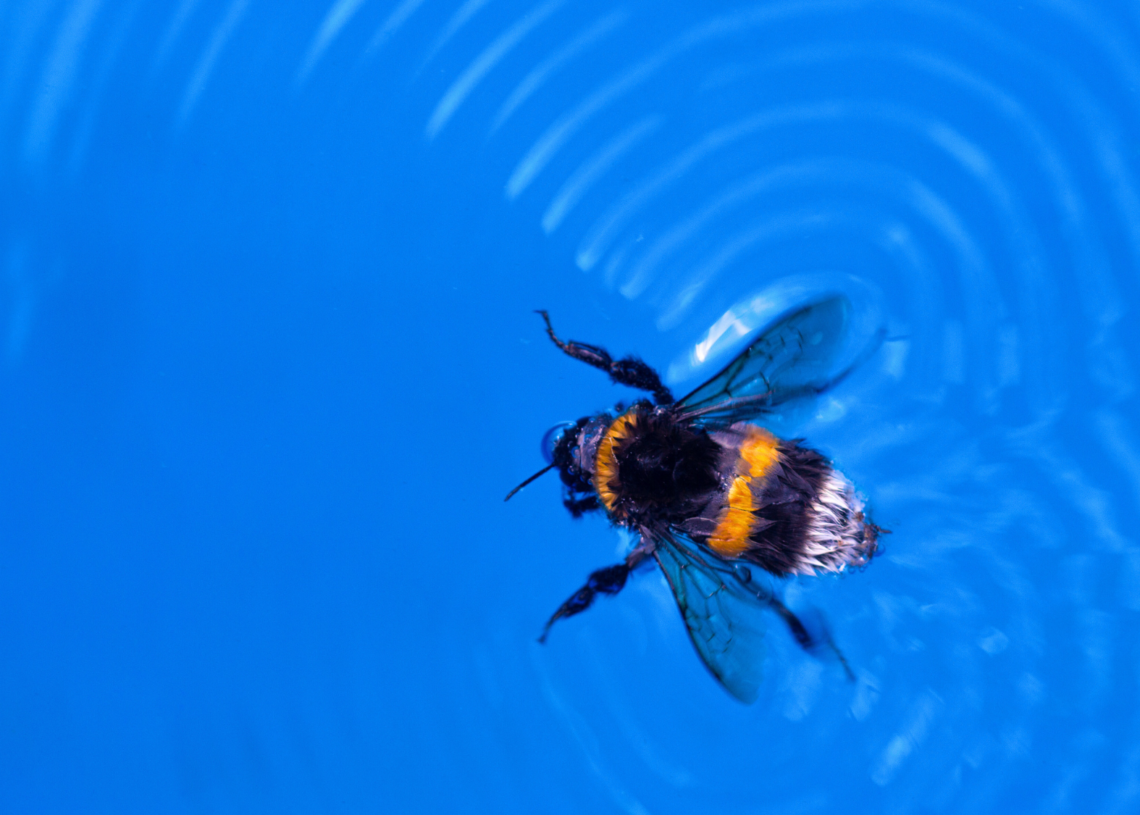
When the temperatures drop and the frigid winter air becomes too harsh for Queen bumblebees, they retreat underground for safety. But what happens if their underground hibernation palaces become flooded? Well, they are biologically prepared for such an eventuality, as new research has found that hibernating queens can survive fully submerged in water for up to a week… while still breathing.
As reported by the New York Times, with the research originally published in Proceedings of the Royal Society B, the research team was trying to find out more about the little-understood stage of the bumblebee lifecycle. After mating, queen bumblebees enter a hibernation-like state called diapause that can last 6 to 9 months. In that time, they hide in shallow underground burrows to wait out the cold months before emerging in the spring to start new colonies.
Those burrows aren’t surefire safe havens. They can be decimated by rainstorms and melting snow, flooding the chambers whether queens are resting. Scientists didn’t know how queens were surviving these floods. But they do now, and it all began with a lab accident. But a good one, not the horrifying ones that kick off B-movies (or Bee movies, in this case).
At the University of Guelph in Ontario, researcher Sabrina Rondeau was studying how pesticides affect overwintering bees. To mimic winter conditions, she placed queen bees in soil-filled tubes stored in a refrigerator. When condensation unexpectedly flooded some of the tubes, four queens ended up completely underwater.
Instead of drowning, they survived.
Follow-up experiments involving more than 100 queens of the common eastern bumblebee, Bombus impatiens, confirmed they could remain submerged for about seven days and fully recover.
Queen Bumblebees Can Cut Their Oxygen Needs by 99%
Sensors in controlled laboratory chambers revealed that the queens weren’t just holding their breath for an exceptionally long time. They kept consuming oxygen and producing carbon dioxide. I phrase it that way because the researchers know they were still breathing but don’t yet fully understand how.
It’s at least partially explained by diapause, their hibernation state in which queen bumblebees reduce their metabolism by about 99 percent, which means they don’t need nearly as much oxygen. When they are submerged in water, their metabolism slows down even more and is then supplemented with anaerobic metabolism, a process that generates energy without oxygen.
They don’t need much oxygen, but getting any at all while underwater is something the researchers can only theorize about, and right now a leading theory is that they have something called a “physical gill,” a thin layer of trapped air around the body that allows oxygen from surrounding water to diffuse inward while releasing carbon dioxide.
It’s a remarkable discovery that, in retrospect, it does make some sense considering that bumblebees evolved millions of years ago in cold, snowy climates. The ability to survive underwater was a necessity nobody noticed until now.
The post How Queen Bumblebees Are (Almost) Immune to Drowning appeared first on VICE.