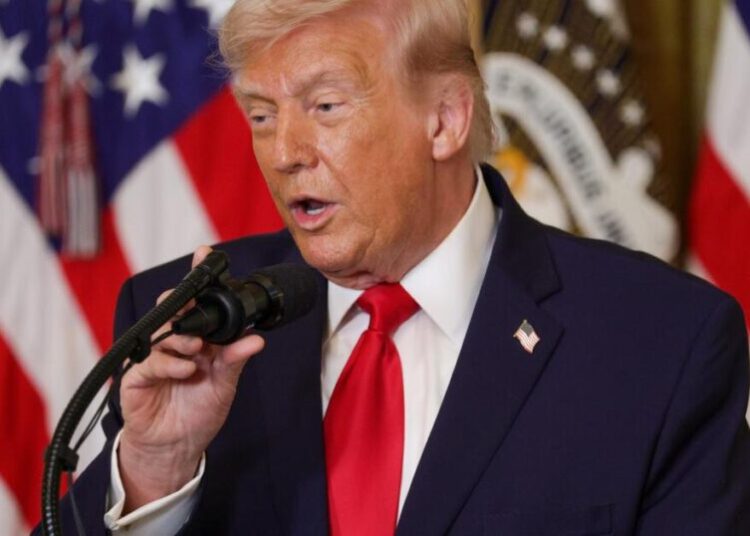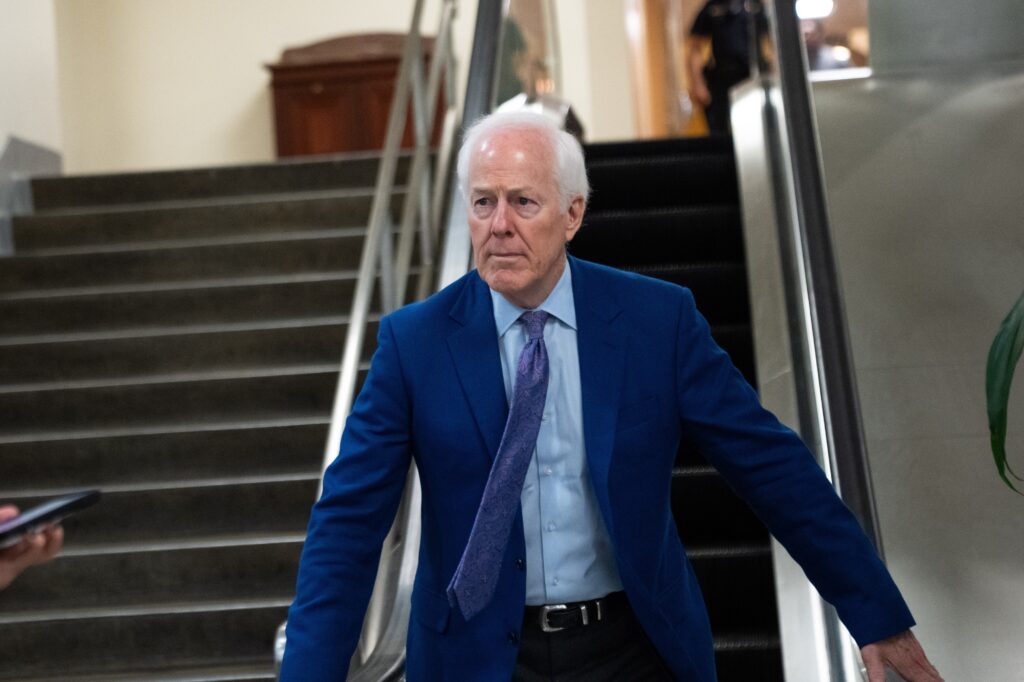
Sen. John Cornyn’s reversal on the Senate filibuster may or may not be sincere, but it is logical. The Texas Republican, facing a fierce primary challenge from the right, writes in the New York Post that he’s prepared to waive the Senate’s 60-vote requirement to pass strict new voting rules favored by President Donald Trump.
That supermajority threshold for most legislation has historically made it harder for the majority party to steamroll the minority. Cornyn (who has been in the Senate for nearly a quarter-century) argues that this arrangement used to make sense, but today’s Democratic Party can no longer be trusted to respect it.
He has a point. Democrats tried to blow up the Senate filibuster during Joe Biden’s presidency. In 2022, 48 Democratic senators voted to suspend the procedural guardrail and rewrite the country’s election laws on a party-line vote. As Cornyn notes, the two holdouts — Joe Manchin (West Virginia) and Kyrsten Sinema (Arizona) — couldn’t stay in the Democratic Party and are no longer in the Senate.
That close call, Cornyn argues, means that the filibuster is dead the moment Democrats control the Senate again, and the GOP needs to act accordingly to defend itself. As he puts it: “If a man takes a swing at you and barely misses, that doesn’t make him a pacifist — it just means he has bad aim.” Democrats, in his telling, already took their swing, and the GOP needs to swing back before it gets wiped out.
Republicans probably don’t have the votes to “go nuclear” this Congress to pass Trump’s favored election law or any other legislation, but the share of the Senate GOP caucus willing to throw caution to the wind is growing. The Democrats’ 2022 escalation failed to destroy the Senate filibuster, but it weakened the mutual deterrence that the filibuster relies on. This partisan logic contains lessons for Trump’s war on Iran.
Iran has been inveterately hostile to the United States for decades. But the U.S. has long managed to deter the regime from taking the two steps that would be most threatening to American interests: closing the Strait of Hormuz and building a nuclear weapon.
Sometimes maintaining that deterrence has required the application of military force. In 1988, an Iran mine severely damaged a U.S. Navy ship in the Persian Gulf. President Ronald Reagan responded by destroying half of Iran’s navy in Operation Preying Mantis. Last year, Trump set back Iran’s nuclear program with bunker-busting bombs in Operation Midnight Hammer.
The all-out war being waged today with Operation Epic Fury is different. It was not so much an effort to deter the regime as to destroy it. The U.S.-Israeli bombardment killed dozens of Iran’s top government officials, including the supreme leader, in its opening days. The regime predictably responded by maximally escalating: launching missile and drone barrages at its neighbors and in effect closing the Strait of Hormuz.
If the regime survives the U.S.-Israeli attempt on its life, as looks increasingly likely, where will deterrence stand? Think back to Cornyn’s logic on the filibuster: If your adversary “takes a swing at you and barely misses,” then you’d be a chump if you let that deter you in the future. Deterrence in the Senate is breaking down because Republicans already see Democrats as having escalated past the point of no return. There’s a good chance the surviving elements of the Iranian regime will see the U.S. the same way.
Like the Senate filibuster, there’s an argument that mutual deterrence between the U.S. and Iran was rational for both parties — not on every issue, of course, but on the crucial issues of nuclear weapons and the Strait of Hormuz. Now that one government has tried to wipe out the other, restraint will be a harder sell in the future. And the Islamic Republic’s “nuclear option” is literal, not figurative.
When deterrence erodes, incapacitation becomes more important. If the U.S. and Israel want to prevent Iran from closing the strait or lunging for a nuclear weapon, they’ll need to make sure it never rebuilds the capacity to do so after this war. That will be an arduous process, likely requiring further attacks. And there’s no guarantee that a future U.S. president will be up for them.
The best hope for avoiding a prolonged entanglement, then, is that Iran’s regime remains deterrable in the postwar period. Perhaps the U.S. is so powerful that it can still influence the regime’s behavior with measures short of war. After all, despite Cornyn’s professed change of heart, many Republican senators still don’t want to nuke the Senate filibuster — in part because they worry about an overwhelming Democratic response (such as packing the Supreme Court) when the tables turn.
But it seems much more likely than not that one party or the other will successfully invoke the nuclear option in the Senate in the next decade or two. The chances of Iran building a bomb are thankfully much lower — but, I fear, higher than they were before Trump started this war.
The post How deterrence fails — in the U.S. Senate and the Persian Gulf appeared first on Washington Post.