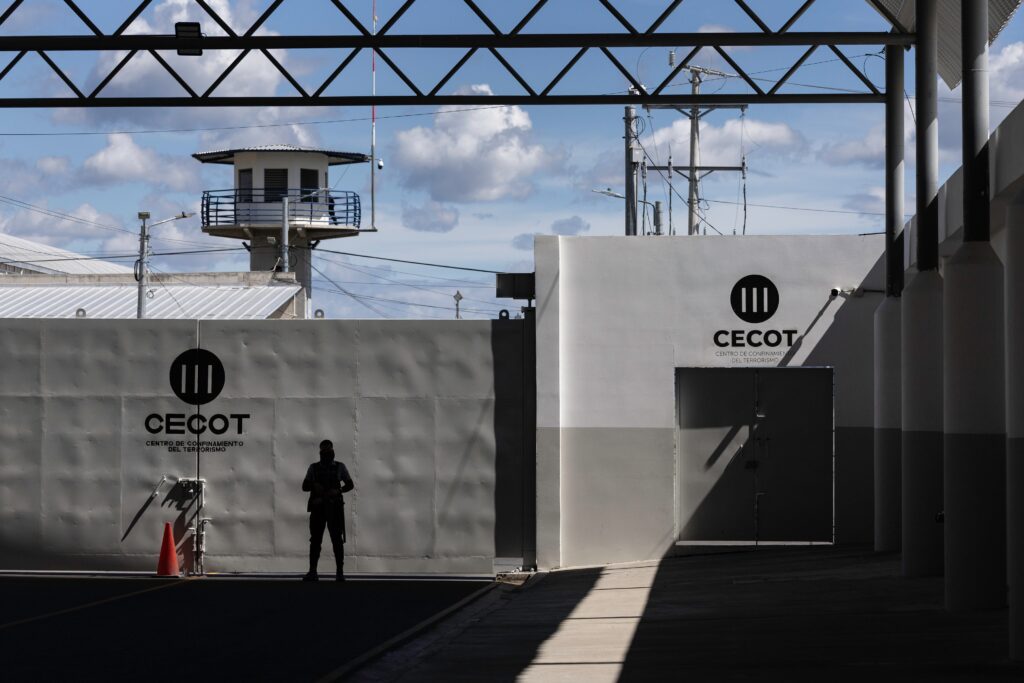
Brandon Sigaran Cruz was only 9 when his parents brought him and his brother to the United States, far away from the gangs recruiting young boys in the elementary schools of El Salvador.
The next time he set foot in his native country was more than a decade later, on March 15 of last year, when the Trump administration deported the 21-year-old alongside more than 260 migrants to El Salvador’s Terrorism Confinement Center, or CECOT, an infamous megaprison known for human rights abuses that is completely cut off from the outside world.
Sigaran has no known criminal record in El Salvador. But for an entire year, he has remained imprisoned with no access to a lawyer, no contact with his family and no prospect of a trial before a judge, according to human rights lawyer Kelvi Zambrano. He was deported under an agreement with Salvadoran President Nayib Bukele that became one of President Donald Trump’s most aggressive and attention-drawing immigration enforcement initiatives in his early months in office.
Little is known about the exact whereabouts of the deported Salvadorans who are imprisoned. Relatives and lawyers of some of the men told The Washington Post that they have had no contact with their detained loved ones and have been unable to confirm where they are being held.
The majority of the migrants sent to CECOT were Venezuelans who the Trump administration said were members of Tren de Aragua, a Venezuela-based gang — often without presenting evidence or offering a chance to contest the claim. After being held for four months, the Venezuelans were released to their home country as part of a prisoner swap.
The U.S. also deported 23 Salvadorans that same day a year ago, including Kilmar Abrego García, an undocumented immigrant living in Maryland whose removal the Trump administration admitted was a mistake because an immigration judge had barred his return to El Salvador over concerns he would be persecuted. The U.S. Supreme Court ultimately ordered the Trump administration to bring Abrego back to the U.S., where he now faces human smuggling charges. He has pleaded not guilty.
The Department of Homeland Security had classified the Salvadorans as gang members and criminals in deciding whom to put on the planes, according to a person familiar with U.S. decision-making, who spoke on the condition of anonymity to describe internal discussions. Bukele had insisted that all of those deported on March 15 be criminals. U.S. officials — who paid the Bukele government $4.76 million under the arrangement, according to a recent report from Senate Democrats — left it up to the Salvadoran government to make its own determination about its citizens, and they did not specifically ask Bukele’s authorities to detain the men in CECOT, the person said.
But Kristi L. Noem, then the homeland security secretary, toured the prison not long after the deportees arrived, using it as a backdrop to deliver on social media the administration’s message to “criminal illegal aliens.”
“If you do not leave,” her post on X read, “… you could end up in this El Salvadorian prison.”
In a response to questions from The Post, DHS said Saturday that the men deported to CECOT were “human rights abusers, gang members … or suspected terrorists.”
“They may not have criminal records in the U.S., beyond breaking our laws to enter the country illegally, but many of these illegal aliens are far from innocent,” DHS said in a statement. “If you come to our country illegally, you could end up in CECOT, GITMO, or another third country.”
Asked about Sigaran’s case, DHS said he was a “confirmed MS-13” gang member, but provided no evidence.
Aside from a misdemeanor marijuana possession case that was dropped in 2024, The Post was not able to find any other criminal cases for Sigaran in Dallas County, where he lived.
“These people have been sent to a black hole, a court system with no due process,” said Juan Pappier, a deputy director of the Americas program at Human Rights Watch.
In all, more than 9,000 Salvadorans have been deported from the U.S. since Trump took office in January 2025, according to Human Rights Watch. Pappier said only a fraction have been detained by the Salvadoran government, including some who have criminal convictions.
However, “whether they are criminals or not, their relatives deserve to know where they are,” Pappier said.
After their release from CECOT, 16 Venezuelans told The Post last summer that they were subjected to repeated beatings that left them bruised, bleeding or injured. One man said he was sexually assaulted by guards. They said prison staff restricted medical care for detainees with diabetes, high blood pressure or kidney failure.
A group of international jurists last week released a report concluding there are reasonable grounds to believe that El Salvador has committed in its prisons crimes against humanity, including arbitrary imprisonment, torture and enforced disappearances — a policy “known and promoted by the highest levels of government.”
Two communications officials for the Bukele government did not respond to a request for comment on the deported Salvadorans who remain detained, including Sigaran. On Wednesday, Bukele posted a video in which he acknowledges that prisoners have human rights, but criticizes those who “only defend the human rights of criminals.”
The plight of the Salvadoran deportees stands in contrast to the fate of the estimated 250 Venezuelan men who spent four months at CECOT before being returned to their native country in a prisoner swap in which Caracas freed 10 Americans.
A year after their initial deportation, the impact of the Trump administration’s sweeping attempt to use the Alien Enemies Act as the legal rationale for removing more than half of that group of Venezuelans continues to reverberate through the immigration system and federal courts. Trump invoked the 1798 law, which provides a president wartime authority to bar citizens of enemy countries, to target alleged members of Tren de Aragua. The administration did not provide evidence that the men were gang members, and many did not have criminal records.
Chief Judge James E. Boasberg of the U.S. District Court for the District of Columbia, who sought to block their removal, ruled in December that the government must provide the 137 Venezuelans who were deported under the Alien Enemies Act a chance to challenge their deportations, either by returning them to the U.S. or allowing them remote hearings from abroad.
Boasberg also has resumed criminal contempt proceedings against the Trump administration in that case. The courts have since blocked the administration from deporting anyone else under the Alien Enemies Act.
Despite the legal victories for the Venezuelans, however, immigration attorneys said the administration was successful in using the CECOT gambit to spread fear in immigrant communities.
“People were really shocked by this outcome: You’re not just going to be deported, but they’re going to stick you in one of the worst prisons in the world. This was something no one could have foreseen as a possibility before this administration,” said David Bier, director of immigration studies at the Cato Institute, a libertarian think tank in Washington. “It really sends the impression that there is just no limit to what they might do to you when they catch you.”
A coalition of rights organizations filed a request last summer for an emergency order from the Inter-American Commission on Human Rights, noting that at least 36 Salvadorans were “being held incommunicado” after being transferred from the U.S.
Months later, the commission granted precautionary measures ordering the Bukele government to protect three of the detainees, including Sigaran. In court filings from El Salvador, the government confirmed that some detainees were moved to a different prison in Santa Ana. But Sigaran remained at CECOT, the government said.
Sigaran was raised and graduated high school in Irving, Texas, where he loved skateboarding and painted houses with his brother to pay for classes to become a barber. He was on his way to work with his brother in early 2024 when the siblings were stopped by a police detective, according to his stepmother, Karla Sigaran.
The detective did not question the brother, who was driving, but instead asked Brandon Sigaran for his identification documents, the stepmother said.
Sigaran told the detective he had a passport from El Salvador. The detective ordered him out of the car and accused him of being a gang member, his parents said. He was sent to a detention center in Dallas and held in an immigration facility for more than a year.
A notice to appear before an immigration judge mentioned his tattoos: A bullet on his left arm, and a cross and devil’s head on his right leg.
For months, he fought in immigration court to remain in the U.S. He learned from his friends in prison that others had been deported to El Salvador and released to family members there.
Eventually, he ran out of willpower. “He told us he couldn’t take it anymore,” his stepmother said. An immigration judge issued him a final order of removal on Jan. 15, 2025, according to DHS.
On March 13 of last year, he called his parents to let them know he would be deported. His uncle in El Salvador went to the San Salvador airport to meet him. But Sigaran disappeared. His family’s questions to Salvadoran authorities went unanswered. In desperation, his stepmother said, she wrote a letter addressed to Bukele, telling the president of her son: “I’m dying inside without hearing from him.”
It wasn’t until months later, the parents said, that they learned he had been sent to CECOT.
Aaron Schaffer and Razzan Nakhlawi contributed to this report.
The post Deportees sent by Trump to Salvadoran prison are still stuck a year later appeared first on Washington Post.