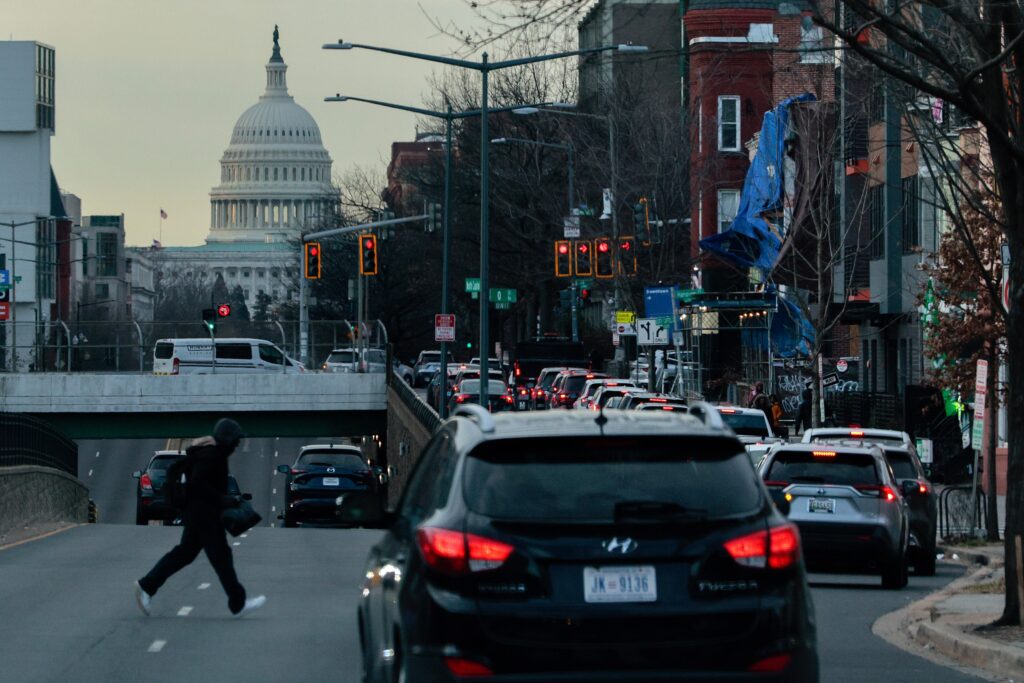
With the Democratic mayoral primary three months away, outgoing Mayor Muriel E. Bowser (D) is sounding the alarm about the harm congestion pricing would inflict on D.C. But the leading candidates to succeed her seem determined to support the tax regardless of the consequences.
As D.C. continues struggling more than most places to recover from the pandemic, with low commercial occupancy rates and scores of shuttered storefronts, erecting extra barriers to come and go would be self-destructive.
Congestion pricing is a regressive tax that disproportionately hits the poor, who lack the flexibility to work from home and often don’t live close enough to reliable public transit to count on it. Many white-collar workers would love another excuse to not come into the office. Restaurants and retailers will close without their business, inviting lawlessness and disorder.
Last week, Bowser released a study commissioned by the D.C. Council in 2019 that explored a variety of options to deter people from bringing cars into town, such as charging a $10 flat fee every weekday and $5 on weekends or 60 cents per minute for driving downtown. Consultants hired by the city estimated that D.C. could raise between $122 million to $667 million in annual revenue, depending on how extreme they decided to be.
Bowser opted not to release the study after receiving it in 2021 because it was built around flawed assumptions and relied on pre-pandemic data, but a left-wing interest group called Greater Greater Washington has been suing to force its release. She relented before a looming court hearing.
That same group endorsed the socialist council member Janeese Lewis George for mayor last month after she pledged to “champion” congestion pricing. Lewis George unrealistically expects people to bike, walk, and ride the Metro instead. “If it’s faster, easier, and cheaper for people to get downtown by car—we are doing something wrong,” she wrote in response to a candidate questionnaire.
Her main opponent, former council member Kenyan McDuffie, has also expressed support for this bad idea, albeit with less enthusiasm.
Advocates point to congestion pricing in Manhattan, which has reduced the number of cars on the roads, but D.C. is not an island. “Our Downtown’s economic model, foot traffic patterns, building height limits, and sheer density are exponentially lower,” said Bowser.
It’s also easier here for many companies to relocate their offices right across the Potomac River into Northern Virginia, where taxes are already lower. “Adding yet another charge to the cost of doing business in the city won’t make the District any more business-friendly,” Bowser added.
Depending on how it’s designed, some D.C. residents could wind up being forced to pay $10 multiple times a day as they transit through the city. Delivery services and ride-share drivers would get hammered, and they’d pass along higher costs to their customers. Bowser said the old study assumes that “retail businesses have such a surplus of consumers demanding to come and shop downtown that they can be taxed for the privilege of it.”
Many on the left see capitalism as so resilient that they can keep saddling people and businesses with additional taxes and fees while remaining oblivious to the consequences, but the economy is more fragile than they realize.
The post Congestion pricing would cripple downtown D.C. appeared first on Washington Post.