For anyone who regularly travels by rail between New York and New Jersey, few words instill a greater sense of dread than “Portal Bridge opening.”
The 116-year-old swing bridge, which hovers over the Hackensack River and has a tendency to get stuck when it opens, has become synonymous with scrambled travel plans and Pennsylvania Station pandemonium. The bridge periodically opens for passing maritime traffic — and then often gets stuck, requiring work crews to slam the bridge back into place with sledgehammers. Until they do, no trains can move along the two-track mainline connecting Newark to New York City: the busiest passenger rail route in the Western Hemisphere.
Soon this will all be water under the troubled bridge.
On Sunday, the Portal Bridge’s replacement, the towering Portal North Bridge, officially begins carrying passenger trains. The bridge’s debut is the culmination of decades of planning, over $2 billion in funding and nearly four years of construction, including a recent spell that disrupted commutes for a month while the new bridge was connected to the existing tracks of the Northeast Corridor.
“This is a miracle,” said David Alff, a University at Buffalo professor and the author of “The Northeast Corridor,” a 2024 book about the history of the line. “It’s a monument, a commitment to public works and a testament to good planning and to everyone who keeps the corridor running.”
That’s a herculean task on a rail line whose century-old infrastructure habitually shows its age, hamstringing travel for hundreds of thousands of daily riders. Days before the new bridge entered service, overhead wire issues on the old bridge torpedoed the Friday morning commute.
“Looking at the tracks is like reading the rings of an oak tree,” Professor Alff said. “In some cases with this line, we’re living with design decisions that date from Andrew Jackson’s presidency.”
Even as NJ Transit and Amtrak introduce new, faster trains, speed and reliability are limited by the tracks below or the wires above. Amtrak’s gleaming new Acela trains, which can travel up to 160 miles per hour, still have to crawl through certain sections of the Northeast Corridor at school-zone speeds.
Choreographing the Cutover
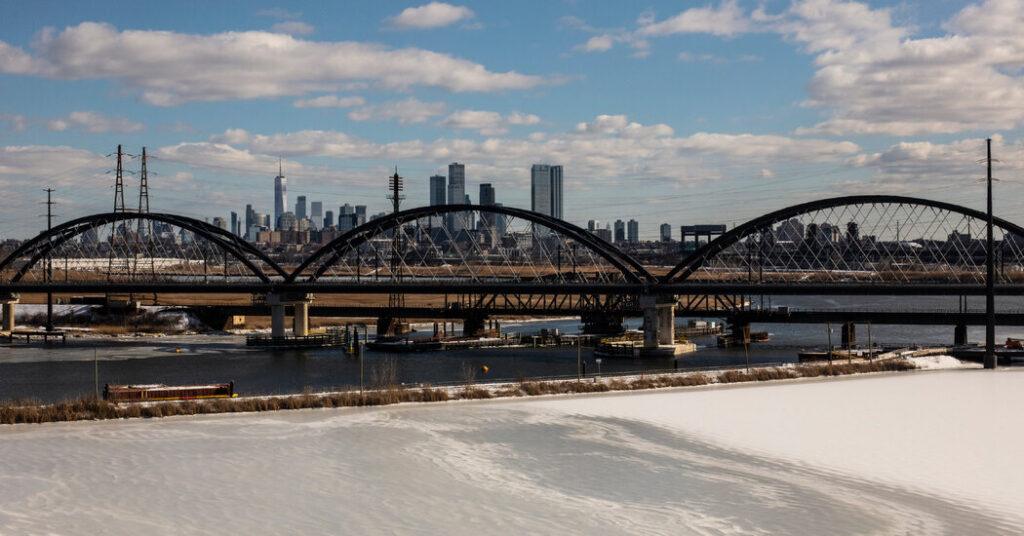
Unlike previous infrastructure patch-up jobs along this part of the corridor, the new bridge is just that: new. Its fixed, three-arch span soars 50 feet above the Hackensack, high enough that river traffic below can pass through unimpeded, eliminating the need for the movable parts that have made the old bridge such a liability.
And in an era when American infrastructure projects invariably run decades late and billions of dollars over budget, the Portal North project stayed on schedule and on budget.
“It was a very choreographed process,” said Chrissa Roessner, the active chief of construction and project management for NJ Transit, the prime sponsor of the project.
The bridge’s three arches were built upstate at the Port of Coeymans, near Albany, then floated down the Hudson River and up the Hackensack to the job site. The arches crossed under and through 18 different bridges, including, poetically, the original Portal Bridge.
“We actually had to time the arch passing through the Portal with the tides because of overhead wires and the draft of the river,” said Tim Snow, senior resident engineer for the bridge project at AECOM, a construction management firm.
Once the bridge was in position, the cutover could begin. Amtrak took the lead on the complex work required to transition one of the Northeast Corridor’s two tracks from the old bridge alignment to the new 2.5-mile segment of track that traverses the new bridge.
To pull it off, NJ Transit, which operates most of the line’s trains, and Amtrak, which owns the tracks and associated infrastructure, coordinated a plan to complete the work without entirely suspending rail service. The agencies gave themselves a four-week window to finish the job.
For commuters, this meant a month of service reductions and reroutings. During the cutover, Amtrak curtailed its Acela and Northeast Regional schedules and reduced the number of weekday Keystone trains, which run between New York and Philadelphia, from 24 to 10. NJ Transit cut its weekday service over the bridge almost in half, from 332 daily trains to 178, and redirected all its Midtown Direct trains to Hoboken Terminal.
It was a short-term sacrifice designed to pay long-term dividends.
Over the past four weeks, Amtrak built two new signal-controlled crossing points, or “interlockings,” laid 4,500 linear feet of new track (modifying or demolishing 6,000 feet of existing track), unloaded 1,600 tons of new ballast and installed 4,500 linear feet of new overhead wire, the company said.
Amtrak then began the comprehensive testing of features, including signaling and communications systems, using test trains and over 1,000 simulations.
The monthlong effort required approximately 40,000 crew hours, with an average of 80 employees per shift working two shifts per day, seven days a week.
“This despite a massive snowstorm, extreme cold weather and technical challenges inherent to the nature of this work,” said Laura Mason, Amtrak’s executive vice president of capital delivery. “To say we’re proud of this project is an extreme understatement.”
A ‘Smooth Ride’
A second cutover, and accompanying service reduction, is slated for the fall, when the remaining original track will be shifted over to the new bridge, clearing the way for the old bridge to be decommissioned and ultimately demolished.
For now, eastbound trains will continue to cross the old bridge, while westbound trains will use the northern track of the new bridge. If all goes according to plan, Monday’s Jersey-bound commuters will be the first weekday riders to cross this part of the Hackensack River without the threat of the tracks swinging open 90 degrees to let a boat pass through.
On Thursday, Gov. Mikie Sherrill of New Jersey and several government and transit officials got a preview of this new Northeast Corridor reality, riding the ceremonial first train over the Portal North Bridge.
A specially painted red, white and blue dual-mode locomotive led the train, operating under diesel power to prevent any potential overhead wire issues from threatening the proceedings. The train slinked out of Newark’s Pennsylvania Station and cruised toward the new bridge, ascending its freshly laid, gently inclined tracks.
To the south, Amtrak and NJ Transit trains clattered over the old Portal Bridge, which is limited to a maximum speed of 60 m.p.h. Portal North can handle a top speed of 90, though the inaugural train glided onto the new bridge at a more genteel 15 m.p.h.
“Fantastic,” Ms. Sherrill said as she walked through the double-decker train. “Smooth ride.”
As the train reversed for the short trip back to Newark, snow began to fall, almost obscuring an optimistic feature of the new bridge: a concrete structure called a duck-under. It was built to accommodate the tracks of a second, and still theoretical, fixed-span bridge.
That bridge, Portal South, would transform this congested two-track stretch of the Northeast Corridor into a four-track mainline. Its construction, however, is a moot point until the creation of a new Hudson River tunnel, a project mired in multibillion-dollar funding fights and years away from completion.
Still, the opening of just one new Portal Bridge represents more than improved rail service between New York and Newark.
“I think to commit to building public transit infrastructure is to decide to keep being a society,” said Professor Alff. “It’s the one place where the rubber of our ambitions for the future meets the road of practical work. And it’s going to outlive and outlast all of us.”
The post Commuters, Rejoice! The New Portal Bridge Is Ready for Riders. appeared first on New York Times.