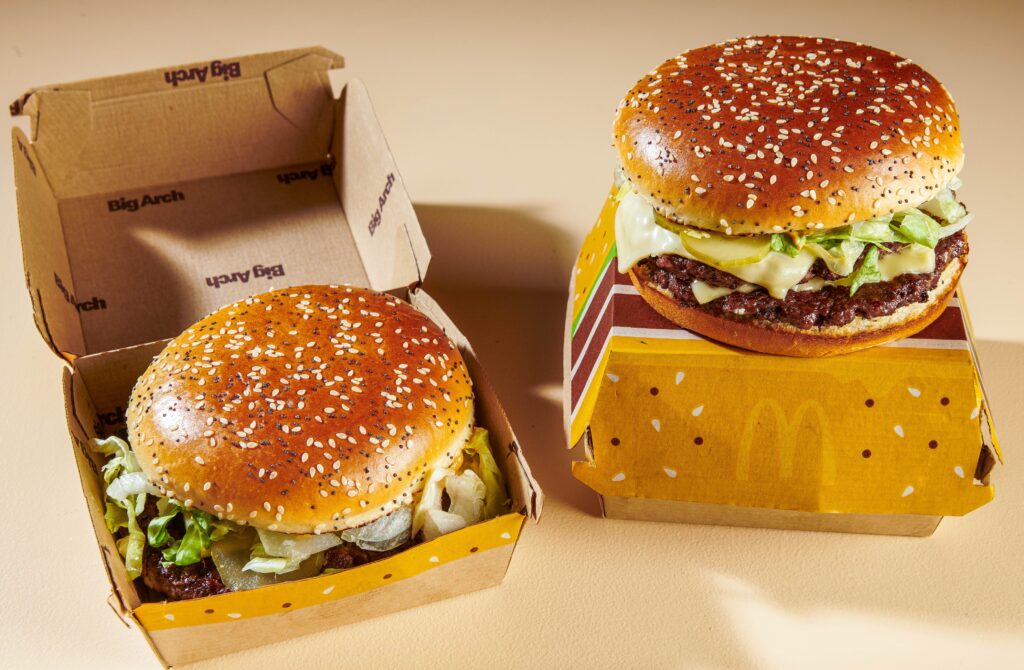
In a video, Chris Kempczinski sits in what appears to be a workplace break room — faux marble table, nondescript blond-wood cabinets, acoustic tiles on the ceiling. In front of him is that staple of break room lunches: the McDonald’s burger and fries. Like the room, Kempczinski is tidy and ordinary-looking in a V-neck sweater and collared shirt.
“I love this product,” he says, tapping the box. His voice holds all the enthusiasm of a mid-level finance executive describing a new expense reporting system. “It is so good.”
After some preliminary description of his lunch, he proclaims “the moment of truth” and takes a single, dainty bite.
Actually, Kempczinski is the chief executive of McDonald’s, and the video, posted on his LinkedIn account last month, announced the introduction of the Big Arch to America. After test runs in Europe, the Big Arch was ready for the Big Show.
So, apparently, was Kempczinski, who went viral for his half-hearted taste of the burger. Reviews of his performance were, we might say, somewhat mixed.
Many were downright savage. A pithy summation of the reaction, from the comments to the original post: “Yo that wasn’t even a bite.” Or, as another commenter put it, “cringe.” There were reaction videos, spoofs and AI-generated “outtakes” — followed by reviews of the burger and think pieces on the aesthetics of food influencing. Wendy’s and Burger King got into the act, posting videos where executives tucked into their own products with somewhat more noticeable enthusiasm.
Epic fail, one might think. But in the new attention economy, it counts as a rousing success.
In my now-distant youth, product launches like this followed a pattern. First, chains would develop a product, test it in certain areas, and then, if successful, there would be a nationwide ad blitz. It wouldn’t take long until practically everyone in the country was aware that McDonald’s had a new menu item, and out of curiosity or enthusiasm, a large percentage of them would try it at least once.
Those days are long gone. America once had three major burger chains, three major television networks and a mass culture where those things formed a common currency. To a first approximation, everyone ate at McDonald’s at least occasionally — and everyone was familiar with dozens of ad campaigns, often for products they didn’t buy. Even middle-schoolers and Mormons could identify Joe Camel and make “great taste, less filling” jokes. Possibly the most famous Budweiser ad of all — a tribute to 9/11 — only ran once.
Pop quiz: What’s the last ad you remember? Odds are it ran during the Super Bowl, and there’s a good chance that was the first and last time you saw it. But even Super Bowl ads are a diminished cultural and commercial force.
Twentieth century advertising wielded tremendous cultural influence, so much so that a cottage industry of paranoid thrillers and panicky nonfiction arose on the premise that advertising was a kind of mind control. This was nonsense, of course — mostly. Ads introduced us to new products or features and perhaps influenced which brands we bought. But those authors could be forgiven for thinking it was much more than that, given the amount of money spent on ads and the way advertising permeated not just our television shows but the rest of our daily lives.
That influence was achieved via ceaseless repetition. The ads would air during multiple commercial breaks, night after night, and if successful, spawn late-night jokes, movie moments and parodies. Even when the television was off, people hummed jingles, cracked jokes and turned lines from commercials into catchphrases.
Now late-night shows are on life support, and the rest of television has split into millions of individualized streams. You can’t joke about an ad you’ve seen because what’s the chance your audience saw it, too? Americans increasingly lack a common frame of reference.
How, then, do you get a new product noticed? You can pay influencers or podcasters to tout it. Or you can become an influencer yourself, as Kempczinski did, against all odds.
Sure, we were laughing at him. But every reaction video or parody drove home the message that McDonald’s has a big new burger on the market, a message I’d never have heard if I hadn’t seen so many people making fun of the CEO. I would have eaten a Big Arch for dinner tonight — for research purposes, of course — if my column-writing duties hadn’t chained me to my desk.
Such viral moments are marketing gold and at a bargain price — however much McDonald’s spent making that video, it probably only amounted to a fraction of the cost of producing a traditional ad, much less of blasting it into our consciousness in a prime time loop. Corporate America’s problem is that such moments are wildly unpredictable. If you want brand awareness on the cheap, you are dependent on the kindness (or more likely, unkindness) of strangers.
The problem for the rest of us, meanwhile, is the void where our common culture used to be. Sure, it was sad and crass that so much of common culture rested on people trying to sell us things. Undoubtedly, it would have been much better if we’d all been humming Beethoven’s Fifth instead of “I’d like to buy the world a Coke.” But at least we were all making music together.
The post An ‘epic fail’ by McDonald’s turned into a marketing win appeared first on Washington Post.