President Donald Trump on Friday night announced that the United States had bombed Kharg Island, targeting Iran’s most critical oil terminal in an attack that Tehran has warned would escalate the conflict.
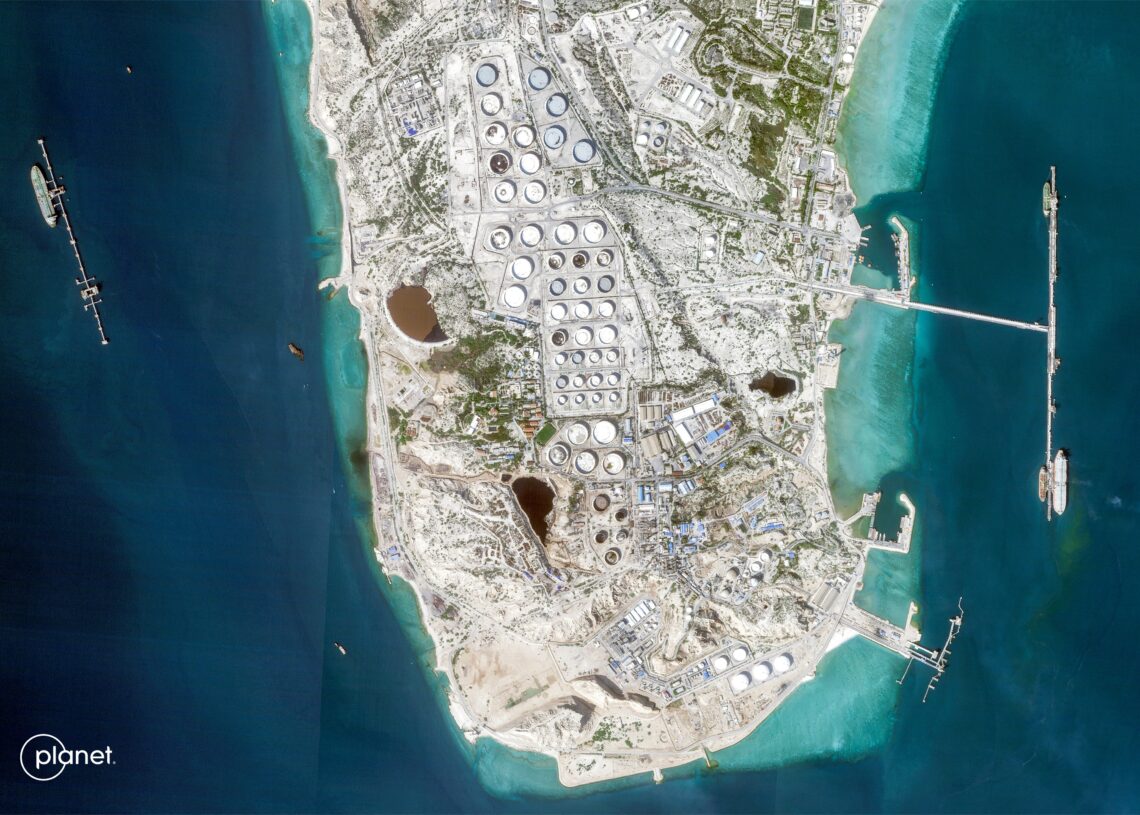
Located about 15 miles from the Iranian mainland in the Persian Gulf, Kharg Island is the centerpiece of Iran’s oil-based economy. About 90 percent of the country’s oil exports move through facilities there, and an attack could strangle what remains of Tehran’s economy — including the government’s limited ability to pay its military.
Trump said in a post on Truth Social that the U.S. had “totally obliterated every MILITARY target in Iran’s crown jewel.”
“Last night, U.S. forces executed a large-scale precision strike on Kharg Island, Iran,” read a statement posted early Saturday to X by U.S. Central Command. “The strike destroyed naval mine storage facilities, missile storage bunkers, and multiple other military sites. U.S. forces successfully struck more than 90 Iranian military targets on Kharg Island, while preserving the oil infrastructure.”
A U.S. official, speaking on the condition of anonymity because of the sensitivity of the issue, said that U.S. forces struck after seeing indications that Iran might soon reinforce the island with renewed defenses. The strikes, the official said, were designed to eliminate that possibility.
A video posted by Central Command to X on Saturday, verified by The Washington Post, shows the strikes on Kharg Island, on apparent military sites and the airport but not oil facilities. An independent damage assessment was not possible immediately.
The president threatened to reverse his decision to leave oil-related targets intact if Iran continues to interfere with the passage of ships through the Strait of Hormuz, the world’s most vital oil transit choke point. Shipping traffic through the strait has been effectively halted since the start of the conflict, rocking global energy markets.
“Iran’s Military, and all others involved with this Terrorist Regime, would be wise to lay down their arms, and save what’s left of their country, which isn’t much!” Trump posted while flying from Washington to Palm Beach, Florida, where he is expected to spend the weekend at his Mar-a-Lago estate.
Iranian authorities told semiofficial Iranian news agency Tasnim that the strike had damaged military sites and the island’s airport without causing casualties and that the oil industry there remained in operation.
The Pentagon referred queries on the Kharg strikes to Central Command, which did not respond immediately to requests for additional information.
For the U.S., decimating Kharg has significant strategic advantages, and The Post previously reported on the potential for a ground invasion of the island.
The island has an airstrip on its northeastern corner and numerous jetties for ship loading, according to a review of satellite imagery.
It is also protected by a network of military infrastructure on other nearby islands and mainland Iran, said Michael Rubin, a senior fellow at the American Enterprise Institute who has advocated for the Trump administration to seize Kharg. Rubin said the bombing is “setting the stage to take the island,” should Trump give the order.
To prepare, Rubin said, Trump could approve strikes on what Iran calls its “invisible jetties,” or low-profile launch points across a number of islands from which the Iranian navy could launch speedboats to harass or endanger vessels in the Persian Gulf.
In a news briefing earlier in the day on Friday, Pentagon officials promised to combat Iran’s efforts to limit transit through the Strait of Hormuz, following criticism that the administration had failed to anticipate the war’s impact on the channel and the resulting economic effects.
Gen. Dan Caine, chairman of the Joint Chiefs of Staff, forecast that Friday would be “our heaviest day of kinetic fires” across the region, with U.S. forces continuing to target Iranian ballistic missiles and drone-launching points. He also said the U.S. military would go after Iran’s mine-laying capability and destroy its ability to attack commercial vessels.
“As the world is seeing, they are exercising sheer desperation in the Straits of Hormuz,” Defense Secretary Pete Hegseth said during the briefing. “It’s something we’re dealing with, we have been dealing with it. Don’t need to worry about it.”
Hegseth added that U.S. officials have heard discussion about Iran recently placing new mines in the strait, but said “we have no clear evidence” of its military doing so.
Caine acknowledged during the briefing that “Iran still has the capability to harm friendly forces and commercial shipping.”
“They are the belligerents here holding the straits closed, although there is some traffic moving through there,” Caine said. “We’ve made it a priority to target Iran’s mine-laying enterprise.”
U.S. officials have declined to discuss whether they are preparing for a ground operation on Kharg Island.
Such a mission would make U.S. troops vulnerable to attacks by Iranian drones and other missiles, and potentially improvised explosives or other defenses hidden on the island.
On Friday, U.S. officials said that a Marine Corps air-ground task force will deploy on Navy vessels from Okinawa, Japan, to the Middle East — bringing with it amphibious landing craft, helicopters, F-35 fighter jets and an infantry battalion of about 800 Marines.
The task force, known as a Marine expeditionary unit, includes more than 2,200 Marines and is complemented by more than 2,000 additional Navy personnel spread across the USS Tripoli and two other warships.
It was not clear whether the deployment, first reported by the Wall Street Journal, has any connection to Kharg. The Marines are trained in amphibious landings, seizing islands and launching rocket artillery at adversaries in a maritime environment.
The bombing of Kharg could already have an effect on global oil prices, which have soared since the Trump administration launched Operation Epic Fury last month. The administration has temporarily lifted sanctions on Russian oil shipments and taken other measures to stabilize the market, but prices continue to climb at gas pumps and jet fuel prices continue to rise.
Before boarding Air Force One on Friday, Trump claimed that gas prices would decrease when the conflict ends, but declined to say how long he expected the war to last.
“Well, I think your gas prices, as soon as that’s over, are going to come tumbling down along with everything else,” Trump said. “I think it’s going to be, you’re going to see a very big decrease in the price of gasoline, gas, anything having to do with energy, as soon as this has ended.”
Evan Hill contributed to this report.
The post Trump says U.S. struck Kharg Island, core of Iran’s oil economy appeared first on Washington Post.