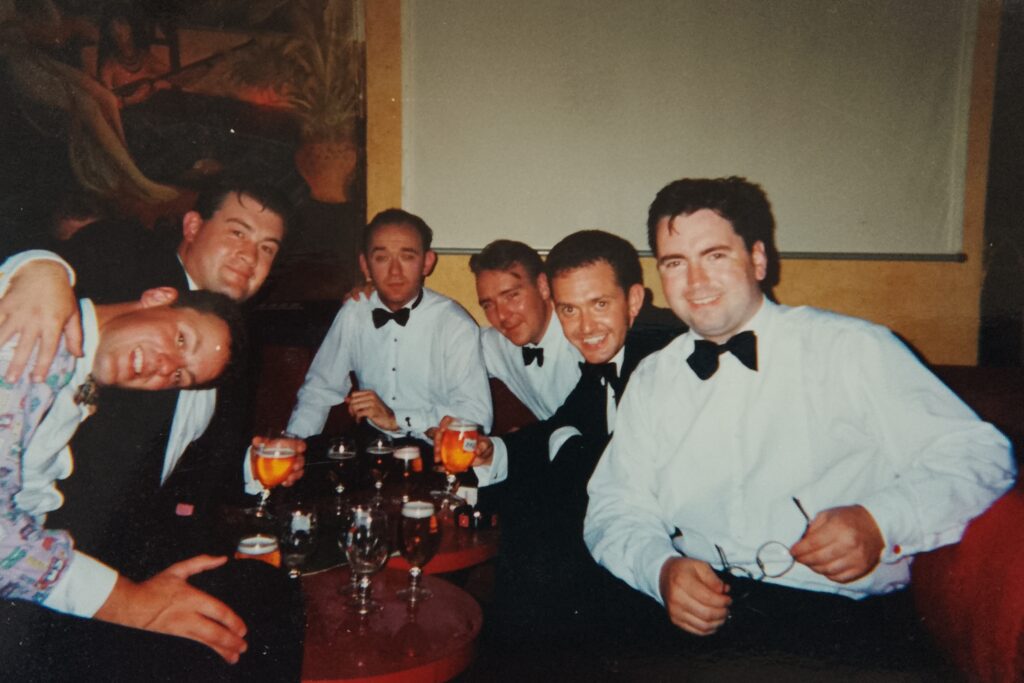
It began, as so many ideas do, over drinks. Lots of them.
The year was 1994, and a handful of Irish lads were gathered at a hotel in Northern Ireland to celebrate Colin Cather’s pending nuptials. They ate. They drank. They hugged. The “I love you, man’s” flowed as freely as the Guinness.
The following morning at breakfast, rumply and nursing killer headaches, they rehashed the previous evening’s shenanigans.
Cather, then 26, looked around the room. These were his best mates. Before long, almost all would have families. He wished aloud that they could get together in person more often, but with newfound adult responsibilities, it seemed impossible.
“Can we have a fake bachelor party every year?” joked Chris Patterson, then 25.
The men laughed. But the more they discussed it, the more sense it made. Why not make a concentrated effort to see each other every year? Someone suggested using the alphabet as a framing device. They could wind their way through the world letter by letter, choosing cities in alphabetical order — Aberdeen. Brighton. Caen. Düsseldorf. Eastbourne — all the way to Z (or “Zed,” in U.K. parlance.)
It would be like “Same Time, Next Year,” but without the cheating.
Patterson returned to London, where he was working as a consultant, and designed custom letterhead inspired by London’s A-to-Z map guide. Not everyone had email, so he sent invitations the old-fashioned way. A year later, on June 10, 1995, six of the men — five of whom had met in the British army, three of whom had known each other since grade school — gathered for the inaugural A to Z Club in Aberdeen, Scotland, launching a 30-year tradition that has taken them through the entire alphabet.
“A to Z has been most of our adult lives,” said Graham Dunlop, 54, a civil servant in Belfast. “It lasts through all the changes. It’s a constant you have outside partner and family.”
On that long-ago night, the men drafted bylaws on a menu, which they signed in ink. Weekends would last from Friday to Sunday (Monday in recent years), with a fancy dinner held on Saturdays, black tie mandatory. Membership would be closed to outsiders, and they would rotate chairmanship. They would find a neutral place to meet, accessible for everyone’s budget. To that end, they would all share hotel rooms (and, after they were invented, Airbnbs).
Patterson framed the menu and hung it on his wall, where it remains today.
“If you put it on paper, you wouldn’t think we’d get along,” said Brian McKenna, 57, a government worker in Northern Ireland. “We’re not all terribly like-minded individuals. But we have enough mutual knowledge, experience, understanding and sense of worth with each other that it works.”
Consistency is key
Throughout the years, the format has remained remarkably unchanged. The men typically do one touristy thing in each location: The Alhambra in Granada, Spain. A Yankees game in New York. A visit to the World War I battlefront in Ypres, Belgium. The rest of the weekend, they roam from cafe to pub to cocktail lounge, letting whimsy be their guide.
“It’s accidental tourism,” said Patterson, who is now 55, retired and living in Manhattan. “We’re not there to do the sites. We just start wandering. You stumble upon things.” Like the private party they crashed at a castle in Jerez, Spain, an endeavor made possible by their tuxedos.
But it hasn’t all been smooth. Covid ruined a few years, and the group has also skipped some years due to extenuating circumstances — like in 2016, when one member was deployed to South Korea.
Financial constraints have sometimes forced domestic U.K. destinations instead of exotic European locales — Brighton, Falmouth, and a small Irish village, Virginia, that proved less than thrilling.
The year they went to Warsaw, McKenna had an aortic dissection and was unable to join. Mike Murdoch, 57, a career infantry officer, was sick with meningitis and didn’t make Madrid.
“Meningitis is much less fun than Madrid, I’m told,” he said wryly.
As is normal with old friends, the relationships have gone through phases. Cather, 57, remembers reaching the midpoint of the alphabet and questioning the whole enterprise. He’d left Northern Ireland and built a new life in Oxford, England, with his wife and kids, played in a band, and made new friends. He was busy with his marketing career; the A to Z weekends began to feel like a time capsule he wasn’t sure he wanted to reopen.
“I said to my wife, ‘I don’t know if this is something I want to keep doing, because it’s all a bit wayward,’” he recalled. “‘I love all the guys dearly. But are we just reminiscing and harking back?’ I’m not a harking-back kind of guy.”
The next time they got together, in New York, something strange happened. The vibe felt … different. They weren’t just bantering and “slagging each other off” — that’s Irish slang for teasing — they were actually talking in ways men typically aren’t encouraged to do. Whereas earlier vulnerability had been a liability, now the men opened up about strained marriages, career hurdles, parenting challenges, mental health concerns, empty nests and ailing parents. The bravado had dissipated.
“There were some one-on-one conversations,” Cather said. “It was more authentic — dare I say emotional. There might have been tears. We broke out of the time capsule we were trying to maintain around us.
“You don’t get to make new old friends,” he continued. “It matters to have background and connective tissue and longevity. But it also matters to have today’s stories, not just old ones.”
Patterson has watched the transformation with awe. “Years ago, you wouldn’t want to reveal anything because everyone was looking for an opportunity to bust a chop,” he said. “Now, if someone mentions something — ‘this is happening with work,’ or ‘I’m having a hard time with this’ — we’ll all be pretty empathic, and that will draw out more people.”
There is still relentless teasing, but the abuse coexists with deep affection. “Used to be, a chink in the armor was a target,” Patterson said. “You were trying not to let out any embarrassing things. Now it’s an opening to have a conversation.”
What comes after Zed?
The A to Z Club has become somewhat legendary, at least in certain circles. People have asked to join; an acquaintance even offered to fund an entire trip for everyone just to participate. The group politely refused, honoring the original Aberdeen Agreement.
Four of the six men live within half an hour’s drive of one another in the Belfast area. They see each other maybe five times a year between trips, individually or in small groups. And Patterson flies over from New York on occasion. But it’s the annual gathering that matters most.
“It’s like a really intoxicating drug that you only get a hit of once a year,” said Neil Hughes, 56, a management consultant in Holywood, outside Belfast (“Home to Rory McIlroy, the golfer,” he noted proudly). “That’s very addictive. The relationships are really precious to me.”
In September, 30 years after they began, the men completed a full rotation around the alphabet, landing at an Airbnb in Zaragoza, in northeastern Spain. They stumbled upon a Star Wars festival and sang Irish songs in local bars until 2 in the morning. The weekend was a perfect bookend to that 1994 night: The A to Z Club began with Cather’s bachelor party. It was ending with his divorce.
By the end of the weekend, they had to wrestle with an existential question: Now that they reached the end of the line, what next?
They debated reversing the concept, choosing cities by their final letter or selecting places they’d missed. They considered opening it up to countries. Patterson suggested organizing the weekends around drinks or foods. Ultimately, they decided to go back to the beginning of the alphabet, with the unspoken understanding that they probably wouldn’t all make it to Z a second time. The real draw, after all, isn’t the destinations; it’s one another.
“I don’t think I have enough time to have friends as old as them,” Cather said. “Even if we met someone new today, do you really have 45 years left? The realization of that makes it all the more valuable.”
Cather considers the group his innermost circle. “I think of friendship a bit like a dartboard,” he said. “You’ve got the bull’s eye, the friends that are nearest and dearest. That is very small. Outside the five guys in A to Zed, there are probably only a few people in it. A to Zed is my bull’s eye.”
The A to Z itinerary
Over nearly three decades, the six members of the A to Z club have met once a year, choosing their destinations in alphabetical order. Some cities were obvious. Others required creativity, compromise, or a willingness to go somewhere they might have never found otherwise.
A — Aberdeen, Scotland. B — Brighton, England. C — Caen, France. D — Düsseldorf, Germany. E — Eastbourne, England. F — Falmouth, England. G — Granada, Spain. H — Hamburg, Germany. I — Inistioge, Ireland. J — Jerez, Spain. K — Kraków, Poland. L — Lille, France. M — Madrid, Spain (missed by a member with a serious illness). N — New York City, USA. O — Oxford, England. P — Portmarnock, Ireland. Q — Quimper, France. R — Rome, Italy. S — Stockholm, Sweden. T — Toledo, Spain. U — Utrecht, Netherlands. V — Virginia, Ireland. W — Warsaw, Poland (missed by a member after a major health crisis). X — Xàbia, Spain. Y — Ypres, Belgium. Z — Zaragoza, Spain.
The post The ultimate boys trip offers a lesson in male friendship appeared first on Washington Post.