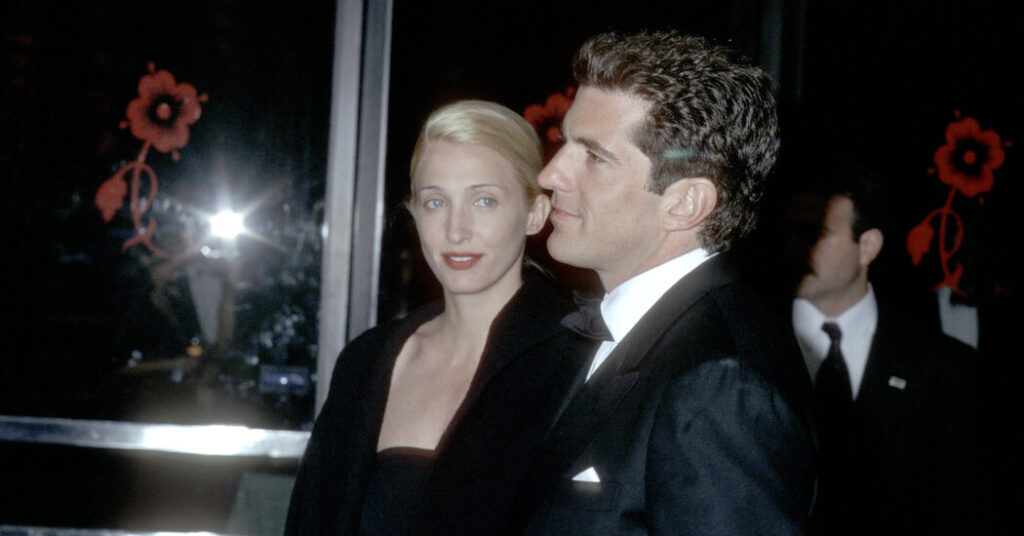
Once, in the mid-1990s, John F. Kennedy Jr. called me. He had a great voice, with a seductive thread of mischief running through it. Even on the phone, I could feel the magnetism of the reigning dreamboat.
He wanted to do a Q&A with me for his new magazine, George, which blended politics with pop culture.
“After all,” he said, “you’re the godmother of this form of journalism.”
I really wanted to meet J.F.K. Jr. But I write better than I talk, and I told him I was afraid that I’d be hopelessly inarticulate.
“That’s what editors are for!” he said puckishly, adding, “You’re the only person who has turned me down for this — except the pope.”
I was skeptical about George. Politics and entertainment were merging, and I was worried that the balance would tilt toward the superficial. George was a fanzine for “the giant puppet show” of politics, as J.F.K. Jr. called it — a strange blend of Vanity Fair and C-SPAN. Was it too frivolous, with a glossy debut cover of Cindy Crawford cosplaying George Washington? Was it weird to have a cover with Drew Barrymore vamping as Marilyn Monroe, the paramour of J.F.K. Jr.’s father and uncle?
J.F.K. Jr. was the nation’s magic child: little John-John saluting his father’s casket in a gesture that broke the nation’s heart, now all grown up. He had become a stylish, adventurous man surfing New York City on bikes and Rollerblades, searching for his purpose in life.
Miraculously, despite all his travails, he was a caring soul who tried to make people feel special. I thought he should use that magic for more than persuading Salma Hayek to pose with an elephant. He was considering a bid for New York governor when he died.
His grandfather Joseph Kennedy turned the family into a powerhouse with a clever formula: alchemize great hair, great teeth and upper-crust glamour, epitomized by Jacqueline Bouvier, into real power.
The cool aesthetics were a means to an end, an ensorcelling engine that put you in a position to change the world.
The Camelot myth has tattered, particularly with the rise of Robert F. Kennedy Jr. as a destructive, unhealthy force in Trump world.
But it has been revived by Jack Schlossberg’s run in New York’s posh 12th Congressional District and Ryan Murphy’s “Love Story” on FX, tracing the romance, wedding and stunningly sad death of J.F.K. Jr. and Carolyn Bessette. The pair went from an unlimited horizon to a “false horizon,” when pilots get dangerously disoriented. All that promise literally vanished into thin air.
Even the creators of “Love Story” are surprised that it’s become a viral phenomenon.
A lot of parasocial young people on Instagram and TikTok are gobsmacked with the fractured fairy tale about a cigarette-smoking Cinderella, a Calvin Klein shop girl who made it to the lawn at Hyannis Port.
A legion of new acolytes is emulating Bessette’s chic ’90s minimalism, neutral palette and quiet luxury, while men in Gotham are comically imitating John’s carefree style, biking in suit and backpack, with a Kangol hat or a backward baseball cap.
Gen Z viewers are click-happy for an era without cellphones or social media, where people met in person and cultivated mystery and didn’t doomscroll all day long.
Women, increasingly dejected by unsatisfying online interactions with men, were verklempt about the episode depicting John sending flowers to Carolyn’s office every day until she agreed to go out with him; they can’t get over the way that John, played by the hunky, if not savvy enough, Paul Anthony Kelly, gazes adoringly at Carolyn, played by the lovely, if not lusty enough, Sarah Pidgeon. They want to take cues from Carolyn’s “Rules”-like way of staying elusive.
There are tons of videos online of besotted young women flipping their long hair around, wearing Selima Optique shades, carrying Prada and Hermès bags, and posing in crisp white shirts, white Petit Bateau tees and black turtlenecks, vintage Levi’s 517s, slip dresses, midi skirts and boots. C.O. Bigelow, the renowned apothecary in Greenwich Village, has been besieged by women hunting for Carolyn’s signature wide tortoise headband.
Panna II Garden, the East Village Indian restaurant where John and Carolyn had their first date, has long lines out the door.
There have been howls about “Love Story” playing fast and loose with characterizations of real people, but that has long been an unholy hallmark of Hollywood.
Schlossberg told me he was worried that the show would be “salacious” and misleading about his uncle in pursuit of ratings and money. But, as their spat turned out, Schlossberg and Murphy are adversaries who are actually helping each other.
Daryl Hannah, the actress who dated J.F.K. Jr. before Carolyn, with a bit of overlap, wrote a trenchant guest essay in Times Opinion, claiming that the show turns her into a cocaine-snorting “obstacle” to the love story, a narrative device that is not “remotely accurate.” She said she’s never done cocaine.
Nina Jacobson, a “Love Story” producer, admitted, “Given how much we’re rooting for John and Carolyn, Daryl Hannah occupies a space where she’s an adversary to what you want narratively in the story.” The producers did not consult with Hannah or the Kennedys. Connor Hines, the showrunner, told Variety that “it allows you to be a lot more objective.” Besides, he added inanely and selfishly, “it’s an incredibly large family as well. So if you were to talk about consulting them, where would you even begin?”
In a superficial era rife with subjective truths, multitudes latching onto the show for style and dating tips isn’t surprising. Celebrating a show larded with falsehoods for the sake of entertainment and profit? That’s the defining factor of social media, the internet and the Trump presidency.
“Love Story” fans have flipped Joe Kennedy’s formula: The aesthetic is now the end goal.
The Times is committed to publishing a diversity of letters to the editor. We’d like to hear what you think about this or any of our articles. Here are some tips. And here’s our email: [email protected].
Follow the New York Times Opinion section on Facebook, Instagram, TikTok, Bluesky, WhatsApp and Threads.
The post The Lost Horizon of John and Carolyn appeared first on New York Times.